
Who Is Wu Zhu Yu Tang Suitable For? Composition, Effects, and Contraindications

Many people hear about the classic formula “Wu Zhu Yu Tang” when experiencing headaches, nausea, retching, or cold hands and feet. In traditional Chinese medicine, it is not regarded as a general antiemetic but is applied based on differentiating cold, heat, deficiency, and excess. This article will explore traditional understandings of Wu Zhu Yu Tang, covering its composition, therapeutic direction, possible suitable presentations, unsuitable situations, and differences from formulas such as Zuo Jin Wan, helping readers build a clearer framework for assessment.
Traditional Understanding of Wu Zhu Yu Tang
In Chinese medicine theory, Wu Zhu Yu Tang is generally classified as a formula that warms the middle, tonifies deficiency, and directs rebellious qi downward to stop vomiting. It mainly targets states of “liver-stomach deficiency cold with upward counterflow of cold turbidity,” rather than all types of vomiting or headache.
Traditionally, when yang qi is insufficient and cold lodges inside, especially when the liver channel and stomach are affected by cold, turbid yin tends to rise and counterflow upward, producing relatively specific manifestations. In such cases, using Wu Zhu Yu Tang to warm the interior, disperse cold, and descend rebellious qi may help address these issues.
Therefore, it is not a general analgesic or antiemetic; one must first determine whether a cold tendency exists before use.
Composition of Wu Zhu Yu Tang
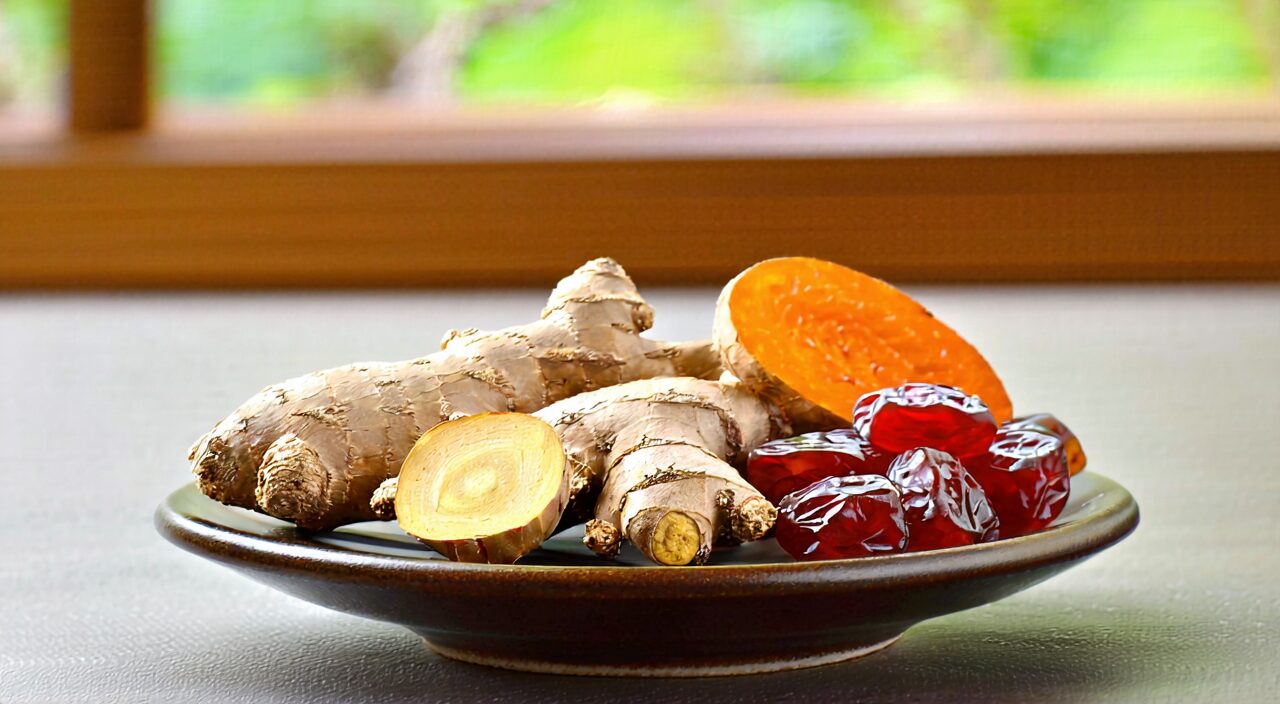
Wu Zhu Yu Tang originates from the Shang Han Lun. Its composition is relatively simple but has a clear therapeutic direction. The commonly used herbal ingredients are as follows:
| Herb | Traditional Action |
|---|---|
| Wu Zhu Yu | Warms the liver and stomach, directs rebellious qi downward to stop vomiting, disperses cold and alleviates pain |
| Ren Shen | Tonifies spleen and stomach qi, strengthens the upright qi |
| Sheng Jiang | Warms the middle and stops vomiting, assists Wu Zhu Yu in dispersing cold |
| Da Zao | Tonifies the spleen and stomach, moderates the nature of the other herbs |
The four herbs are combined primarily to warm and disperse, supplemented by tonifying deficiency, and are commonly used to address vomiting, retching, and headache of deficiency-cold nature. Wu Zhu Yu itself is acrid and hot in nature and enters the liver and stomach channels, forming the core of the formula.
Possible Suitable Presentations for Wu Zhu Yu Tang
Suitability cannot be determined by just one or two symptoms, but traditionally the following types of cold counterflow presentations are considered:
1. Vomiting Due to Stomach Cold
This type of vomiting is generally not caused by food poisoning or damp-heat and has distinct features:
- Vomiting of clear, thin drool or retching
- Cold sensation in the epigastric region
- Preference for hot drinks and warmth applied to the stomach
- Aggravation after eating cold food or exposure to cold
When the above tendencies are present, the presentation may be closer to the range of application for Wu Zhu Yu Tang.
2. Headache Mainly at the Vertex
Chinese medicine holds that the foot jueyin liver channel is closely connected to the vertex of the head. When there is cold in the liver channel and cold qi rises along the channel, the following may appear:
- Headache primarily on the top of the head
- Pain sometimes relatively intense
- Accompanied by aversion to cold and a desire for warmth applied to the head
This type of headache differs from common wind-cold headache or distending headache and requires careful differentiation.
3. Cold Hands and Feet, Preference for Hot Drinks
People with an overall deficiency-cold constitution often exhibit:
- Cold hands and feet, even cold limbs
- Usually prefer drinking hot water
- Dislike cold beverages
When such systemic cold signs are combined with the local symptoms mentioned above, they may serve as a reference direction for considering this formula.
4. Retching, Vomiting of Drool, and Chest Fullness with Discomfort
Some individuals do not have obvious vomitus but frequently expel white, thin, watery drool and simultaneously feel chest oppression and discomfort. This presentation is traditionally attributed to stomach deficiency cold with upward counterflow of turbid yin and often falls within the consideration range of this formula.
All of the above presentations need to be combined with professional assessment such as tongue and pulse diagnosis, and should not be matched solely based on one or two items. If symptoms are chronic, recurrent, or severe, it is advisable to consult a trained Chinese medicine practitioner.
Contraindications and Unsuitable Situations for Wu Zhu Yu Tang
Wu Zhu Yu Tang tends toward a warm and hot nature; thus, all heat presentations or yin-deficiency fire-hyperactivity constitutions are unsuitable for casual use. The following situations are generally considered inappropriate:
- Stomach heat with acid reflux, bitter taste, and bad breath: Vomiting or acid reflux accompanied by a distinct burning sensation, thirst with preference for cold drinks, and dry stool usually indicates stomach heat; using a warm formula may aggravate the discomfort.
- Yin-deficiency fire-hyperactivity constitution: Presentations such as hot palms and soles, dry mouth and throat, night sweats, red tongue with little coating are opposite to the warming and dispersing direction of Wu Zhu Yu Tang.
- Excess heat exuberance in the interior or damp-heat stagnation: Manifestations like high fever, thick yellow phlegm, jaundice, scanty dark reddish urine with burning sensation, which are clearly heat patterns, make the formula unsuitable.
- Pregnant and breastfeeding women, as well as individuals with specific underlying diseases: These situations are more complex, and the use of any formula should be conducted under professional guidance; it should not be self-applied.
- Allergic constitution or known allergy to any of the herbal ingredients: Contact should be avoided.
If vomiting, headache, or other symptoms recur repeatedly or are accompanied by severe abdominal pain, fever, altered consciousness, blood in vomitus, etc., medical evaluation should be prioritized rather than attempting any formula on one’s own.
Brief Distinctions Between Wu Zhu Yu Tang and Similar Formulas
Many formulas have similar-sounding names or involve keywords such as “middle burner,” “vomiting,” or “headache,” but their therapeutic directions differ significantly. Here is a brief comparison in table form of several easily confused formulas:
| Formula | Main Direction | Key Difference from Wu Zhu Yu Tang |
|---|---|---|
| Zuo Jin Wan | Clears and drains liver fire, directs rebellious qi downward to stop vomiting | Used for liver fire invading the stomach (bitter taste, hypochondriac pain, acid swallowing); its direction is clearing, completely opposite to the warming and dispersing of deficiency-cold in Wu Zhu Yu Tang |
| Xiao Jian Zhong Tang | Warms the middle, tonifies deficiency, relaxes spasms and alleviates pain | More oriented toward spleen and stomach deficiency-cold abdominal pain; its descending rebellious qi action is not prominent, and the cold signs are usually milder than those in Wu Zhu Yu Tang patterns |
| Fu Zi Li Zhong Wan | Warms and tonifies spleen and kidney yang qi | Focuses on spleen-kidney deficiency-cold with diarrhea and reversal cold of the limbs; acts more on the lower burner, differing from the upward counterflow pathway of liver-stomach deficiency cold targeted by Wu Zhu Yu Tang |
| Ban Xia Xie Xin Tang | Acridly opens and bitterly descends, dissipates binding and eliminates focal distention | Used for combined cold and heat with epigastric focal distention, vomiting, and borborygmus; it is not a pure deficiency-cold pattern, differing from the purely cold direction of Wu Zhu Yu Tang |
These formulas each have their own emphasis; assessment should integrate constitution, cold-heat deficiency-excess, and disease location, and they should not be used interchangeably.
Summary
In traditional Chinese medicine, Wu Zhu Yu Tang is a formula with a clear directional focus, primarily addressing liver-stomach deficiency cold with upward counterflow of cold turbidity. It is commonly used for cold-type stomach vomiting, vertex headache, cold hands and feet, and preference for hot drinks.
However, it is warm in nature and not suitable for people with stomach heat, yin-deficiency fire-hyperactivity, or obvious excess heat. Compared with Zuo Jin Wan, Xiao Jian Zhong Tang, Fu Zi Li Zhong Wan, and Ban Xia Xie Xin Tang, each formula has a distinct emphasis and cannot simply be substituted for another. This article is for informational reference only and cannot replace professional diagnosis or treatment advice. Whether it is suitable still requires assessment based on individual constitution, symptoms, and professional judgment.