
Who Is Liu Jun Zi Tang Suitable For? Composition, Effects and Contraindications

Many people first encounter a spleen-strengthening formula through Si Jun Zi Tang (Four Gentlemen Decoction), and on the basis of Si Jun Zi Tang, a more broadly adaptable formula is derived—Liu Jun Zi Tang (Six Gentlemen Decoction). Readers often ask whether, when they have both spleen deficiency symptoms like poor appetite and easy fatigue, and also frequently feel they have a lot of phlegm and a throat that never feels clear, Liu Jun Zi Tang would be more appropriate for regulation.
From the perspective of traditional Chinese medicine, this article will clearly sort out the composition of Liu Jun Zi Tang, its common applicable directions, situations where it is unsuitable, and its differences from several similar formulas, helping everyone make a judgment in combination with their own situation after understanding.
Formula Composition of Liu Jun Zi Tang
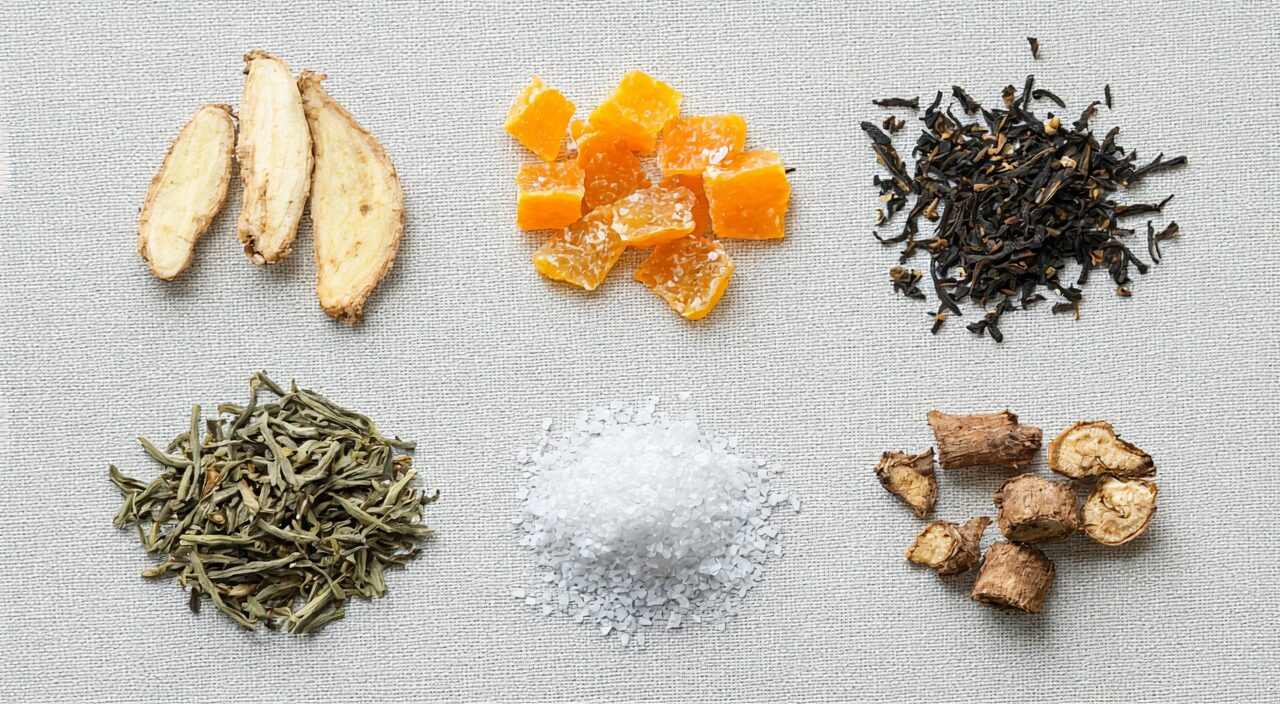
Liu Jun Zi Tang is not a single herb but a compound formula composed of multiple medicinals working together. In terms of formula origin, it is made by adding two herbs to Si Jun Zi Tang, and the “Liu” (six) in its name corresponds exactly to the six medicinals.
Let’s first use a table to intuitively understand its compositional structure:
| Medicinal | Traditional Understanding |
|---|---|
| Ren Shen / Dang Shen (Ginseng / Codonopsis Root) | Sweet and warm to tonify qi, can strengthen and transport the spleen and stomach; the primary qi-tonifying herb in this formula |
| Bai Zhu (White Atractylodes Rhizome) | Bitter and warm to strengthen the spleen and dry dampness, assists in restoring the spleen and stomach’s transportation and transformation functions |
| Fu Ling (Poria) | Sweet and bland to leach out dampness and strengthen the spleen, both helps Bai Zhu dispel dampness and calms the heart |
| Gan Cao (Licorice) | Sweet and warm to boost qi, harmonizes all the medicinals |
| Chen Pi (Tangerine Peel) | Acrid, bitter and warm, regulates qi and strengthens the spleen, dries dampness and transforms phlegm, so that tonification does not cause stagnation |
| Ban Xia (Pinellia Rhizome) | Acrid and warm to dry dampness and transform phlegm, direct rebellious qi downward and stop vomiting, targeting phlegm-dampness and upward reversal of stomach qi |
These six herbs combine to form two main directions: one is to tonify qi and strengthen the spleen, and the other is to dry dampness and transform phlegm. Among them, Ren Shen, Bai Zhu, Fu Ling, and Gan Cao are the classic Si Jun Zi Tang, which establishes the foundation of boosting qi and strengthening the spleen; the addition of Chen Pi and Ban Xia extends the entire formula a large step towards transforming phlegm, regulating qi, and drying dampness.
Traditionally, it is considered that the core idea of Liu Jun Zi Tang is “tonify without causing congestion, dispel without causing injury,” which means, while tonifying qi, it relies on Chen Pi and Ban Xia to dredge phlegm-dampness and qi stagnation in the middle burner, avoiding the stuffy and blocked sensation that pure supplementation can bring.
Traditional Efficacy Directions of Liu Jun Zi Tang

From the perspective of traditional Chinese medicine, Liu Jun Zi Tang is often used to regulate a complex state called “spleen deficiency with phlegm-dampness.” The spleen deficiency here does not only refer to the weakening of a specific organ, but more describes a decline in the ability to digest and absorb, and the resulting abnormality in water-dampness transportation and transformation. When the spleen and stomach’s transportation function is weak, water-dampness cannot be properly distributed and tends to coalesce into phlegm. This phlegm-dampness can remain in the lungs or obstruct the qi mechanism of the middle burner.
Therefore, the traditional efficacy directions of Liu Jun Zi Tang can be summarized as:
- Boosting qi and strengthening the spleen: For conditions related to insufficient spleen qi, such as fatigue and lack of strength, shortness of breath and disinclination to speak, decreased appetite, and abdominal bloating after meals.
- Drying dampness and transforming phlegm: For internally generated phlegm-dampness, manifesting as copious white phlegm that is easy to expectorate, or a persistent sticky and unclear sensation in the throat.
- Harmonizing the middle and directing rebellious qi downward: Chen Pi regulates qi and harmonizes the middle, Ban Xia directs rebellious qi downward and stops vomiting, offering a regulating effect on potential nausea, hiccups, chest tightness, and epigastric stuffiness in this state.
It is important to note that the “phlegm” here is not only the visible phlegm coughed up in daily life; Chinese medicine also has the concept of “invisible phlegm,” which is often used to explain manifestations such as a heavy and muddled sensation in the head, heavy body sensation, sluggish and incomplete bowel movements, and a thick, greasy tongue coating. Traditionally, Liu Jun Zi Tang focuses more on phlegm-dampness related signs arising on a basis of spleen and stomach qi deficiency, and it is not suitable for all types of profuse phlegm or productive cough.
Who Is Liu Jun Zi Tang Suitable For?
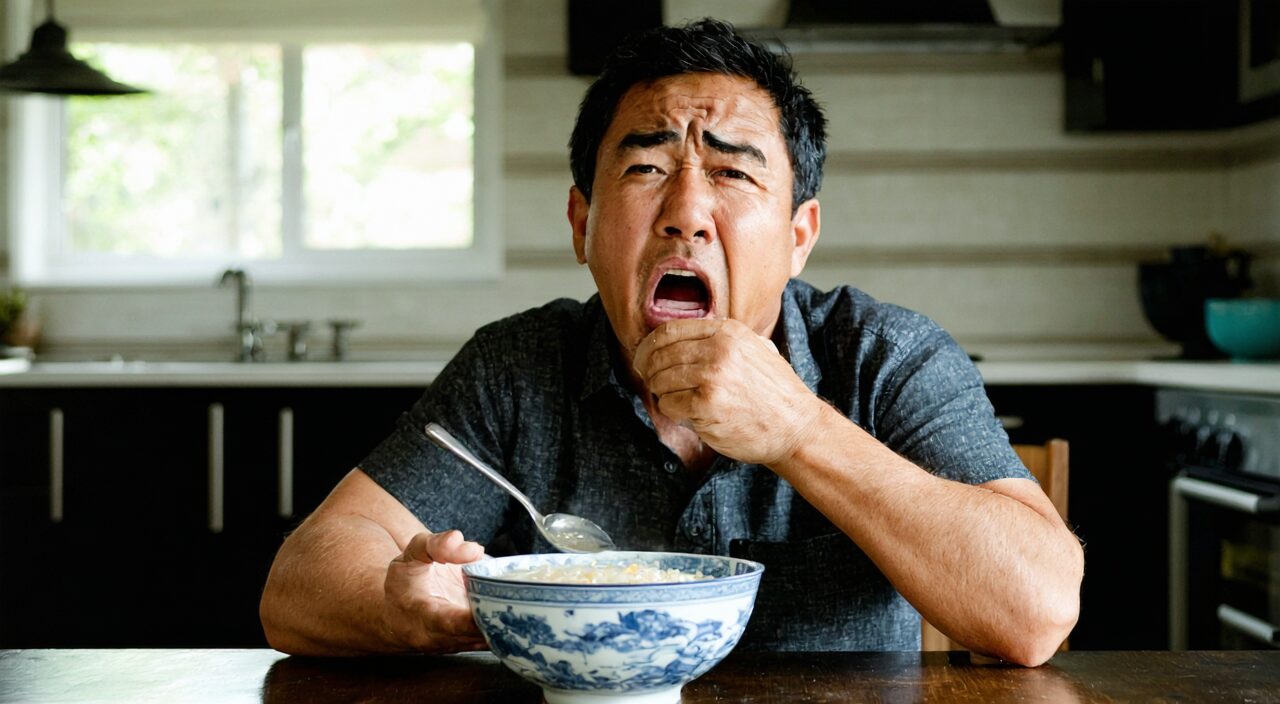
The key to understanding who Liu Jun Zi Tang is suitable for is to grasp the two key points of “spleen deficiency” and “phlegm-dampness,” and that they must coexist. When there is simple spleen qi deficiency without obvious phlegm-dampness, Si Jun Zi Tang may be sufficient; when phlegm-dampness is heavy but qi deficiency is not prominent, formulas more focused on transforming phlegm might be needed.
The following types of manifestations are traditionally used to help determine whether it’s appropriate to further consult a professional about Liu Jun Zi Tang:
- Poor appetite with abdominal bloating, easy fullness after meals
Loss of appetite, feeling of epigastric stuffiness and blockage after eating just a little, sometimes with obvious bloating that feels relieved after passing gas, but tends to recur with the next meal. If the tongue coating tends toward white and greasy in such cases, it is often seen as spleen deficiency failing to transport and transform, with turbid dampness stagnation.
- Copious white phlegm, throat never feels clear
Without having a cold, one feels there is always phlegm in the throat, needing to clear the throat from time to time, with sputum mostly white, slightly thin or sticky, especially noticeable upon waking in the morning. Traditionally, this is considered related to spleen deficiency generating dampness that turns into phlegm, not typical lung-heat dry cough nor yin-deficiency dry cough.
- Nausea, occasional retching, or upward reversal of stomach qi after meals
Without obvious dietary impropriety, one often feels nauseous, especially when smelling greasy odors or after eating, with a bland and tasteless sensation in the mouth. These manifestations are often categorized as “spleen deficiency trapped by dampness, stomach qi failing to descend.”
- Heavy body sensation, fatigue in the limbs
It is not necessarily due to excessive physical labor, but rather a general feeling that “the body is heavy,” with a muddled head as if wrapped in a wet towel, weak and soft legs, and no desire to move. These are sometimes viewed in traditional pattern differentiation as manifestations of dampness encumbering the spleen and clear yang failing to rise.
- Stools tend to be loose, unformed, or sticky and sluggish
Stools are relatively soft, easily stick to the toilet and are difficult to flush away, and after defecation there is still a sense of incomplete evacuation. This often indicates impaired transportation and transformation of water-dampness and is one of the common reference directions for this formula.
If multiple of the above manifestations are present at the same time, and the tongue tends to be pale, with tooth marks on the edges and a white, greasy coating, traditionally this may be considered relatively corresponding to the approach of Liu Jun Zi Tang. It should be emphasized that these are only directions for judgment. There are large differences in individual constitutions, and whether it is suitable for use must still be based on the specific circumstances of the person, ideally with pattern discrimination by an experienced professional.
Who Is Unsuitable for Using Liu Jun Zi Tang
Every formula has its scope of application and boundaries, and Liu Jun Zi Tang is no exception. The following situations are generally considered unsuitable for self-initiated trials:
- Yin deficiency with dry cough or yin-deficient constitution: If there is dry cough without phlegm, scanty and sticky phlegm, dry throat and mouth, hot palms, night sweats, and a red tongue with little coating, the warm and drying nature of Liu Jun Zi Tang may aggravate the discomfort.
- Obvious phlegm-heat: When phlegm is yellow and sticky, difficult to expectorate, with dry mouth and bitter taste, red tongue with yellow greasy coating, it leans more towards phlegm-heat, which is incompatible with the direction of Liu Jun Zi Tang.
- Damp-heat or excess-type accumulation: When there are obvious signs of excess pathogens such as bitter taste and bad breath in the mouth, epigastric and abdominal distension and pain that resists pressure, stools that are sticky, smelly and accompanied by a burning sensation, and a yellow, thick, greasy tongue coating, simple tonification is not appropriate.
- Acute external contraction or fever stage: During colds and fevers, early-stage cough, sore throat and runny nose, the use of tonifying and phlegm-transforming formulas is usually not recommended to avoid interfering with the expulsion of external pathogens.
- Special populations: Pregnant women, children, individuals with severe underlying diseases or in postoperative recovery periods—use of any formula requires guidance from a professional physician and should not be self-selected.
Furthermore, even if the manifestations appear to match the pattern, if the above-mentioned symptoms occur repeatedly over a long period, or are accompanied by noticeable weight loss, persistent vomiting, black stools, chest tightness with palpitations, or abnormal breathing, priority should be given to seeing a doctor for investigation rather than staying at the level of self-regulation.
Differences Between Liu Jun Zi Tang and Several Similar Formulas
Many readers confuse Liu Jun Zi Tang with several formulas that have similar names or similar functions. A brief comparison is provided below in a table to help establish a framework for differentiation.
| Formula | Core Composition Characteristics | Main Applicable Directions | Key Difference from Liu Jun Zi Tang |
|---|---|---|---|
| Si Jun Zi Tang | Ren Shen, Bai Zhu, Fu Ling, Gan Cao; a basic formula for boosting qi and strengthening the spleen | Simple spleen qi deficiency: fatigue, poor appetite, loose stools, pale complexion | Does not contain phlegm-transforming and qi-regulating herbs; suitable for conditions where qi deficiency is primary and phlegm-dampness is not obvious |
| Er Chen Tang | Mainly Ban Xia and Chen Pi, combined with Fu Ling and Gan Cao; a basic formula for drying dampness and transforming phlegm | Damp-phlegm pattern: copious phlegm easy to expectorate, chest tightness and nausea, white greasy tongue coating | Its spleen-strengthening and qi-boosting strength is weak; suitable when phlegm-dampness is heavy but qi deficiency is not prominent |
| Xiang Sha Liu Jun Zi Tang | Based on Liu Jun Zi Tang with the addition of Mu Xiang and Sha Ren | Qi deficiency with phlegm-dampness accompanied by obvious epigastric and abdominal distension and fullness, belching, extremely poor appetite, and qi stagnation manifestations | Has a stronger action in moving qi and awakening the spleen; more suitable for patterns where qi stagnation and distension are prominent |
| Shen Ling Bai Zhu San | Si Jun Zi Tang plus Shan Yao, Lian Zi, Yi Yi Ren, Jie Geng, etc. | Spleen deficiency combined with dampness, mainly manifesting as loose stools, poor appetite, and sallow complexion | Excels in leaching dampness and stopping diarrhea; its strength in transforming phlegm and harmonizing the middle and directing rebellious qi downward is less than that of Liu Jun Zi Tang |
In specific applications, the choice among these formulas requires a comprehensive judgment based on the emphasis of constitution and symptoms, and cannot be decided solely on a single sensation. If you are unsure which state you belong to, it is advisable to seek systematic pattern differentiation from a professional.
Summary
Liu Jun Zi Tang is a formula developed on the basis of Si Jun Zi Tang for boosting qi and strengthening the spleen, drying dampness and transforming phlegm. Traditionally, it is more suitable for a state where spleen deficiency and phlegm-dampness coexist, such as the simultaneous presence of poor appetite with abdominal bloating, copious white phlegm, nausea, heavy body sensation, and loose stools. Its overall direction is relatively warm, tonifying, and drying, so it is generally unsuitable for self-directed use in cases of yin-deficiency dry cough, phlegm-heat, damp-heat, and acute disease states.
This article serves only as a general science-based overview and does not make treatment recommendations for any specific formula. There are large differences in individual constitutions and specific contributing causes. If related problems do not resolve over a long period, or if symptoms are severe or complex, it is recommended to consult a professional doctor first and explore suitable regulation approaches only after a clear diagnosis.