
Who is Ginseng Spleen-Invigorating Pill Suitable For? Composition, Benefits, and Contraindications Explained

Many people talk about strengthening the spleen, but when faced with a gradually worsening appetite, stomach bloating after meals, persistently unformed stools, and whole-body fatigue, they often don’t know where to start.
In traditional Chinese medicine, these symptoms often point to weakened spleen and stomach function, and Ginseng Spleen-Invigorating Pill (Ren Shen Jian Pi Wan) is a frequently mentioned classic formula. This article mainly explores the formula composition, traditional efficacy directions, and reference for suitable body constitutions, to help everyone more clearly understand who it actually suits and in which situations extra caution is needed.
Understanding the Approach from the Perspective of Spleen Deficiency

Traditional Chinese medicine holds that the spleen governs transportation and transformation, responsible for distributing the essence of food and drink to the entire body. When spleen qi is weak and its transformative capacity is insufficient, several typical manifestations tend to appear:
- Feeling bloated after eating just a little
- Pronounced drowsiness after meals
- Stools that are persistently loose or prone to diarrhea
- A sallow complexion lacking luster
- A low, weak voice
- Heavy limbs and lack of desire to move
Ginseng Spleen-Invigorating Pill is designed precisely around this state of spleen-stomach weakness and impaired transportation. It is not aimed at just one or two symptoms but attempts to restore the functional rhythm of the middle burner spleen and stomach. Therefore, in traditional use, it is often applied to complex situations of spleen-stomach weakness accompanied by qi movement stagnation, poor digestion, and internal retention of dampness and turbidity.
Composition and Formula Characteristics of Ginseng Spleen-Invigorating Pill
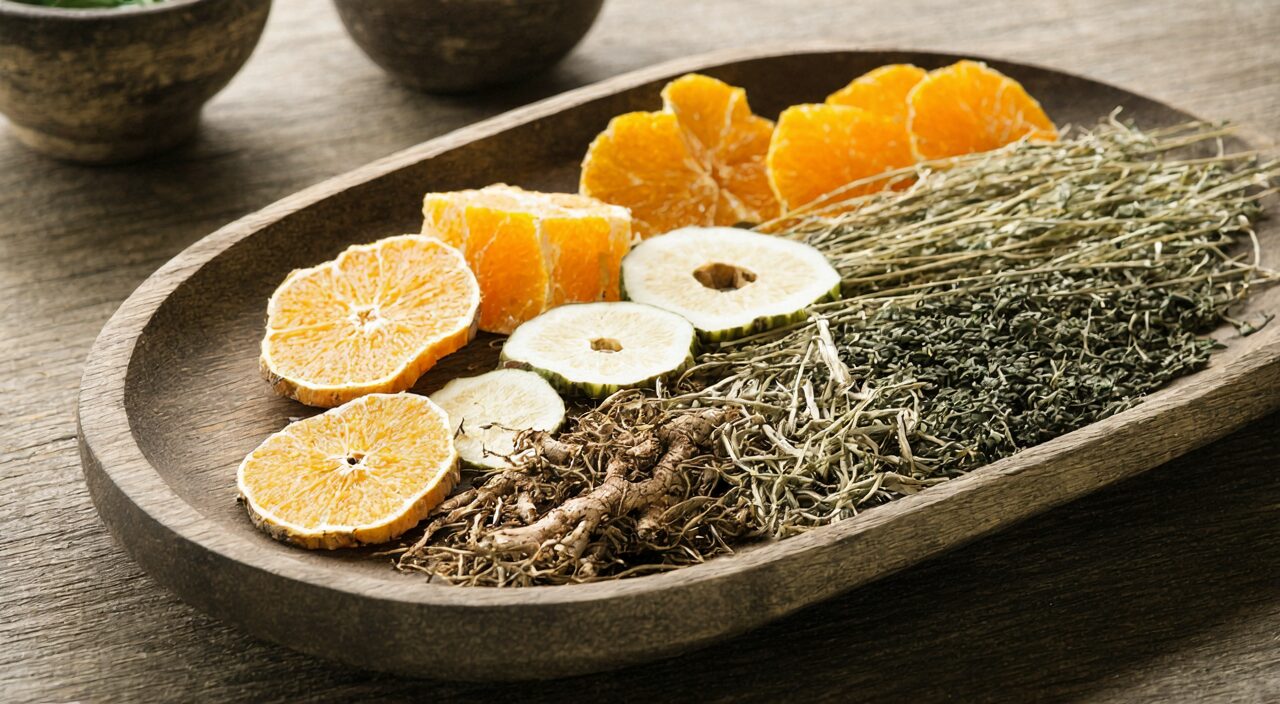
The composition of this formula simultaneously addresses supplementing qi, strengthening the spleen, regulating qi, and transforming dampness. The following is the traditional common compositional structure; specific proportions may be adjusted by different practitioners or dosage forms and are provided only for general reference:
| Medicinal | Primary Direction of Action in the Formula |
|---|---|
| Ginseng (Ren Shen) | Strongly tonifies original qi, strengthens the spleen and nourishes the stomach |
| Atractylodes (Bai Zhu) | Strengthens the spleen and boosts qi, dries dampness and promotes water metabolism |
| Poria (Fu Ling) | Strengthens the spleen and leaches out dampness, benefits the heart and calms the spirit |
| Chinese Yam (Shan Yao) | Tonifies the spleen and stomach, boosts qi and nourishes yin |
| Tangerine Peel (Chen Pi) | Regulates qi and strengthens the spleen, dries dampness and harmonizes the stomach |
| Costus Root (Mu Xiang) | Moves qi and relieves pain, regulates the middle burner and guides out stagnation |
| Amomum (Sha Ren) | Transforms dampness and opens the appetite, warms the spleen and stops diarrhea |
| Astragalus (Huang Qi) | Tonifies qi and raises yang, boosts the defensive exterior and consolidates the surface |
| Angelica Sinensis (Dang Gui) | Nourishes blood and harmonizes the ying, relaxes tension and moistens the intestines |
| Jujube Seed (Suan Zao Ren) | Nourishes the heart and liver, calms the heart and settles the spirit |
| Polygala (Yuan Zhi) | Calms the spirit and benefits the mind, connects the heart and kidneys |
From the composition, it can be seen that Ginseng Spleen-Invigorating Pill does not simply rely on Ginseng and Astragalus to tonify qi but integrates many qi-regulating and dampness-transforming medicinals, such as Tangerine Peel, Costus Root, and Amomum. The purpose of this combination is to avoid stagnation when supplementing, so that the spleen and stomach maintain smooth qi movement while receiving tonification. For abdominal distension and reduced appetite caused by spleen deficiency with dampness and qi stagnation, this combination is traditionally considered more suitable for the pattern.
Populations That May Be Suitable for Reference
In traditional use, Ginseng Spleen-Invigorating Pill is more often applied to chronic stages of spleen-stomach weakness complicated by qi stagnation and dampness-turbidity. The following groups may consider it as a direction for understanding after pattern differentiation by a physician:
- Markedly reduced appetite, no interest in the sight of food, feeling blocked in the stomach after eating just a little;
- Post-meal abdominal bloating that persists, requiring a long time to digest, even with increased belching and flatulence;
- Stools that are long-term unformed, loose, or paste-like, with a noticeable feeling of incomplete evacuation, yet without a foul, putrid odor;
- Declining physical strength, mental fatigue, daytime drowsiness and sleepiness, reluctance to speak and move, and these manifestations are directly related to poor digestion;
- Sallow complexion, relatively pale lips, tendency to palpitation, light sleep with excessive dreaming, reflecting a state of blood insufficiency on top of spleen deficiency.
It is important to note that these manifestations are only reference dimensions for clinical pattern differentiation, and meeting just one or two of them does not necessarily mean the formula is suitable. Traditional Chinese medicine emphasizes comprehensive evaluation by all four diagnostic methods; the decision to use this formula must integrate information such as tongue appearance and pulse patterns and be made by a professional.
Situations Where It Is Generally Not Suitable
Although Ginseng Spleen-Invigorating Pill primarily strengthens the spleen, it is not suitable for all types of indigestion. If the direction is misjudged, it may even worsen discomfort. The following types of situations are generally not recommended as a first choice and warrant special attention:
- When there is internal retention of damp-heat with a yellow, greasy tongue coating: If the mouth feels sticky, with pronounced bitter taste or bad breath, stools are loose but foul-smelling with difficult defecation, and the tongue coating is thick, yellow, and greasy, this often indicates relatively severe damp-heat. In this case, pure tonification is likely to fuel dampness and engender heat. Traditionally, clearing and disinhibiting damp-heat would take precedence.
- When food accumulation is an excess pattern with abdominal distension and pain that worsens with pressure: Abdominal distension and pain after binge eating, belching with a rancid odor, foul-smelling or dry, difficult stools, and a thick, greasy tongue coating that tends toward yellow indicate an excess pattern of food stagnation. This does not suit the predominantly supplementing nature of Ginseng Spleen-Invigorating Pill, which would instead trap the pathogen.
- When there is obvious stomach fire with tendency to hunger and acid reflux: Some people have a strong appetite and feel hungry easily, along with epigastric burning, acid reflux, dry mouth with preference for cold drinks, and swollen, painful gums. This is mostly related to stomach fire and does not align with the warm-tonifying approach of Ginseng Spleen-Invigorating Pill.
- Special populations requiring extra caution: During pregnancy, lactation, children, elderly with frail constitutions and complex conditions, and those using other medications all need to be evaluated under professional medical guidance, rather than self-matching symptoms to the formula.
Additionally, if bodily discomfort has persisted for a long time or is accompanied by noticeable weight loss, black stools, repeated vomiting, intense abdominal pain, chest tightness, palpitations, severe anxiety or depression, priority should be given to seeking medical diagnosis rather than relying on self-regulation.
Differences from Several Common Spleen-Strengthening Formulas
To understand Ginseng Spleen-Invigorating Pill, it is often necessary to distinguish it from other classic spleen-strengthening formulas, otherwise confusion easily arises.
Shen Ling Bai Zhu San
Shen Ling Bai Zhu San also mainly strengthens the spleen and boosts qi but focuses more on strengthening the spleen and leaching out dampness. The formula contains a relatively large proportion of dampness-leaching and antidiarrheal medicinals such as Coix Seed, White Hyacinth Bean, and Lotus Seed. It is frequently used for diarrhea, poor digestion, and heavy limbs caused by spleen deficiency with predominant dampness, when abdominal distension and qi stagnation are not prominent.
If spleen deficiency with obvious dampness predominates, with watery stools or noticeable puffiness, the dampness-leaching advantage of Shen Ling Bai Zhu San is traditionally considered. Ginseng Spleen-Invigorating Pill, on the other hand, has stronger qi-regulating, dampness-transforming, distention-relieving, and spleen-reviving power, making it more suitable for spleen deficiency accompanied by marked bloating and belching.
Si Jun Zi Tang
Si Jun Zi Tang, composed of Ginseng, Atractylodes, Poria, and Licorice, is a foundational formula for tonifying qi and strengthening the spleen. Its action is mild and pure, primarily targeting the basic state of spleen qi deficiency. It often serves as a bottom-line tonic but lacks the power to regulate qi, transform dampness, and calm the spirit.
When spleen deficiency manifestations are relatively simple, without significant bloating, qi stagnation, or sleep issues, Si Jun Zi Tang and its derivatives are often considered first. Ginseng Spleen-Invigorating Pill can be viewed as building upon the Si Jun Zi Tang base by adding more qi-moving, dampness-transforming, blood-nourishing, and spirit-calming ingredients, making its scope more suitable for somewhat more complex spleen deficiency with qi stagnation.
Xiang Sha Liu Jun Zi Tang
Xiang Sha Liu Jun Zi Tang adds Tangerine Peel, Pinellia, Costus Root, and Amomum to the Si Jun Zi Tang base, highlighting spleen strengthening, phlegm transformation, and qi-movement with stomach harmonization. Traditionally, it is often used for epigastric stuffiness, vomiting, belching, and poor appetite due to spleen-stomach qi deficiency with internal obstruction of phlegm-dampness and inhibited qi movement.
Compared with Ginseng Spleen-Invigorating Pill, Xiang Sha Liu Jun Zi Tang has a clearer direction toward transforming phlegm and stopping vomiting, while Ginseng Spleen-Invigorating Pill is more prominent in tonifying qi, nourishing the heart and calming the spirit, and addressing concurrent blood deficiency. If spleen deficiency is accompanied by nausea, vomiting of phlegm-drool, and a distinct sensation of blockage in the stomach, the Xiang Sha Liu Jun Zi Tang direction may be more worth investigating.
Bao He Wan
Bao He Wan is a representative formula for dispersing food and guiding out stagnation, mainly used for excess patterns of food accumulation such as epigastric distension and pain, belching with putrid sourness, vomiting of undigested food, and irregular bowel movements.
Its difference from Ginseng Spleen-Invigorating Pill lies in the therapeutic orientation: Bao He Wan emphasizes dispersal, using digestant medicinals like Hawthorn, Medicated Leaven, and Radish Seed, suitable for the excess pattern of undigested food accumulating in the middle burner after overeating. Ginseng Spleen-Invigorating Pill emphasizes supplementation combined with qi regulation and dampness transformation, suitable for weak digestive function at the foundation of spleen-stomach deficiency. One disperses and the other supplements, their directions are almost opposite and they cannot substitute for each other.
Viewing Formula Selection from Differences in Body Constitution
In traditional Chinese medicine practice, even with the same formula, the response may vary in people with different body constitutions.
Those with a constitution predominantly qi deficient but not heavily burdened by phlegm-dampness may find the tonifying strength of Ginseng Spleen-Invigorating Pill moderate; whereas those originally with relatively severe damp-heat or qi constraint transforming into fire might experience dry mouth, symptoms of heat, or worsened bloating after use. Therefore, formula selection should not only look at lists of therapeutic effects but must comprehensively evaluate the current constitutional tendencies.
Especially in overseas environments, dietary structure, climate, and daily rhythms differ greatly from those in China, and the proportion of spleen deficiency mixed with dampness, heat, and qi constraint is very high. If one only focuses on Ginseng Spleen-Invigorating Pill and neglects different emphases such as Shen Ling Bai Zhu San, Xiang Sha Liu Jun Zi Tang, or even Si Jun Zi Tang, it is very possible to miss the more suitable timing for your own regulation.
Summary
In traditional Chinese medicine, Ginseng Spleen-Invigorating Pill is a commonly used formula for tonifying spleen qi, strengthening the spleen and stomach, and stopping diarrhea, especially suitable for complex states of spleen-stomach weakness accompanied by qi stagnation and abdominal bloating, reduced appetite, loose stools, and mental and physical fatigue. Its composition balances tonification of qi with regulation of qi and transformation of dampness, preventing the stagnation that comes from blind supplementation.
However, spleen-stomach issues are far more than just spleen deficiency; situations such as damp-heat, food accumulation, and stomach fire all require different treatment directions. Ginseng Spleen-Invigorating Pill is not suitable for people with obvious damp-heat, food accumulation excess patterns, or relatively intense stomach fire. Benchmarking it against Shen Ling Bai Zhu San, Si Jun Zi Tang, Xiang Sha Liu Jun Zi Tang, and Bao He Wan further clarifies the boundaries of each formula.
This article is for educational reference only. Each individual’s specific situation differs; whether this formula direction is appropriate still requires comprehensive judgment by combining constitution, symptoms, and professional advice, and should not be decided upon independently.