
Who is Duhuo Jisheng Tang suitable for? Composition, effects and contraindications

Many people may have heard of the formula “Duhuo Jisheng Tang,” especially when older family members or friends mention issues like lower back and leg soreness or joint discomfort, they might bring it up as a traditional approach. Yet when faced with this formula, most people become confused: What kinds of discomfort is it actually suitable for? Who might not be appropriate to use it? How is it different from similarly named formulas like Qianghuo Shengshi Tang and Fangji Huangqi Tang? This article will walk through these common questions in as clear a way as possible.
How traditional Chinese medicine understands Duhuo Jisheng Tang
Duhuo Jisheng Tang comes from Sun Simiao’s Essential Prescriptions Worth a Thousand Gold (Bei Ji Qian Jin Yao Fang) of the Tang Dynasty. Historically it has been used for prolonged bi syndrome with a mixture of deficiency and excess. In traditional Chinese medicine, chronic bi syndrome is not only about expelling wind, dispersing cold, and transforming dampness; it also pays particular attention to the liver and kidneys, as well as qi and blood.
Because the liver governs the sinews and the kidneys govern the bones, long-standing illness tends to consume and damage the liver and kidneys. At the same time, when qi and blood are insufficient, the body finds it even harder to expel pathogenic factors, often leading to chronic pain that is difficult to resolve and recurs frequently.
The strategy behind this formula is to dispel wind, scatter cold, and eliminate dampness while simultaneously adding herbs that supplement the liver and kidneys and boost qi and blood, so that supporting the body’s healthy qi and eliminating pathogens happen at the same time. Therefore, it is different from some analgesic formulas that focus purely on expelling pathogens; it is more suited to a pattern where “the pain is not extremely severe, but it lingers without end, worsens after exertion, and improves with warmth, and there is an aversion to cold.”
Main composition and direction of action
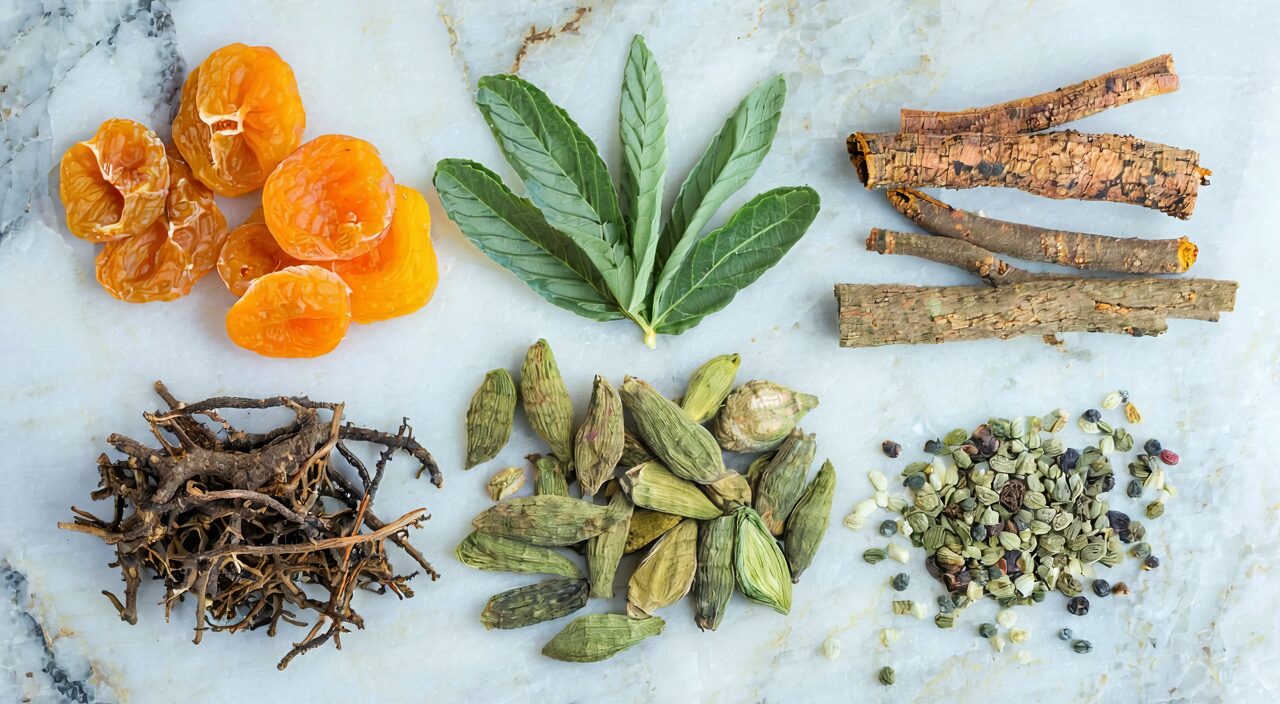
Duhuo Jisheng Tang consists of multiple Chinese herbal medicines, with each category having a broad focus of action. Below is a simple categorization of the commonly used reference composition to help grasp the overall structure.
| Category | Commonly included herbs | Main direction of action |
|---|---|---|
| Dispel wind-dampness, stop bi pain | Duhuo (Angelica pubescens), Qinjiao (Gentiana macrophylla), Fangfeng (Saposhnikovia divaricata), Xixin (Asarum sieboldii) | Traditionally used to disperse wind-cold-dampness pathogens, unblock collaterals and relieve pain |
| Supplement liver and kidneys, strengthen sinews and bones | Sangjisheng (Taxillus chinensis), Duzhong (Eucommia ulmoides), Niuxi (Achyranthes bidentata) | Commonly used for presentations of liver and kidney insufficiency such as soreness in the lower back and knees, weakness of sinews and bones |
| Boost qi and blood, support healthy qi | Renshen (Ginseng), Fuling (Poria cocos), Gancao (Glycyrrhiza uralensis), Danggui (Angelica sinensis), Chuanxiong (Ligusticum wallichii), Ganshengdi (Rehmannia glutinosa dried), Shaoyao (Paeonia lactiflora) | Traditionally used as a common combination for supplementing both qi and blood |
| Warm and unblock the channels | Rougui (Cinnamomum cassia bark) | Helps to disperse cold, warm and unblock the blood vessels; suitable for cold-type pain |
It should be noted that the above composition is a reference version only. In actual practice, individual herbs may be added or subtracted depending on regional habits or differences in prescribing rationale. Understanding the overall direction is useful, but it is absolutely crucial that you do not directly fill a prescription based on this information.
Suitable population: characteristics of deficiency, cold, and chronic bi

Let’s return to the question everyone is most concerned about: Who is Duhuo Jisheng Tang suitable for? From the perspective of traditional pattern differentiation, it is generally more focused on people with “chronic wind-cold-dampness bi, combined with liver and kidney deficiency and dual vacuity of qi and blood.” In terms of specific manifestations, it may include the following types:
- Soreness and pain in the lower back and knees, limited joint mobility: The pain is primarily a dull, deep aching sensation, without obvious redness, heat, or swelling.
- Aggravated by cold, relieved by heat: Discomfort becomes more pronounced when the weather turns cold or before rainy or overcast days, and improves with heat application or keeping warm.
- Worsens after exertion, eases with rest: For example, after walking a lot, standing for long periods, or doing household chores, the discomfort in the lower back and legs becomes more prominent.
- Generally more deficient, easily feels cold: The person may often feel cold, with cold hands and feet, a heavy and tired sensation in the body, and a complexion that is not rosy and lustrous.
- Long course of illness, recurrent attacks: This is not a discomfort of just one or two days; it has persisted or recurred over quite a long period, with fluctuations between better and worse.
If your or your family member’s situation broadly fits these characteristics, then the direction of this formula may be a traditional approach worth understanding. However, it must be comprehensively assessed together with the tongue and pulse presentations and the individual’s overall condition; do not match yourself based on just one or two symptoms.
Which situations might not be suitable
Although Duhuo Jisheng Tang has a supporting-the-righteous aspect, it is still overall warm, supplementing, and somewhat drying in nature. The following situations are generally avoided or require great caution:
- Damp-heat bi pain: Joints are red, swollen, hot and painful, the pain is relatively intense, local temperature is elevated, and the tongue coating is yellow and greasy. This pattern focuses more on clearing heat, draining dampness, and unblocking collaterals, not on warming and supplementing.
- Acute stage with redness, swelling, heat and pain: For example, an acute gout attack with obvious redness, swelling, heat and pain in the joints. Approaches that clear heat, transform stasis, and unblock collaterals are more common initially.
- Pregnancy: The formula contains herbs like Duhuo, Niuxi, and Rougui. Pregnancy is a special circumstance, and it is generally not recommended to independently use any formulas without professional medical judgment.
- Special constitution or concurrent use of other medications: For instance, people with easy bleeding tendencies, significantly low blood pressure, or severe liver or kidney function problems, as well as those on long-term anticoagulant therapy, all need evaluation under professional guidance.
Additionally, if during the course of discomfort there are symptoms such as marked anxiety, depression, palpitations, chest tightness, shortness of breath, unexplained weight loss, black stools, or persistent vomiting, do not treat it simply as ordinary bi pain. It is advisable to consult a doctor promptly to rule out other conditions.
What is the difference compared with similar formulas
Many people compare Duhuo Jisheng Tang with several other formulas, so below is a brief explanation of their respective focuses to give a rough framework for understanding.
Qianghuo Shengshi Tang
Qianghuo Shengshi Tang leans more toward “wind-dampness in the exterior and upper body.” Traditionally it is often used for heaviness in the head and body, and soreness in the shoulders and back, usually connected with externally contracted wind-dampness and a relatively acute onset. Its overall emphasis is on dispersing wind-dampness, with very few supplementing ingredients, so it is more suitable for people whose body is not deficient and who are merely encumbered by wind-dampness pathogens. If there is cold soreness in the lower back and knees, a long-standing deficiency pattern, and obvious cold aversion, then the thinking is quite different.
Fangji Huangqi Tang
Fangji Huangqi Tang is commonly used for “wind water” or “wind-dampness” accompanied by qi deficiency and internal water-dampness retention, manifesting as, for example, body heaviness, lower extremity edema, and sweating with aversion to wind after activity. Its direction of boosting qi, securing the exterior, and percolating dampness to promote urination is more prominent, while its wind-damp-dispelling and pain-stopping power is relatively mild, and its action of supplementing the liver and kidneys is also relatively weak. This means that if the main problem is a dull aching in the lower back and knees with weakness of sinews and bones, using Fangji Huangqi Tang alone may not be sufficiently strong; comprehensive assessment is needed.
Jingui Shenqi Wan
Jingui Shenqi Wan focuses on warming and supplementing kidney yang. It is mostly used for lower back and knee soreness and weakness, cold limbs, poor urination or increased nocturia caused by kidney yang insufficiency. It does not contain specific herbs for dispelling wind-dampness and stopping bi pain. Therefore, when lower back and leg discomfort is combined with obvious cold-damp bi obstruction, merely warming the kidneys and assisting yang is often insufficient and needs to be combined. In traditional application, sometimes kidney yang is regulated first, and sometimes warming kidney approaches are used together with dispelling dampness and unblocking collaterals.
Guizhi Fuling Wan
Guizhi Fuling Wan mainly activates blood, resolves stasis, and slowly reduces masses. It is often used for blood-stasis-related menstrual irregularities, incomplete lochia discharge after childbirth, or fixed lower abdominal pain from blood stasis patterns. It targets “stasis,” not “wind-dampness.” Although chronic bi may also involve stasis, if the pain mainly presents as lower back and knee soreness, aversion to cold, and relief with warmth, along with qi and blood insufficiency, then the direction of Duhuo Jisheng Tang is more aligned. If the wrong direction is chosen, not only might the expected effect fail to materialize, but necessary treatment timing may also be delayed.
Looking at these categories of formulas together helps us understand the uniqueness of Duhuo Jisheng Tang: it takes supplementation into account at the same time as expelling pathogens, making it more suitable for chronic joint and muscle problems where the illness has lasted a long time, the body is weak, and cold signs are evident. But this also means it is not universally applicable to all “joint pain.”
Summary
As a traditional formula, Duhuo Jisheng Tang is often used in Chinese medicine clinical practice for the specific type of condition where wind-cold-dampness bi has persisted for a long time, with liver and kidney deficiency and dual vacuity of qi and blood. Its composition covers several levels: dispelling wind-dampness, supplementing the liver and kidneys, and boosting qi and blood. Thus, although it appears complex, the rationale is actually quite clear: expel pathogens on one hand and support the body’s healthy qi on the other, making it suitable for lingering lower back and leg pain that is worse with cold and exertion, and where the constitution is generally deficient.
At the same time, it is important to recognize that situations completely different from this type—such as damp-heat bi pain, acute redness, swelling and heat, or conditions that purely require activating blood and resolving stasis, warming and supplementing kidney yang, or dispelling wind and overcoming dampness—will each have their own more matching approach to regulation. Formulas with similar-sounding names do not imply similar actions, and every choice depends on meticulous differentiation of an individual’s constitution and symptoms.
This article is for informational reference only and cannot replace professional diagnosis or treatment advice. If physical discomfort persists for a long time or the situation is complex and recurrent, it is advisable to seek standardized professional advice for more reliable judgment.