
Who Is Bu Zhong Yi Qi Tang Suitable For? Composition, Effects, and Contraindications

In daily life, many people feel “weak” or “too tired to talk,” yet no clear organic problem is found. In traditional Chinese medicine, such conditions are often classified as “qi deficiency” or “sinking of middle qi,” and Bu Zhong Yi Qi Tang is one of the representative formulas widely discussed based on this concept.
This article will outline the composition and traditional effects of Bu Zhong Yi Qi Tang, focusing on analyzing which presentations it may be more suitable for, and which situations require special caution. It will also compare it with similar formulas such as Gui Pi Tang, Si Jun Zi Tang, Ba Zhen Tang, and Shen Ling Bai Zhu San, helping readers establish a clearer understanding.
Overview of Traditional Formula Principles

Bu Zhong Yi Qi Tang originates from Li Dongyuan’s Pi Wei Lun (Treatise on the Spleen and Stomach) in the Jin-Yuan period, and is a typical embodiment of the approach of “tonifying the middle and boosting qi, raising yang to lift sinking.”
Traditional theory holds that the spleen and stomach reside in the middle energizer and are the source of qi and blood generation. If the spleen and stomach are qi deficient and clear yang fails to ascend, a series of manifestations primarily characterized by “powerlessness, sinking sensations, and shortness of breath” may occur. The formula not only tonifies qi but also considers raising and lifting, so it is not a mere qi-tonifying formula but is aimed at the specific state of “qi deficiency accompanied by qi sinking.”
Composition and Main Directions of Each Herb
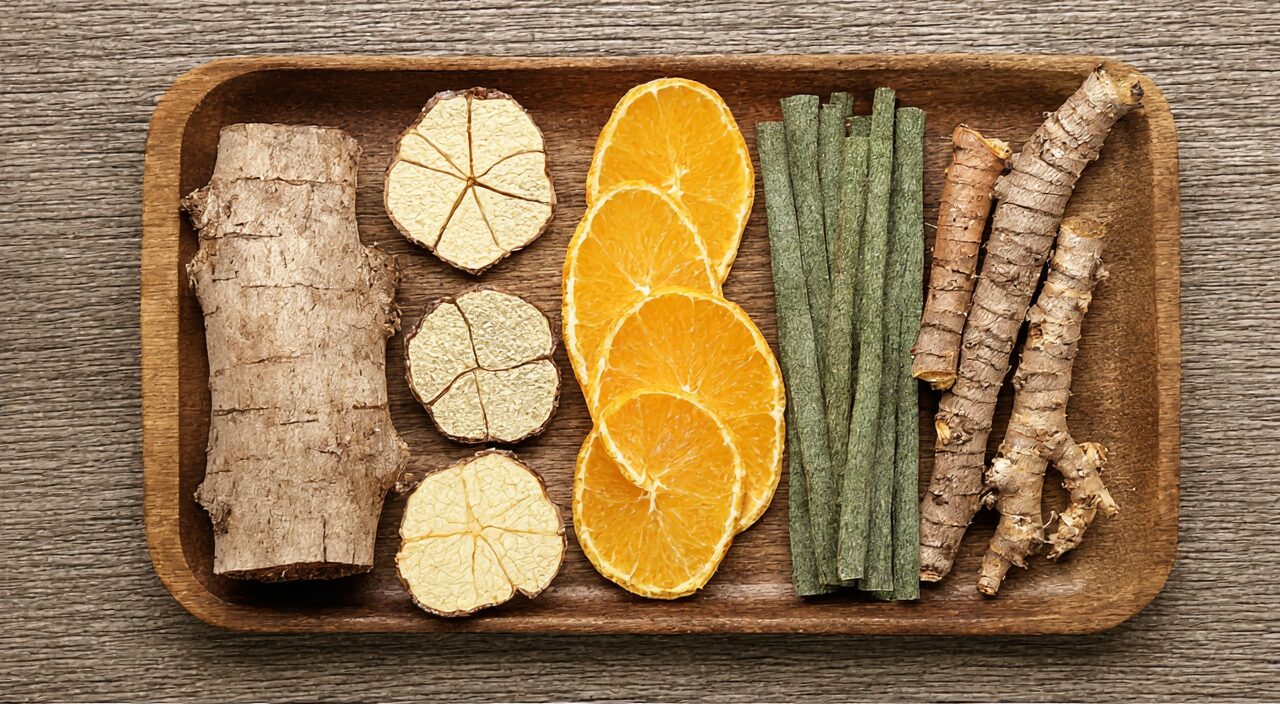
The following is the common composition of Bu Zhong Yi Qi Tang and the traditional understanding of each herb’s emphasis. Specific dosages may vary according to different sources and individualized adjustments, and are only provided for reference.
| Herb | Main Direction in Traditional Understanding |
|---|---|
| Huang Qi (Astragalus) | Tonifies qi and stabilizes the exterior; as the sovereign herb, it emphasizes raising the defensive qi of the skin and muscles and the middle qi. |
| Ren Shen (Ginseng) or Dang Shen (Codonopsis) | Greatly tonifies the original qi, tonifies the spleen and benefits the lung; reinforces the qi-tonifying strength when combined with Huang Qi. |
| Bai Zhu (Atractylodes) | Strengthens the spleen and dries dampness; assists spleen and stomach transportation and transformation so that tonification does not cause stagnation. |
| Zhi Gan Cao (Honey-fried Licorice) | Tonifies the spleen and harmonizes the stomach, moderates the properties of the other herbs. |
| Dang Gui (Angelica) | Tonifies blood and moves blood; plays a synergistic role so that “qi is generated from blood” among a large number of qi-tonifying herbs. |
| Chen Pi (Tangerine Peel) | Regulates qi and harmonizes the stomach, preventing the tonifying herbs from causing clogging and stagnation. |
| Sheng Ma (Cimicifuga) | Raises yang qi, guiding clear yang to ascend. |
| Chai Hu (Bupleurum) | Soothes the liver and raises clear qi, assisting Sheng Ma in jointly lifting the sinking qi. |
Through such a combination, the entire formula centers on tonifying qi while incorporating elements that raise and lift, regulate qi, and nourish blood, preventing stagnation from supplementation.
Traditional Effects and Common Perspectives

From traditional discourse, the effects of Bu Zhong Yi Qi Tang are often summarized as: tonifying the middle and boosting qi, raising yang to lift sinking. Specifically, this can be understood on two levels:
- Tonifying the middle and boosting qi: Addresses spleen and stomach qi deficiency, improving appetite, physical strength, mental state, and fatigue caused by qi deficiency.
- Raising yang to lift sinking: Addresses failure of clear yang to ascend and sinking of middle qi due to qi deficiency, which may be associated with chronic diarrhea, prolapse of the rectum, gastroptosis, uterine prolapse, or a sinking sensation in the lower abdomen and lumbosacral region after prolonged standing, etc.
It must be emphasized that these directions are traditional Chinese medicine conditioning approaches based on pattern identification, not targeting a single disease, and not all fatigue is suitable.
Characteristics of Potentially More Suitable Populations

In traditional pattern identification, the applicable direction of Bu Zhong Yi Qi Tang typically points to the coexistence of “spleen and stomach qi deficiency” and “sinking of middle qi.” The following presentations may be used as reference, but still require comprehensive assessment:
- Persistent fatigue and weakness: Hard to recover even after rest, with a clear sensation of bodily heaviness.
- Shortness of breath and reluctance to speak: Speaking in a low, weak voice; feeling out of breath after talking just a little more.
- Decreased appetite and post-meal bloating: Eating very little but feeling indigestion, with bloating often worsening in the afternoon or after exertion.
- Loose stools or chronically unformed stools: Soft and loose stools, possibly with undigested food; a heavy, bearing-down sensation persists after bowel movements.
- Sinking sensation after prolonged standing or exertion: For example, feeling a bearing-down sensation in the lower abdomen or anal region after standing for a long time, possibly accompanied by sore and weak lower back, which improves upon lying down.
- Sallow or pale complexion: Lack of luster on the face, lips appear pale.
- Prone to recurrent colds or low-grade fever: Especially low-grade fever or spontaneous sweating appearing after exertion, traditionally considered “qi deficiency fever.”
If only one or two manifestations are present, it does not necessarily indicate Bu Zhong Yi Qi Tang. Generally, multiple features need to coexist and be comprehensively evaluated by an experienced professional in conjunction with tongue and pulse signs (e.g., pale tongue with white coating, pulse that is empty, soft, and forceless).
Situations Where It Is Unsuitable or Requires Caution
Although Bu Zhong Yi Qi Tang is a tonifying formula, its characteristics of raising and lifting and tonifying may not be suitable in the following situations, and may even worsen discomfort:
- Those with yin deficiency and fire exuberance: Manifestations include heat sensation in the palms and soles, night sweats, dry mouth and throat, red tongue with little coating. Such individuals, if given raising and qi-tonifying substances, may further fuel fire and damage yin.
- Damp-heat excess patterns or internal food accumulation: Thick, greasy tongue coating; abdominal bloating that worsens with pressure; sticky, foul-smelling stools; sticky sensation in the mouth, etc. Should first clear damp-heat or abduct food stagnation, and not tonify too early.
- During external contraction with fever: In the acute stage of a cold or flu, especially when fever and sore throat are pronounced. Traditionally, one should first release the exterior and expel pathogens, and not tonify too early to avoid “locking the door and detaining the thieves.”
- Hypertension or constitution prone to heat/fire: The formula contains raising herbs such as Sheng Ma and Chai Hu, and the suitability should be professionally assessed; self-administration is not recommended.
- Pregnancy, breastfeeding, and special constitutions: Should be guided by a physician or professional; do not self-assess.
Furthermore, if fatigue is accompanied by warning signs such as obvious palpitations, chest pain, unexplained weight loss, black stools, or persistent low-grade fever, modern medical examination should be sought first to rule out organic diseases.
Differences from Gui Pi Tang, Si Jun Zi Tang, Ba Zhen Tang, and Shen Ling Bai Zhu San
These formulas all involve the category of “tonifying qi,” but their emphases differ and are easily confused. A differentiation based on applicable directions is made below to help readers understand their respective positioning.
Bu Zhong Yi Qi Tang vs. Gui Pi Tang
- Gui Pi Tang: Commonly used for heart-spleen dual deficiency and insufficient qi and blood, with reference presentations including palpitations, insomnia, forgetfulness, dream-disturbed sleep, poor appetite, and sallow complexion. It tonifies qi while emphasizing nourishing blood and calming the spirit.
- Bu Zhong Yi Qi Tang: Emphasizes spleen deficiency with qi sinking, highlighting raising yang and lifting sinking. It is more prominent for sinking sensations, chronic diarrhea, fatigue with reluctance to speak, and the spirit-calming effect is not obvious.
Although both can address fatigue and spleen deficiency, Gui Pi Tang often involves “spirit unrest,” while Bu Zhong Yi Qi Tang often involves “qi mechanism sinking.”
Bu Zhong Yi Qi Tang vs. Si Jun Zi Tang
- Si Jun Zi Tang (Ren Shen, Bai Zhu, Fu Ling, Gan Cao): A basic qi-tonifying formula with gentle medicinal strength, mainly addressing spleen and stomach qi deficiency with reduced appetite, loose stools, fatigue, and low voice. It lacks raising and blood-nourishing components and can be seen as the “basic model” of qi tonification.
- Bu Zhong Yi Qi Tang: Modified from Si Jun Zi Tang foundation, removing Fu Ling to avoid draining downward, and adding Huang Qi, Sheng Ma, Chai Hu, Dang Gui, and Chen Pi, shifting the entire direction from simple qi tonification to tonifying qi and raising yang, suitable for those with qi deficiency and a tendency to sink.
Bu Zhong Yi Qi Tang vs. Ba Zhen Tang
- Ba Zhen Tang: Combines Si Jun Zi Tang with Si Wu Tang, committed to dual tonification of qi and blood, suitable for qi and blood dual deficiency causing pale complexion, dizziness, palpitations, fatigue, weakness, and irregular menstruation, etc.
- Bu Zhong Yi Qi Tang: Although it also touches on the blood aspect (using Dang Gui), the focus is on raising qi and addressing the sinking issue of spleen and stomach qi deficiency, with tonifying blood not being the primary aim.
If manifestations are primarily severe anemia or insufficient menstrual blood, the approach of Ba Zhen Tang may be more corresponding.
Bu Zhong Yi Qi Tang vs. Shen Ling Bai Zhu San
- Shen Ling Bai Zhu San: On the basis of Si Jun Zi Tang, adds Shan Yao, Lian Zi, Bai Bian Dou, Yi Yi Ren, etc., mainly used to fortify the spleen, percolate dampness, and stop diarrhea, while also supplementing lung qi. Suitable for spleen deficiency with dampness causing indigestion, loose stools, shortness of breath with cough, and limb fatigue.
- Bu Zhong Yi Qi Tang: Emphasizes the sinking sensation and prolapse tendency characterized by lifting and raising maneuvers.
When diarrhea is accompanied by bearing-down distention and pronounced qi deficiency fatigue, the selection reasoning between the two formulas will differ. These comparisons help understand the TCM differential thinking of “finding differences within similarities.” In practical application, individual constitution, accompanying symptoms, and comprehensive assessment by professionals must be integrated.
Summary
Bu Zhong Yi Qi Tang, as a classic formula for tonifying qi and raising yang, mainly targets states of spleen and stomach qi deficiency accompanied by a tendency of middle qi sinking, such as chronic fatigue, shortness of breath with reluctance to speak, post-meal bloating, loose stools, and sinking sensations after prolonged standing.
Before use, unsuitable conditions such as yin deficiency with fire exuberance, internal damp-heat accumulation, and external contraction with fever should be ruled out. Especially for those with special constitutions or long-term complex symptoms, it is not recommended to self-assess based on a single manifestation.
Compared with formulas like Gui Pi Tang, Si Jun Zi Tang, Ba Zhen Tang, and Shen Ling Bai Zhu San, the uniqueness of Bu Zhong Yi Qi Tang lies in the combination of “raising” and “tonifying the middle,” making it more applicable to qi sinking directions such as sagging and bearing-down distention. Clarifying these differences helps describe one’s condition more accurately when communicating with professionals.
The content of this article is for educational reference only and cannot replace individualized professional diagnosis and advice.