
Who Is Danggui Niantong Tang Suitable For? Composition, Benefits, and Contraindications

Many overseas Chinese with a damp-heat constitution or joint discomfort often come across Danggui Niantong Tang when researching traditional formulas. It is not as widely known as Si Wu Tang or Si Jun Zi Tang, but in terms of addressing damp-heat pain, it traditionally has a relatively clear therapeutic approach. This article will provide a framework for understanding this formula, covering its basic background, composition, traditional benefits, potentially suitable individuals, situations where it is not appropriate, and differences from several similar formulas.
Formula Origin and Basic Positioning
Danggui Niantong Tang was first recorded in Zhang Yuansu’s Yixue Qiyuan during the Jin-Yuan period, and later generations have largely followed this composition. In traditional Chinese medicine, it is generally classified as a formula that clears heat, drains dampness, dispels wind, and relieves pain. It primarily addresses a series of manifestations caused by exuberant internal damp-heat and wind-damp-heat pathogens lodged in the meridians and joints. It is neither a simple tonic formula nor a single-purpose wind-damp-dispelling formula; rather, it simultaneously clears damp-heat and disperses wind pathogens.
Therefore, the therapeutic focus of Danggui Niantong Tang is more on “damp-heat impediment pain,” and it is not suitable for all joint pain. Without the core pathogenesis of damp-heat, using this formula deviates from its original intention.
Composition of Danggui Niantong Tang
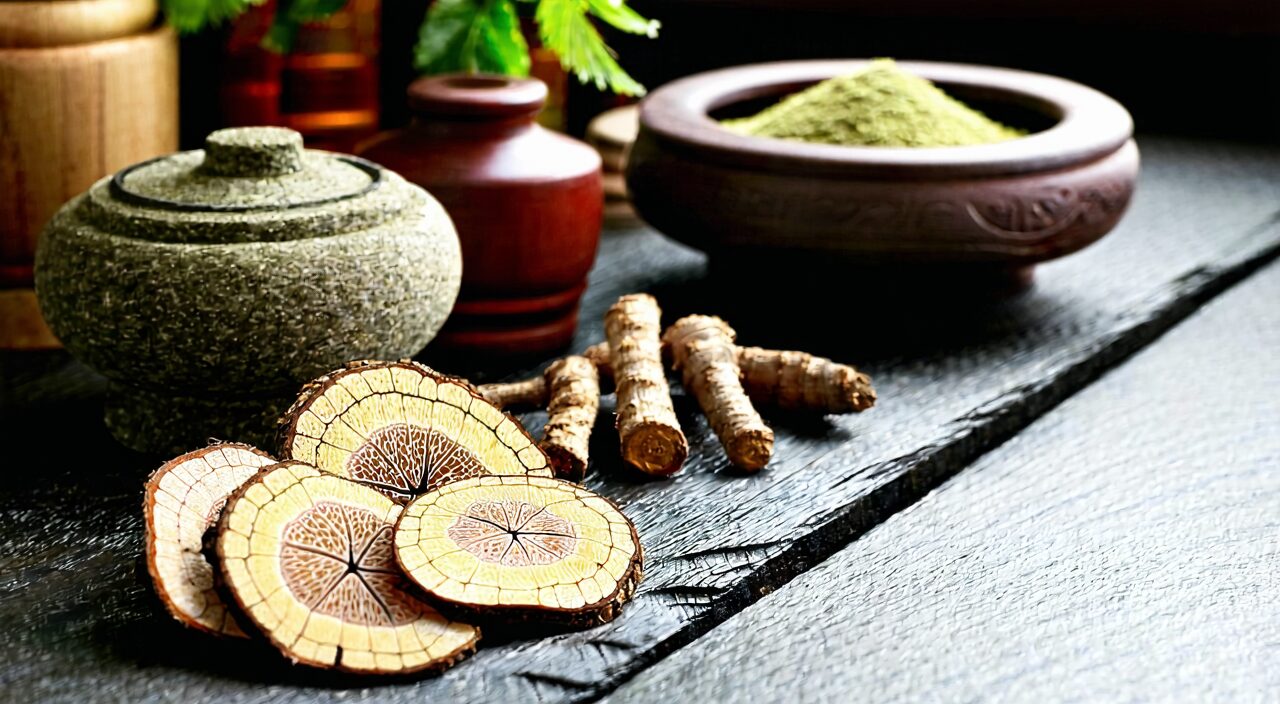
The structure of a formula often directly indicates its direction of action. Danggui Niantong Tang is composed of multiple herbs, typically including the following. Specific dosages must be adjusted by a professional based on individual conditions, and only the common composition is listed here:
| Herb | Brief Traditional Action |
|---|---|
| Dang Gui (Angelica sinensis) | Nourishes and moves blood, regulates menstruation, relieves pain |
| Qiang Huo (Notopterygium incisum) | Dispels wind, overcomes dampness, alleviates joint pain |
| Fang Feng (Saposhnikovia divaricata) | Dispels wind, releases the exterior, overcomes dampness, stops pain |
| Sheng Ma (Cimicifuga foetida) | Releases the exterior, vents pathogens, clears heat, resolves toxicity |
| Zhu Ling (Polyporus umbellatus) | Promotes urination and leaches out dampness |
| Ze Xie (Alisma orientale) | Promotes urination, leaches out dampness, drains heat |
| Yin Chen (Artemisia capillaris) | Clears and drains damp-heat, abates jaundice |
| Huang Qin (Scutellaria baicalensis) | Clears heat, dries dampness, drains fire, resolves toxicity |
| Ge Gen (Pueraria lobata) | Releases muscles, abates heat, generates fluids, quenches thirst |
| Bai Zhu (Atractylodes macrocephala) | Strengthens the spleen, boosts qi, dries dampness, promotes water metabolism |
| Cang Zhu (Atractylodes lancea) | Dries dampness, strengthens the spleen, dispels wind, scatters cold |
| Ku Shen (Sophora flavescens) | Clears heat, dries dampness, dispels wind, kills parasites |
| Zhi Mu (Anemarrhena asphodeloides) | Clears heat, drains fire, nourishes yin, moistens dryness |
| Gan Cao (Glycyrrhiza uralensis) | Harmonizes the properties of other herbs |
Looking at the composition, the formula gathers wind-dispelling and pathogen-scattering herbs such as Qiang Huo, Fang Feng, and Sheng Ma, while simultaneously using Yin Chen, Huang Qin, Ku Shen, Zhu Ling, and Ze Xie to clear and drain damp-heat. With Dang Gui to nourish and move blood, Bai Zhu and Cang Zhu to strengthen the spleen and dry dampness, and Zhi Mu to clear heat and nourish yin, the overall strategy is to “disperse damp-heat from both the upper and lower body” while scattering wind pathogens.
Traditional Benefits and Actions
From the perspective of traditional Chinese medicine, the benefits of Danggui Niantong Tang can be summarized as follows:
- Clears heat and drains dampness: Targets damp-heat accumulation, often presenting with a yellow, greasy tongue coating, dark, scanty urine, and a heavy body sensation. Herbs such as Yin Chen, Huang Qin, Ku Shen, Zhu Ling, and Ze Xie assist in clearing and draining damp-heat.
- Dispels wind and relieves pain: Herbs such as Qiang Huo, Fang Feng, and Sheng Ma are traditionally used for limb joint pain caused by wind pathogens, especially when pain is in the upper body or migratory.
- Harmonizes blood and unblocks collaterals: Dang Gui nourishes and moves blood, and when combined with wind-dispelling herbs, it helps alleviate pain and discomfort caused by wind-damp-heat pathogens obstructing the meridians.
Due to these actions, the formula is traditionally used in clinical settings for damp-heat descending or damp-heat lodged in the joints. It can address not only red, swollen, hot, painful joints but may also be beneficial for heavy lower limbs, swollen, hot feet and knees. It should be noted that these are traditional understandings, and actual results vary from person to person.
People Who May Be Suitable for Danggui Niantong Tang

When discussing “who is suitable for,” extra caution is needed. Everyone’s constitution is different, and one should never self-diagnose simply based on patterns. The following lists some common presentations from the perspective of traditional pattern identification, for understanding purposes only. Practical application requires professional judgment:
- Damp-heat impediment pain: Joint pain with a local burning sensation, redness and swelling that may worsen with heat and slightly improve with coolness. Often accompanied by dry mouth, bitter taste, red tongue with a yellow greasy coating, dark urine, and sticky, unformed stools.
- Damp-heat descending: Heaviness, soreness, and swelling in the lower limb joints or muscles, hot and swollen feet and knees, or dampness in the genital area, eczema, and itching, sometimes affecting walking.
- Generalized heaviness and fatigue: A persistent sensation of bodily heaviness, reluctance to move, and a fuzzy, unclear head, especially in humid, hot weather.
- Wind pathogen mixed with dampness and heat: Unfixed, migratory pain accompanied by slight aversion to wind or a feeling of fever, with red, swollen joints.
Traditionally, Danggui Niantong Tang is more geared towards damp-heat excess patterns. If the typical presentation shows more “cold signs,” it is not appropriate. In contrast, Qiang Huo Sheng Shi Tang is more suited for wind-damp in the exterior with general body aches but not clearly hot or cold; Long Dan Xie Gan Tang focuses more on liver-gallbladder damp-heat descending, often with rib pain, bitter taste, and prominent genital symptoms. These are further compared later.
Contraindicated Populations to Note
Every formula has its boundaries, and Danggui Niantong Tang is no exception. The following situations generally do not warrant rash use:
- Cold-damp impediment pain: If joint pain is cold, worsens with cold, improves with warmth, without local redness or heat, and the tongue is pale with a white greasy coating, this generally belongs to cold-damp syndrome. Danggui Niantong Tang tends to clear heat, which does not match cold-damp patterns and may easily injure yang qi if misused. Cold-damp problems usually require warming and unblocking formulas, such as Du Huo Ji Sheng Tang when the pattern is appropriate.
- Significant qi and blood deficiency: A sallow complexion, pale lips and nails, fatigue, shortness of breath, dizziness, and palpitations, with joint pain that is mostly sore and weak without obvious redness, swelling, heat, or pain. Such individuals need primarily qi and blood supplementation; simple heat-clearing, damp-draining, and wind-dispelling may further deplete qi and blood.
- Yin deficiency with internal heat: Although there is heat, it is mainly deficiency heat, presenting with dry mouth and throat, heat in the palms and soles, night sweats, and a red tongue with little coating. Danggui Niantong Tang contains many wind-dispelling and damp-drying herbs, which may further consume yin fluids.
- Special physiological periods: Such as pregnancy, breastfeeding, or menstruation, during which the body’s condition requires extra prudence. Any herbal use must be under the guidance of an experienced physician and should not be self-prescribed.
- People with severe chronic diseases or taking other medications: The complexity of their body is higher, and the choice of any formula requires systematic pattern identification to avoid interference.
If joint pain is severe, persistent, and not relieved, or accompanied by fever, rash, significant swelling, limited mobility, or simultaneous chest tightness, palpitations, or breathing difficulties, seek medical attention promptly rather than trying formulas on your own.
Differences from Similar Formulas
Many people, when learning about Danggui Niantong Tang, also encounter Du Huo Ji Sheng Tang, Qiang Huo Sheng Shi Tang, Long Dan Xie Gan Tang, and Fang Ji Huang Qi Tang. These formulas all involve “dampness” or “pain,” but the directions differ markedly.
Danggui Niantong Tang vs. Du Huo Ji Sheng Tang
Du Huo Ji Sheng Tang leans towards supplementing the liver and kidneys, qi and blood, while simultaneously dispelling wind-damp and stopping impediment pain. It is often used for chronic impediment patterns with liver-kidney insufficiency and qi-blood deficiency complicated by wind-cold-damp, characterized by continuous dull pain, sore and weak lower back and knees, aversion to cold, preference for warmth, and a pale tongue with a white coating. Danggui Niantong Tang, on the other hand, is geared towards clearing and draining damp-heat, addressing damp-heat excess patterns with red, swollen, hot, painful joints and a red tongue with a yellow greasy coating. Overall, one supplements and the other clears, one is warming and the other cooling—their directions are opposite.
Danggui Niantong Tang vs. Qiang Huo Sheng Shi Tang
Qiang Huo Sheng Shi Tang primarily dispels wind and overcomes dampness and is often used for wind-damp in the exterior. Typical presentations include pain in the shoulders, back, head, and body, without clear cold or heat signs, often with mild aversion to wind and cold and a white or slightly greasy coating. Its heat-clearing and damp-draining strength is weaker, focusing more on dispersing external dampness. Danggui Niantong Tang focuses more on clearing internal damp-heat and heat pathogens. If the pain is mainly in the shoulders, back, and upper body, without obvious redness, swelling, heat, or pain, and the disease location is more superficial, the direction of Qiang Huo Sheng Shi Tang is usually considered.
Danggui Niantong Tang vs. Long Dan Xie Gan Tang
Long Dan Xie Gan Tang is extremely bitter and cold in nature, with its core action being to drain liver-gallbladder excess fire and damp-heat. Typical manifestations include headache, bitter taste, rib pain, deafness, ear swelling, or damp-heat descending causing genital eczema, painful urination, etc. Although both can address damp-heat descending, Long Dan Xie Gan Tang targets the liver meridian’s pathway and is usually considered when joint problems are not prominent but liver-gallbladder damp-heat is obvious. Danggui Niantong Tang is more focused on joint and muscle damp-heat impediment pain.
Danggui Niantong Tang vs. Fang Ji Huang Qi Tang
Fang Ji Huang Qi Tang belongs to the category of formulas that boost qi, dispel wind, strengthen the spleen, and promote water metabolism. It is suitable for exterior deficiency with failure to secure the exterior, complicated by wind-damp causing edema, heavy body, sweating, and aversion to wind, usually without red, swollen joints. It tends toward deficiency and water-damp retention, while Danggui Niantong Tang is clearly biased toward excess, heat, and pain—their deficiency-excess attributes are different.
These comparisons show that the specific choice of direction must return to analysis of individual constitution and symptom presentations. One cannot simply apply a formula based on “having dampness” or “having pain.”
Summary
Danggui Niantong Tang is one of the important traditional Chinese formulas for damp-heat type joint pain. Its core strategy is to clear heat, drain dampness, dispel wind, and relieve pain, with typical features including red, swollen, hot, painful joints, generalized heaviness, and a yellow greasy tongue coating. In contrast, cold-damp impediment pain, qi and blood deficiency, or yin deficiency with internal heat are generally not suitable; misuse may instead create new imbalances.
Understanding its differences from Du Huo Ji Sheng Tang, Qiang Huo Sheng Shi Tang, Long Dan Xie Gan Tang, and Fang Ji Huang Qi Tang helps more accurately grasp the position of “damp-heat” in impediment patterns. However, these understandings all stem from traditional experience. When actually facing health issues, each person’s situation is far more complex than in books. Always consult a qualified local TCM professional and make judgments only after comprehensive diagnosis.