
Who Should Take Di Huang Yin Zi? Composition, Effects, and Contraindications

When exploring classic formulas in traditional Chinese medicine (TCM), many people encounter the name “Di Huang Yin Zi” (Rehmannia Yin Zi). It is not as well-known as Liu Wei Di Huang Wan (Six-Ingredient Rehmannia Pill), nor is it as widely discussed for tonifying kidney yang as Jin Gui Shen Qi Wan (Kidney Qi Pill from the Golden Cabinet). Consequently, people often ask: Who exactly is Di Huang Yin Zi suitable for? What are the characteristics of its composition? And how does it differ from common kidney-tonifying formulas?
This article will sort through these questions from the perspective of traditional Chinese medicine, helping readers establish a relatively clear understanding.
What kind of formula is Di Huang Yin Zi?
Di Huang Yin Zi first appeared in the Song dynasty text “Sheng Ji Zong Lu” (Comprehensive Recording of Divine Assistance). In traditional formula classification, it is often categorized under “wind-treating formulas” or “tonifying formulas,” but its actual action is more complex than simple tonification or wind-dispelling.
Traditional Chinese medicine often interprets this formula from the perspective of “lower origin deficiency and weakness with turbid phlegm ascending.” It is believed to simultaneously nourish kidney yin, tonify kidney yang, and open the orifices to resolve phlegm.
For this reason, Di Huang Yin Zi has historically been used to address a rather specific pattern—”yin fei” (aphasia and paralysis).
- “Yin” refers to a stiff tongue with inability to speak.
- “Fei” refers to disabled feet with inability to walk.
This condition is not simply an external invasion of wind evil or isolated kidney deficiency; rather, it involves dual deficiency of kidney yin and yang, with floating deficient yang, complicated by turbid phlegm obstructing the orifices.
This makes Di Huang Yin Zi distinctly different in structure and approach from formulas that only supplement yin, only supplement yang, or only resolve phlegm.
The Composition and Structural Characteristics of Di Huang Yin Zi
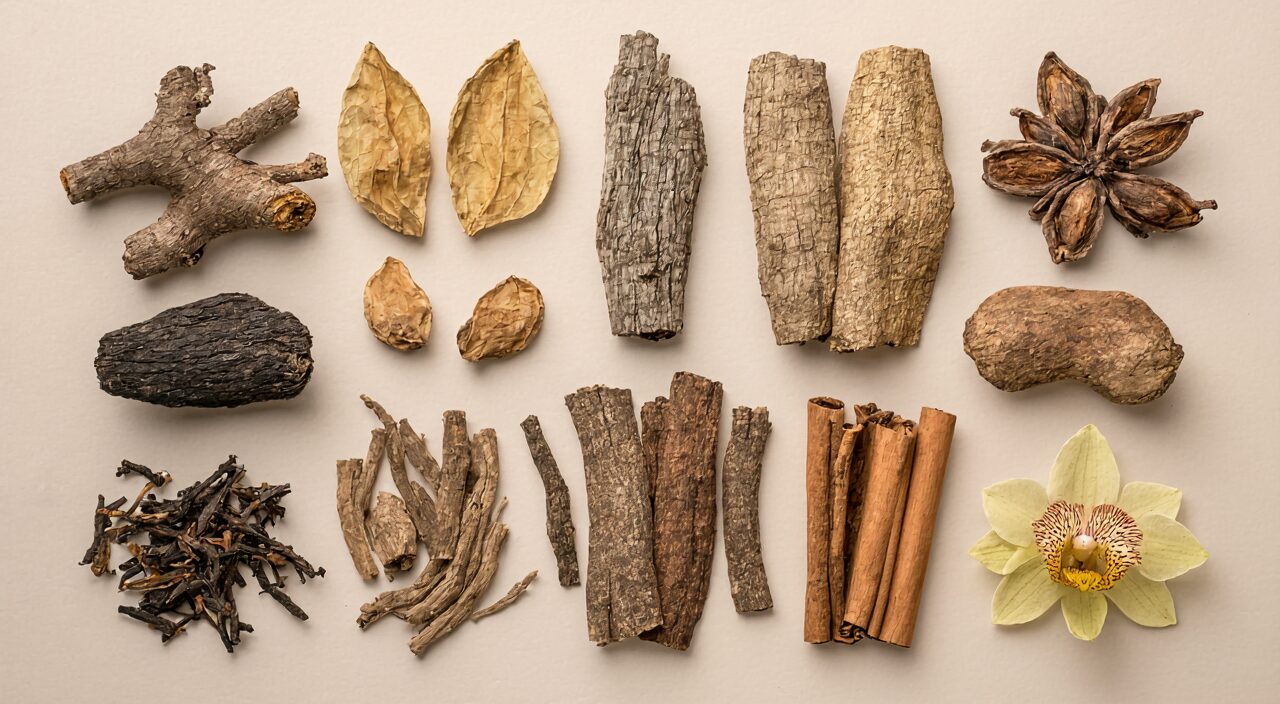
Looking at the formula’s composition, Di Huang Yin Zi selects medicinals that address multiple aspects including yin, yang, phlegm, and the orifices. Traditionally, its commonly used herbs and their action directions can be summarized as follows:
| Medicinal | Traditional Action Direction |
|---|---|
| Prepared Rehmannia (Shu Di Huang) | Nourishes kidney yin, replenishes essence and marrow |
| Morinda Root (Ba Ji Tian) | Warms kidney yang, also strengthens sinews and bones |
| Cornus (Shan Zhu Yu) | Tonifies liver and kidney, astringes and consolidates |
| Dendrobium (Shi Hu) | Nourishes yin fluids, generates body fluids and moistens dryness |
| Cistanche (Rou Cong Rong) | Warms yang and boosts essence, moistens the intestines |
| Prepared Aconite (Fu Zi) | Warms and strengthens kidney yang, dispels cold and assists yang |
| Cinnamon Bark (Rou Gui) | Warms and unblocks blood vessels, assists yang to transform qi |
| Schisandra (Wu Wei Zi) | Astringes the lungs and nourishes the kidneys, calms the heart and spirit |
| Poria (Bai Fu Ling) | Strengthens the spleen and leaches out dampness, also helps resolve phlegm |
| Ophiopogon (Mai Men Dong) | Nourishes lung and stomach, clears the heart and calms the spirit |
| Acorus (Shi Chang Pu) | Opens the orifices and sweeps away phlegm, calms the spirit and unblocks orifices |
| Polygala (Yuan Zhi) | Calms the spirit and benefits wisdom, resolves phlegm and opens the orifices |
| Mint (Bo He) | Clears and benefits the head and eyes, soothes constrained heat |
| Fresh Ginger, Jujube (Sheng Jiang, Da Zao) | Harmonize the spleen and stomach, protect the middle burner |
The formula contains yin-nourishing medicinals such as prepared rehmannia, cornus, dendrobium, and ophiopogon, as well as yang-warming tonifying herbs like morinda, cistanche, aconite, and cinnamon. It also incorporates acorus, polygala, and poria to resolve phlegm and open the orifices.
Fresh ginger and jujube serve as guiding medicinals, intended to protect the spleen and stomach so that the formula tonifies without causing stagnation. This combination of “seeking yang within yin and seeking yin within yang” along with opening orifices and resolving phlegm is what sets Di Huang Yin Zi apart from general kidney-tonifying formulas.
Traditionally, What Is It Used For?
In historical records, Di Huang Yin Zi is primarily directed at the complex manifestations caused by “lower origin deficiency and weakness with turbid phlegm ascending,” rather than isolated kidney deficiency or phlegm patterns alone. Typical reference directions include:
- Tongue stiffness with inability to speak, or hesitant, difficult speech
- Feet disabled with inability to walk, or weakness and lack of strength in both lower limbs
- Dry mouth without desire to drink, or drinking only small amounts
- Concurrent deficiency signs such as aversion to cold, soreness and weakness of the lower back and knees
- Tongue body often pale and enlarged, with a slippery or moist white coating; pulse commonly deep, thready, and weak
These manifestations do not necessarily all appear simultaneously, but overall they present a pattern of “excess above and deficiency below”: the lower body is primarily deficient, with symptoms like weak lower back and knees and fear of cold; the upper part is disturbed by deficient yang mixed with turbid phlegm ascending, leading to tongue stiffness, speech difficulties, etc. Such a pattern is not simple in traditional Chinese medicine theory and requires careful differentiation.
Characteristics of Populations Who Might Be Suited
Based on constitutional and symptomatic characteristics, the following types of situations might make Di Huang Yin Zi worth considering as a direction for understanding, but whether it is truly suitable must be determined by a qualified TCM professional through comprehensive assessment using the four diagnostic methods:
- Individuals with soreness and weakness of the lower back and knees and marked aversion to cold
Persistent soreness and weakness in the lower back and knees, greater sensitivity to cold than average, especially coldness below the waist, along with low spirits — this suggests possible deficiency of the lower origin.
- Individuals with speech difficulties, tongue stiffness, or a tendency toward unclear speech
Not directly caused by acute cerebrovascular incidents, but gradually developing difficulty speaking and a stiff tongue root—traditionally, this raises the possibility of turbid phlegm obstructing the orifices.
- Individuals with profuse phlegm but no externally-contracted cough
Frequent phlegm in the throat without obvious fever, chills, or other external invasion signs, and a slippery or sticky white tongue coating — this may relate to internal generation of turbid phlegm.
- Individuals with dry mouth but no desire to drink much water
Mouth dryness with little desire to drink, or discomfort after drinking — in TCM this often indicates not simple yin deficiency, but a mixture of phlegm-dampness or failure of yang to transform qi.
It must be emphasized that these characteristics only provide an observational direction; one should never self-match and conclude that “Di Huang Yin Zi is suitable for me.” In clinical practice, mixed deficiency-excess conditions are quite complex. Some people may seem to fit the description but actually have patterns like damp-heat accumulation, phlegm-fire harassing the heart, or yin deficiency with fire hyperactivity, which are completely unsuitable for Di Huang Yin Zi.
Situations Where It Is Unsuitable or Requires Extra Caution
Every formula has its contraindications, and Di Huang Yin Zi is no exception. The following situations are generally unsuitable or require extreme caution:
- Those with internal exuberant damp-heat
If the tongue body is reddish with a thick, greasy yellow coating, accompanied by bitter taste, dark yellow urine, sticky and incomplete bowel movements, and other damp-heat signs, Di Huang Yin Zi’s warm, tonifying, and cloying nature may exacerbate dampness and heat, complicating the situation.
- Those with full-heat pattern or yin deficiency with fire hyperactivity
If there are signs like facial flushing, irritability, heat in the palms and soles, night sweats, red tongue with little coating, and a thready rapid pulse — indicating clear upflaring of deficient fire or full heat — this kind of formula that combines warming yang and benefiting yin is unsuitable.
- Those with pronounced phlegm-heat
If phlegm is yellow and thick, with bitter taste, dry throat, chest oppression and feverish sensation, indicating phlegm-heat or phlegm-fire pattern, formulas containing warm and drying medicinals like aconite and cinnamon should be avoided.
- Those without professional pattern differentiation
It is not recommended to self-prescribe Di Huang Yin Zi based on only one symptom or a constitution test, especially obtaining and decocting the herbs oneself. Incorrect pattern differentiation may delay or worsen the condition.
- Pregnant women, breastfeeding women, and children
These special physiological stages respond differently to medications and must only be considered under strict medical guidance; never use on your own.
- During colds, fevers, or acute illnesses
At such times the focus should be on expelling pathogens; complex tonifying formulas should not be used prematurely.
If severe, long-term recurrent tongue stiffness with inability to speak, difficulty walking, or accompanying obvious chest tightness, palpitations, shortness of breath, severe headache, persistent vomiting, black stools, unexplained weight loss, etc., occur, one should first seek help from medical professionals rather than considering which formula to use.
Differences Between Di Huang Yin Zi and Several Common Formulas
To better understand the positioning of Di Huang Yin Zi, we can compare it with several more familiar formulas. The following is based solely on traditional formula theory; actual use must follow medical advice.
Comparison with Jin Gui Shen Qi Wan
- Jin Gui Shen Qi Wan: From the “Jin Gui Yao Lue” (Essential Prescriptions of the Golden Cabinet), it adds aconite and cinnamon twig to the base of Liu Wei Di Huang Wan, primarily warming kidney yang and transforming qi to move water. It is commonly used for kidney yang insufficiency leading to cold pain in the lower back and knees, urinary difficulty or edema, aversion to cold, and cold extremities.
- Di Huang Yin Zi: Although it also uses aconite and cinnamon to warm yang, the key difference is that it simultaneously nourishes kidney yin and opens the orifices to resolve phlegm, characterized by “dual supplementation of yin and yang and simultaneous regulation of phlegm and orifices.”
If there is only yang deficiency with water-dampness, without turbid phlegm obstructing the orifices or marked yin deficiency signs, the choice between these two would differ fundamentally.
Comparison with Liu Wei Di Huang Wan
- Liu Wei Di Huang Wan: Predominantly nourishes kidney yin, commonly used for kidney yin deficiency causing soreness and weakness of the lower back and knees, dizziness, tinnitus, night sweats, heat in the palms and soles, dry mouth and throat, etc. It has virtually no warming yang or resolving phlegm action.
- Di Huang Yin Zi: While it also nourishes yin, it simultaneously includes yang-warming medicinals and can dispel phlegm to open the orifices, targeting a far more complex state of “dual yin-yang deficiency complicated by phlegm.”
Therefore, someone primarily with yin deficiency, without cold signs or phlegm turbidity, is not suitable for Di Huang Yin Zi.
Comparison with Bu Yang Huan Wu Tang
- Bu Yang Huan Wu Tang: Uses the method of supplementing qi, invigorating blood, and unblocking collaterals. It is commonly used for post-stroke sequelae due to qi deficiency and blood stasis, such as hemiplegia, facial deviation, slurred speech, and drooling.
- Di Huang Yin Zi: Also involves speech difficulties and mobility issues, but it targets “lower origin deficiency and weakness with turbid phlegm ascending”—a pathological mechanism entirely different from qi deficiency and blood stasis.
If a person with speech difficulties also has obvious fatigue, a dark purple tongue or ecchymoses, and a choppy pulse—signs of qi deficiency and blood stasis—it would be inappropriate to consider Di Huang Yin Zi.
Comparison with Er Chen Tang
- Er Chen Tang: A famous phlegm-resolving formula, mainly drying dampness and resolving phlegm, regulating qi and harmonizing the middle. It is commonly used for damp-phlegm patterns such as cough with copious easily expectorated phlegm, chest and diaphragm fullness, nausea, and vomiting. It does not supplement yin or yang.
- Di Huang Yin Zi: Its phlegm-resolving and orifice-opening herbs are used on the foundation of tonifying the lower origin, targeting a state where both “deficiency” and “phlegm” coexist.
If it is simply phlegm-dampness without deficiency, then Er Chen Tang is the more direct direction, without needing to resort to such a complex formula that tonifies the kidneys and opens the orifices.
Overall, the core difference between Di Huang Yin Zi and these formulas lies in the pathological mechanism level: it addresses the coexistence of “deficiency” and “phlegm,” with deficiency at the root of the kidneys and turbid phlegm clouding the clear orifices. Other formulas may lean toward supplementing yang, supplementing yin, dispelling stasis, or resolving phlegm, but it is difficult for them to cover all these dimensions simultaneously. It is precisely for this reason that this formula must be applied with exceptional prudence.
Summary
Di Huang Yin Zi is not a formula you can casually select by simply matching symptoms. It is a representative formula in traditional Chinese medicine that simultaneously cares for kidney yin and kidney yang while opening the orifices and resolving phlegm. It is suited to complex conditions with mixed deficiency and excess, such as lower origin deficiency combined with ascending turbid phlegm leading to stiff tongue and inability to speak, lower limb weakness, cold soreness of the lower back and knees, and dry mouth without desire to drink.
For those seeking to understand TCM health regulation approaches, the value of understanding Di Huang Yin Zi lies in appreciating the importance of “pattern differentiation.” The same symptoms of lower back and knee soreness and speech difficulty may have completely different underlying causes, and the corresponding approach might point to Bu Yang Huan Wu Tang, Er Chen Tang, or Jin Gui Shen Qi Wan, rather than Di Huang Yin Zi.
This article is for educational reference only and cannot replace professional diagnosis or treatment advice. If you indeed have recurrent, severe, or progressive related symptoms, you should promptly consult a physician or TCM professional, who can provide individualized assessment based on the four diagnostic methods.