
Ding Chuan Tang: Who Is It Suitable For? Composition, Benefits, and Contraindications

Many people experience recurrent cough and asthma during seasonal changes or after a cold; especially when living abroad, changes in environment and diet can further complicate respiratory reactions.
When simple measures fail to provide relief, some people hope to find a regulating approach from traditional Chinese medicine (TCM) that is more suited to their individual constitution. Among many classic formulas, Ding Chuan Tang is a frequently mentioned name.
This article will introduce it from the perspectives of composition, traditional effects, suitable directions, and contraindications, to help you determine which types of conditions it may generally suit, as well as its differences from similar formulas such as Su Zi Jiang Qi Tang (Perilla Fruit Decoction to Direct Qi Downward).
TCM Understanding of Ding Chuan Tang
In TCM, when evaluating cough and asthma, the focus is not solely on the “qi constriction” itself; rather, it differentiates whether there are patterns such as unresolved external pathogens, internal generation of phlegm-dampness, failure of Lung qi to descend, or internal heat stagnation.
The traditional thinking behind Ding Chuan Tang revolves around “diffusing the Lungs and descending qi, clearing heat and transforming phlegm,” and it particularly addresses:
- External cold that has partially entered the interior and transformed into heat;
- Or pre-existing phlegm-heat in the body with a new contraction of wind-cold.
Under these conditions, a complex scenario often forms: unresolved exterior pathogens, upward counterflow of Lung qi, and exuberant phlegm-heat in the interior.
This type of cough and asthma is often not purely cold or purely heat, but a mixture of cold and heat, dominated by phlegm-heat obstructing the Lungs and the Lung losing its depurative descending function. Traditionally, the direction addressed by Ding Chuan Tang is not suitable for all types of asthma, so careful identification is needed before use.
Composition of Ding Chuan Tang and Its Combination Logic
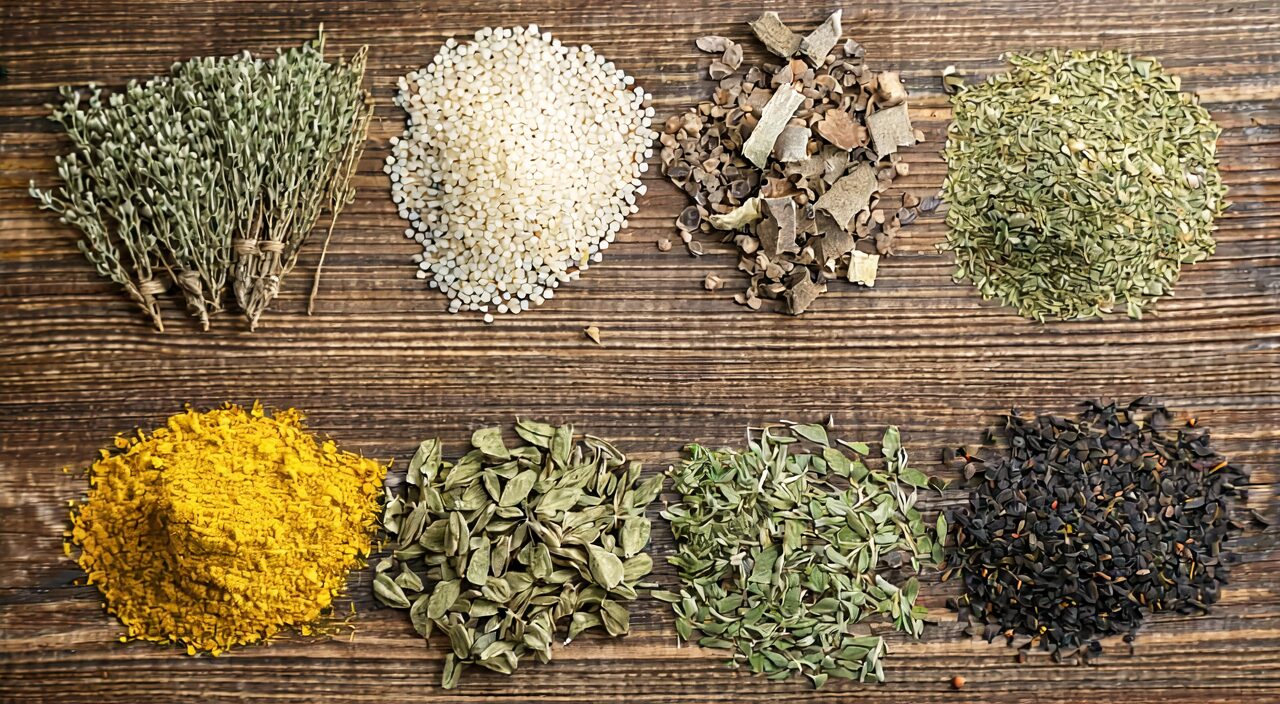
Understanding a formula often begins with its herb combination. Ding Chuan Tang is composed of multiple Chinese herbs, each with a clear function, working together to diffuse and descend in coordination while simultaneously clearing and transforming.
The following is the traditional reference composition of Ding Chuan Tang (the dosages are not fixed; they need to be adjusted by a TCM practitioner based on individual conditions):
| Herb | Traditional Reference Dosage Range | Primary Actions |
|---|---|---|
| Ephedra (Ma Huang) | 6-10g | Diffuses the Lungs, disperses cold, and relieves wheezing; opens the exterior to release lingering external pathogens. |
| Ginkgo nut (Bai Guo) | 6-10g | Transforms phlegm, settles wheezing, and astringes Lung qi to prevent excessive dispersion from Ephedra. |
| Mulberry bark (Sang Bai Pi) | 10-15g | Drains the Lungs, clears heat, promotes urination, and reduces phlegm; targets Lung-heat cough and asthma. |
| Scutellaria (Huang Qin) | 10-15g | Clears and drains Lung heat, dries dampness, and transforms phlegm; works with Mulberry bark to clear internal heat. |
| Coltsfoot flower (Kuan Dong Hua) | 10-15g | Moistens the Lungs, directs qi downward, stops coughing, and transforms phlegm; alleviates cough and rebellious qi. |
| Apricot kernel (Xing Ren) | 6-10g | Directs qi downward, stops coughing, and calms wheezing; assists in descending Lung qi. |
| Perilla seed (Su Zi) | 10-15g | Directs qi downward, transforms phlegm, stops coughing, and calms wheezing; strengthens the power to subdue rebellious qi. |
| Pinellia (Ban Xia) | 6-10g | Dries dampness, transforms phlegm, directs rebellious qi downward, and stops vomiting; reduces the formation of phlegm-dampness. |
| Licorice (Gan Cao) | 3-6g | Harmonizes the other herbs while also moistening the Lungs and stopping cough. |
In this formula, Ephedra diffuses the Lungs and disperses cold, while Ginkgo nut astringes the Lungs and settles wheezing—one disperses, one restrains—so that Lung qi diffuses and descends appropriately. Mulberry bark and Scutellaria clear and drain Lung heat; Coltsfoot flower, Apricot kernel, Perilla seed, and Pinellia transform phlegm and direct qi downward; Licorice harmonizes the formula.
The overall thinking is not simply to suppress cough, but rather to regulate the qi mechanism of the Lungs and clear phlegm-heat, allowing cough and asthma to gradually subside.
Traditional Effects and Suitable Indications of Ding Chuan Tang

From the perspective of effects, Ding Chuan Tang mainly works through “diffusing the Lungs and descending qi, clearing heat and transforming phlegm.” Traditionally, it is often used for wheezing and coughing caused by phlegm-heat internal oppression and failure of Lung qi to descend, which typically presents with the following manifestations:
- Cough and asthma with profuse sputum that is yellowish, thick, sticky, and difficult to expectorate;
- Chest tightness and discomfort, more pronounced when coughing or lying flat;
- Little or no obvious fever, or only mild fever, but a sensation of chest heat and irritability, and dry mouth;
- Tongue body tending toward red with a yellow, greasy coating; pulse slippery or rapid.
Some people may be in the later stages of a cold, where exterior symptoms have diminished and internal heat is gradually surfacing, with the main complaints being yellow sputum, wheezing, and chest tightness. In addition, for respiratory conditions such as chronic bronchitis or asthma that match the above characteristics of phlegm-heat obstructing the Lungs, Ding Chuan Tang is traditionally considered as one of the therapeutic directions.
It should be particularly noted that this does not mean Ding Chuan Tang is effective for everyone; suitability must still be determined by a professional based on detailed symptoms and individual constitutional variations.
Who Should Not Use Ding Chuan Tang
Ding Chuan Tang is not a universal formula for all types of cough and asthma. The following groups or conditions are generally not suitable:
- Pure deficiency-type wheezing: If the wheezing is primarily shortness of breath, difficulty inhaling, worsened after activity, accompanied by fatigue, pale complexion, easy sweating, and little or thin-clear sputum, this mostly belongs to Lung-Kidney qi deficiency or kidney failing to grasp qi, which is not within the scope of Ding Chuan Tang. Traditionally, the approach tends more toward tonifying the Lung and Kidney, grasping qi and calming wheezing.
- Cold-fluid cough and asthma: Manifesting as cough, asthma, thin-white copious sputum, aversion to cold, a cold sensation in the back, and aggravation with cold exposure. This type of cough and wheezing, primarily due to internal stagnation of cold pathogens, should be treated by dispersing cold and transforming fluids. The Lung-clearing and phlegm-transforming direction of Ding Chuan Tang does not match.
- Yin deficiency dry cough: Dry cough with little sputum, possibly blood-tinged sputum, dry throat and mouth, heat in the palms and soles, red tongue with little or no coating; this belongs to yin-fluid insufficiency with deficient fire flaring upward. Ding Chuan Tang, which focuses on diffusing, descending, clearing, and transforming, is inappropriate.
- Pregnant women, breastfeeding women, and children: For these special populations, any formula use must be under the guidance of an experienced TCM practitioner and should never be self-administered.
- Those with allergic constitution or known intolerance to any of the herbs: Inform the practitioner of the situation to avoid potential risks.
Differences Between Ding Chuan Tang and Similar Formulas
Although also addressing cough, asthma, or phlegm patterns, Ding Chuan Tang is easily mentioned alongside formulas such as Su Zi Jiang Qi Tang, Ma Xing Shi Gan Tang, Xiao Qing Long Tang, and Er Chen Tang. While they all involve the respiratory system, their respective focuses are distinctly different.
Difference from Su Zi Jiang Qi Tang
Su Zi Jiang Qi Tang focuses on “descending qi, transforming phlegm, warming the Kidneys, and grasping qi.” Traditionally, it is suitable for wheezing characterized by upper excess and lower deficiency—namely, exuberant phlegm-dampness and rebellious qi with cough and asthma above, and Kidney yang deficiency with soreness and coldness in the low back and knees below. The pathogenesis generally involves a mixture of deficiency and excess, tending toward cold-phlegm.
In contrast, Ding Chuan Tang targets phlegm-heat obstructing the Lungs, leaning toward excess and heat. One tends toward warming and descending, the other toward clearing and diffusing—opposite directions. If the condition is actually deficiency-cold but a heat-clearing and wheezing-relieving formula is mistakenly used, it may damage yang qi.
Difference from Ma Xing Shi Gan Tang
Ma Xing Shi Gan Tang focuses on “acrid-cool out-thrusting, clearing the Lungs, and calming wheezing.” It is used when external pathogens have not been resolved and there is Lung-heat cough and asthma, typically presenting with fever, thirst, cough and wheezing, red tongue, and yellow coating.
Both formulas clear Lung heat, but Ma Xing Shi Gan Tang concentrates more on clearing and venting heat pathogens, while Ding Chuan Tang adds herbs that transform phlegm and direct qi downward, making it more suitable for cases with pronounced phlegm-heat binding and failure of Lung qi to descend.
Difference from Xiao Qing Long Tang
Xiao Qing Long Tang is a representative formula for “releasing the exterior, dispersing cold, warming the Lungs, and transforming thin mucus.” It is suitable for wheezing and cough due to external contraction of wind-cold with internal retained water-fluid, presenting with white, clear, thin sputum, aversion to cold, fever, absence of sweating, etc. Its pathological nature is cold, in stark contrast to the phlegm-heat addressed by Ding Chuan Tang.
If there is yellow sputum, chest tightness, and heat irritability but Xiao Qing Long Tang is used, it may instead exacerbate heat and damage fluids.
Difference from Er Chen Tang
Er Chen Tang is a basic phlegm-transforming formula, primarily “drying dampness, transforming phlegm, regulating qi, and harmonizing the middle.” Its medicinal nature is mild, and it targets cough with profuse sputum and stuffiness in the chest and diaphragm caused by spleen failing to transport and dampness accumulating into phlegm. However, it lacks the specific functions of calming wheezing and clearing Lung heat.
- If there is only profuse sputum and cough without obvious heat signs or wheezing, Er Chen Tang can be considered first.
- If the condition has progressed to wheezing, chest tightness, and yellow, thick, sticky sputum, one should consider incorporating methods to clear heat and descend qi. At this point, the direction of Ding Chuan Tang becomes more appropriate.
From the above comparison, it can be seen that when evaluating cough and asthma, TCM emphasizes differentiating cold, heat, deficiency, and excess, as well as the nature of the phlegm. The choice of formula direction must be based on a detailed pattern analysis rather than solely on the symptom of “cough and asthma.”
How to Understand the Timing for Using Ding Chuan Tang from a TCM Perspective

Ding Chuan Tang is not a daily health-preserving formula but rather a specialized regulating approach directed at specific pathological mechanisms. Traditionally, its use is often associated with the following characteristics:
- Stage of illness: Often appears after an external contraction of wind-cold, when exterior symptoms are not completely resolved but internal heat has already arisen, forming a pattern of cold wrapping fire or exuberant internal phlegm-heat. At this stage, dispersing cold alone may worsen internal heat, while only clearing interior heat may cause the exterior pathogen to sink inward; therefore, it is necessary to combine dispersion and astringing, and use both diffusing and descending simultaneously.
- Constitutional tendency: Those with a usual constitution of damp-heat, or whose diet tends toward spicy and rich flavors, are prone to internal phlegm-heat generation. After contracting an external pathogen, they are more likely to manifest the patterns suitable for Ding Chuan Tang.
- Symptom dynamics: Wheezing and cough primarily with difficulty exhaling, accompanied by wheezing sounds, copious and yellow sputum, or coughing up yellow, lump-like thick sputum in the morning, all indicate relatively pronounced phlegm-heat.
In any case, it is strongly recommended that before using any formula, a licensed TCM practitioner perform an individualized pattern differentiation through observation, listening, inquiry, and palpation. Do not self-prescribe based on a single symptom.
For overseas users with long-term, recurrent cough and asthma, or accompanied by warning signs such as chest tightness or pain, breathing difficulty, blood-tinged sputum, or progressive weight loss, please first seek examination and diagnosis from a local physician to rule out organic diseases before considering auxiliary regulating approaches.
Summary
Ding Chuan Tang is a traditional formula centered on diffusing the Lungs and descending qi, clearing heat and transforming phlegm. It may be more suitable for individuals with cough and asthma characterized by yellow sputum, chest tightness, marked Lung heat without obvious fever, targeting phlegm-heat obstructing the Lungs and failure of Lung qi to descend.
However, it is not suitable for conditions such as deficiency-type wheezing, cold-fluid cough and asthma, or yin-deficiency dry cough. Special populations like pregnant women and children need to exercise extra caution. Moreover, it has clear distinctions in terms of cold, heat, deficiency, and excess compared to formulas like Su Zi Jiang Qi Tang, Ma Xing Shi Gan Tang, Xiao Qing Long Tang, and Er Chen Tang.
The content of this article is for TCM knowledge popularization only and cannot replace professional diagnosis or treatment advice. If you wish to regulate respiratory issues through TCM, please be sure to consult a locally qualified TCM practitioner based on your individual constitution and detailed symptoms.