
Who Is Er Chen Tang Suitable For? Composition, Effects, and Contraindications

Many people have heard that Er Chen Tang can dissolve “excess dampness and phlegm” in the body, yet they are less clear about the specific signs it suits and what precautions should be taken. This article sorts out basic information about Er Chen Tang from a traditional Chinese medicine perspective. If you are concerned about problems such as phlegm-dampness, chest oppression, nausea, or a greasy tongue coating, it may serve as a direction for understanding.
Understanding Er Chen Tang from the Angle of “Internal Phlegm-Dampness Obstruction”

Traditional Chinese medicine often understands many chronic discomforts from the angle of “phlegm-dampness,” such as constantly feeling like there is something in the throat, heaviness of the body, abdominal distension after meals, and easy nausea.
Phlegm-dampness is not simply respiratory tract phlegm; it is a systemic metabolic tendency that affects the whole body. Er Chen Tang exactly addresses this perspective, mainly acting to dry dampness and transform phlegm, regulate qi and harmonize the middle, restoring the qi dynamic of the middle burner.
Composition of Er Chen Tang and the General Role of Each Ingredient
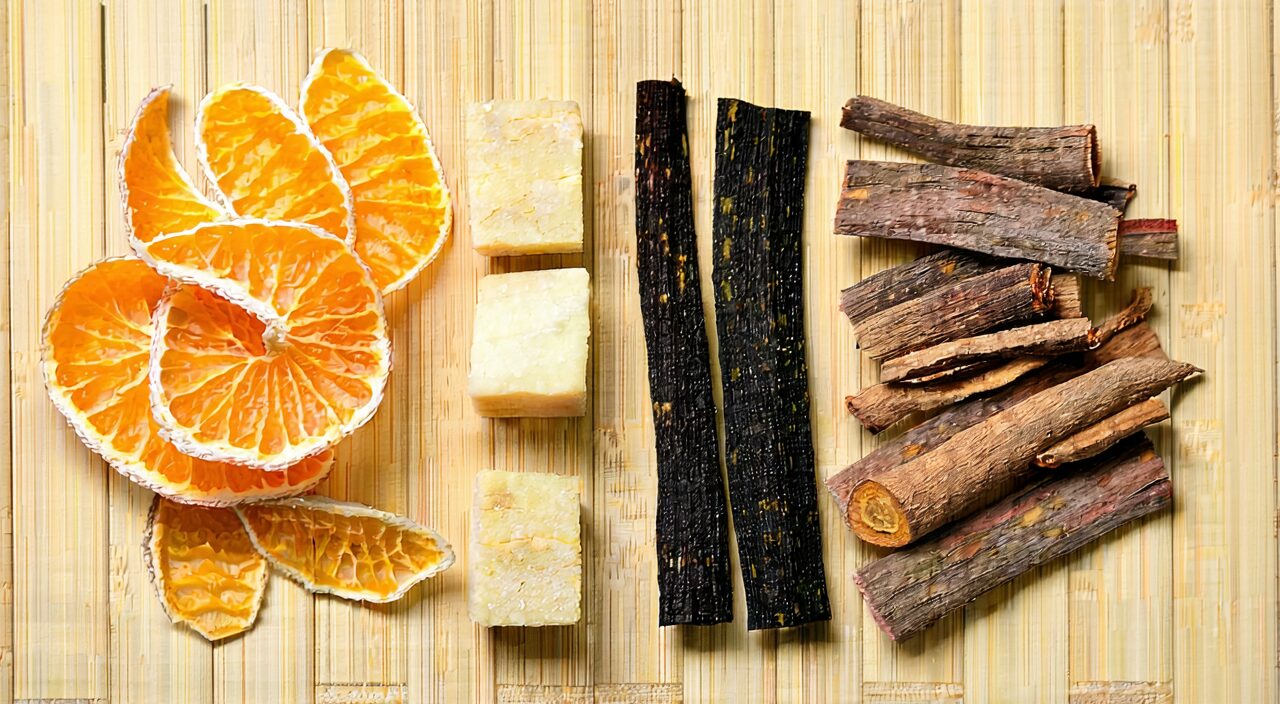
The classical source of Er Chen Tang is the Taiping Huimin Heji Ju Fang (Prescriptions from the Great Peace Imperial Pharmacy). It is composed of the following herbs:
| Herb | General Role |
|---|---|
| Ban Xia (Pinellia Rhizome) | Dries dampness and transforms phlegm, descends rebellious qi and stops vomiting; it is the core herb of this formula |
| Ju Hong (or Chen Pi, Tangerine Peel) | Regulates qi and dries dampness, helps the qi dynamic move and reduces phlegm-dampness accumulation |
| Fu Ling (Poria) | Strengthens the spleen and leaches out dampness, reducing the source of phlegm production |
| Zhi Gan Cao (Honey-fried Licorice Root) | Supplements the spleen and harmonizes the middle, moderates the other herbs |
| Sheng Jiang (Fresh Ginger Rhizome) – usually included | Assists Ban Xia in descending rebellious qi and transforming phlegm, while restraining its harsh nature |
| Wu Mei (Smoked Plum) – used in some variations | Astringes lung qi to prevent excessive dispersal from the drying herbs |
The idea behind this combination is to address already formed phlegm-dampness while also taking the spleen and stomach function into account, reducing the generation of phlegm-dampness at its source.
Effects and Therapeutic Directions of Er Chen Tang
From traditional formula theory, the main actions of Er Chen Tang focus on “drying dampness and transforming phlegm, regulating qi and harmonizing the middle.” Specifically, they may include the following directions:
- Helps improve cough due to phlegm-dampness obstructing the lung, with profuse white sputum that is easy to expectorate
- Regulates rebellious stomach qi caused by phlegm-dampness settling in the middle, such as nausea, vomiting of clear fluids
- Serves traditionally as a basic regulating approach for symptoms such as reduced appetite, post-meal fullness, and heavy body sensation caused by dampness trapping the spleen
- Used as an auxiliary reference for upward disturbance of turbid phlegm leading to heaviness of the head, dizziness, and palpitations
It should be noted that these are only traditional application directions. Whether they are suitable still needs to be determined based on individual constitution, symptoms, and professional recommendations.
Who Is Er Chen Tang Suitable For

From the perspective of TCM pattern differentiation, Er Chen Tang is more inclined to be suitable for people with “internal phlegm-dampness obstruction.” If you often experience one or more of the following sets of signs, you may fall within the range where Er Chen Tang is traditionally considered:
- Cough with profuse sputum that is white, thin-clear or sticky but not thick
- Sensation of oppression or distension in the chest or upper abdomen, easy nausea, morning retching
- Heaviness of the body, weakness in the limbs, a groggy and unclear head
- Tongue coating that is white and greasy or thick and greasy, sticky sensation or sweet taste in the mouth
- Loss of appetite, abdominal distension after eating, unformed or sticky stools
However, a single person rarely has all the signs at once; more often, a tendency toward phlegm-dampness is seen among several related symptom clusters. In such cases, Er Chen Tang may be mentioned as a basic regulating idea, but not necessarily as the first-choice formula.
Contraindications of Er Chen Tang and Who Should Not Use It
Any Chinese medicine formula has its scope of suitability, and Er Chen Tang is no exception. The following situations are generally unsuitable, or require modified combination under professional judgment:
- Yin deficiency with dry cough: dry cough without sputum, scanty sticky sputum, dry throat and mouth, red tongue with little coating. This pattern leans toward “insufficient body fluids,” and using dampness-drying herbs may worsen the discomfort.
- Obvious phlegm-heat: yellow thick sputum, dry and bitter mouth, red tongue with yellow greasy coating. This traditionally belongs to phlegm-heat, requiring clearing heat and transforming phlegm, not simply warming and drying.
- Body fluid damage or blood deficiency: for example, after a major illness, prolonged low-grade fever, obvious night sweating, dry skin, dry bound stools. Such people have lower tolerance for dampness-drying herbs.
- Special populations: pregnant women, breastfeeding women, infants and young children, and those with extremely weak constitutions. If consideration is necessary, it must be done strictly under professional guidance.
- People with bleeding tendency or taking anticoagulants: Ban Xia may affect blood coagulation; the doctor must be fully informed.
Furthermore, if there are symptoms such as long-term, recurrent, or worsening cough, chest oppression, palpitations, or unexplained weight loss, one should not rely on any formula on their own but should promptly consult a doctor to rule out other conditions.
Difference Between Er Chen Tang and Several Similar Formulas
In daily life, it is easy to confuse Er Chen Tang with Ping Wei San, Ban Xia Hou Po Tang, Liu Jun Zi Tang, and Shen Ling Bai Zhu San. Here is a brief explanation of their respective emphases:
- Ban Xia Hou Po Tang: primarily used for “plum-pit qi,” i.e., a sensation of something stuck in the throat that cannot be swallowed or spit out, often related to emotional stress. It has a stronger effect in regulating qi and resolving constraint. When phlegm-dampness is heavy and accompanied by an obvious foreign body sensation in the throat, this direction may be considered first.
- Ping Wei San: mainly composed of Cang Zhu (Atractylodes Rhizome) and Hou Po (Magnolia Bark), it is biased toward drying dampness and activating the spleen, moving qi and harmonizing the stomach. It addresses abdominal distension, nausea, and diarrhea caused by cold-dampness trapping the spleen more directly, but its phlegm-transforming power is not as strong as Er Chen Tang.
- Liu Jun Zi Tang: can be seen as Er Chen Tang with the addition of Ren Shen (Ginseng) and Bai Zhu (White Atractylodes Rhizome). It focuses on spleen qi deficiency with concurrent phlegm-dampness, suitable for people with fatigue, poor appetite, sallow complexion, and profuse thin sputum.
- Shen Ling Bai Zhu San: leans more toward spleen deficiency with predominant dampness accompanied by loose stools, shortness of breath, and reduced food intake. It mainly supplements qi, strengthens the spleen, and leaches out dampness, with weaker phlegm-transforming force. It suits situations where deficiency and dampness are heavy but phlegm is not obvious.
Thus, Er Chen Tang focuses on drying dampness and transforming phlegm while regulating qi and harmonizing the middle. It is more targeted for patterns of rebellious stomach qi and a sense of fullness in the chest and epigastrium caused by phlegm-dampness. Depending on constitution and symptoms, TCM professionals may choose and modify among these formulas. Whichever direction is taken, it is advisable to make a comprehensive judgment by combining product instructions, personal conditions, and professional advice.
Common Misunderstandings About Er Chen Tang
A common impression is that “if there is much phlegm, Er Chen Tang can be used,” but in reality, phlegm can be differentiated into cold, heat, dryness, and dampness types, and its location can be in the lung, stomach, or meridians.
Another case is believing that Er Chen Tang is gentle and can be used long-term. However, ingredients such as Ban Xia and Chen Pi still belong to dampness-drying substances, and inappropriate or prolonged use may affect body fluids. Traditionally, the usage principle is “stop once the condition improves,” meaning the status should be reassessed once symptoms are significantly relieved.
Summary
Er Chen Tang, as a classic TCM foundational formula for drying dampness and transforming phlegm, has traditionally been used for signs such as cough with profuse sputum, nausea, chest oppression, and body heaviness caused by internal phlegm-dampness obstruction. However, it is generally not suitable for yin deficiency, phlegm-heat, fluid depletion, or special populations. Although it shares the common feature of regulating qi and resolving dampness with formulas like Ban Xia Hou Po Tang, Ping Wei San, Liu Jun Zi Tang, and Shen Ling Bai Zhu San, their suitable directions differ distinctly and cannot simply be substituted for one another.
Understanding a formula is more about grasping the constitutional and symptomatic tendencies it targets rather than looking at individual symptoms alone. In any case, the content of this article is for informational reference only and cannot replace professional diagnosis or treatment advice. If physical discomfort is obvious or persistent, you should consult a doctor first and have a comprehensive evaluation by a professional.