
Who Should Take Gegen Tang? Composition, Benefits, and Contraindications

In traditional Chinese medicine, feeling chilly, feverish, and unable to sweat after catching cold, with a stiff and aching neck and back, is a very common external presentation. Many people think of Gegen Tang, but worry about using it incorrectly.
This article starts from Gegen Tang’s composition, traditional actions, suitable groups, contraindications, and differences from similar formulas, to help build a preliminary understanding.
Basic Understanding and Composition of Gegen Tang
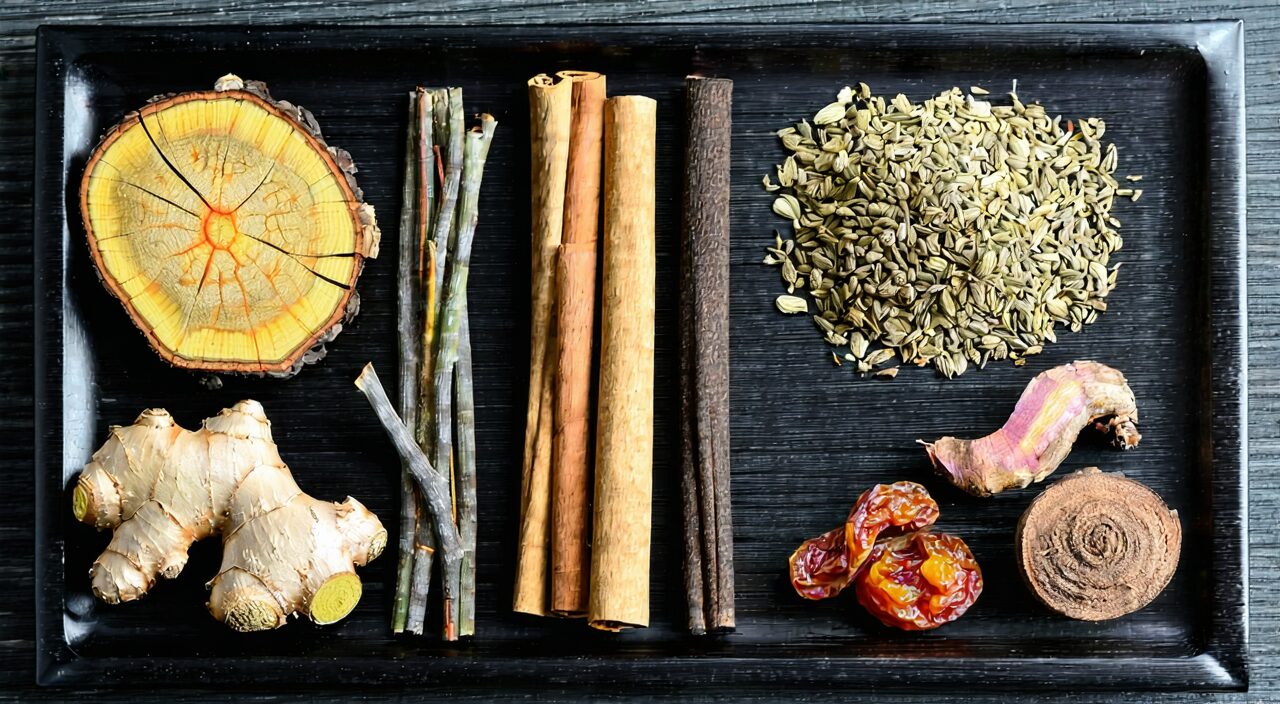
Gegen Tang originates from the Shang Han Lun (Treatise on Cold Damage) and is traditionally regarded as a diaphoretic formula. It mainly works by “releasing the muscle layer and effusing the exterior, raising fluids and relaxing the sinews,” making it especially suitable for presentations where wind-cold fetter the exterior and constrain the flesh, while body fluids fail to ascend properly and the sinews lack nourishment.
Composition of Gegen Tang
Gegen Tang consists of seven traditional medicinal substances, as follows:
| Medicinal | Brief Traditional Role |
|---|---|
| Ge Gen (Kudzu Root) | Raises fluids and relaxes sinews, helping relieve tension in the neck and back |
| Ma Huang (Ephedra) | Induces sweating and releases the exterior, diffuses the lungs and scatters cold |
| Gui Zhi (Cinnamon Twig) | Warms and unblocks the channels, assists yang and transforms qi |
| Bai Shao (White Peony) or Chi Shao (Red Peony) | Restrains yin and harmonizes the nutritive, coordinating with Gui Zhi to harmonize ying and wei |
| Sheng Jiang (Fresh Ginger) | Scatters cold and harmonizes the stomach |
| Da Zao (Jujube) | Supplements the center and protects the stomach |
| Zhi Gan Cao (Honey-fried Licorice) | Harmonizes all medicinals and also cares for the middle burner |
These medicinals work together to both disperse wind-cold from the muscle layer and distribute fluids, relieving stiffness and discomfort in the neck and back. This is one of the key distinctions between Gegen Tang and other exterior-releasing formulas.
Traditional Actions and Directions of Gegen Tang

From a traditional formula analysis perspective, Gegen Tang centers on the core pattern of “wind-cold exterior excess with stiffness and tightness of the neck and back.”
“Exterior excess” means that after wind-cold pathogens invade the exterior, the pores tightly close and sweating cannot occur. In this state, a person has marked aversion to cold and fever but no sweat at all. At the same time, because fluids cannot ascend properly, the sinews of the neck and back lose nourishment, becoming stiff, sore, and limited in movement.
Thus, the traditional actions of Gegen Tang are often summarized as:
- Inducing sweating and releasing the exterior, dispersing wind-cold from the muscle layer
- Raising fluids and relaxing the sinews, improving neck and back stiffness and tightness
- By promoting yang and unblocking, helping restore normal fluid distribution at the body surface
In modern terms, when a person presents with something like “general discomfort after catching cold, stiff neck and back, aversion to cold, fever, and no sweat,” tradition may consider Gegen Tang as a direction to explore. It does not apply to all common colds or neck and shoulder discomfort; the key lies in whether the characteristics of wind-cold exterior excess and neck-back tension are present.
Who Is Gegen Tang Suitable For?

Gegen Tang is not a universal formula; it corresponds to a relatively clear set of signs and symptom combinations. If you or a family member have the following presentations, you can understand it as one traditional regulating approach, but it must be judged in light of individual circumstances and professional advice.
Presentation features that may be relatively suitable:
- Relatively acute onset with a clear history of exposure to wind or cold
- Aversion to cold and fever present simultaneously, and no sweating
- Headache, generalized aching, especially stiffness and tightness in the back of the neck and shoulders
- Possible mild nasal congestion or clear nasal discharge
- Tongue body tends to be pale red with a thin white coating; pulse tends to be floating and tight (requires professional assessment)
It must be emphasized that the above is only a directional description and cannot be used for self-diagnosis. Some people only have neck stiffness without aversion to cold or fever, which is not necessarily a Gegen Tang pattern; or although they have neck and back discomfort, they sweat a lot, which also makes it unsuitable. Therefore, before use, careful comparison is needed to avoid blind application.
Contraindications and People Not Suitable for Gegen Tang
Every formula has its scope of application and boundaries, and Gegen Tang is no exception. The following types of conditions are generally unsuitable, and some require extra caution:
- Wind-heat external contraction presentations: Aversion to cold is not obvious, fever is prominent, throat is red, swollen and painful, mouth is dry with a desire for cold drinks, tongue is red with a yellow coating. This direction has low compatibility with Gegen Tang and should not be used.
- Those who sweat easily or have a relatively weak constitution: If sweating is already present, or if one usually sweats easily, has fatigue, a pale complexion, and fears wind, it is mostly exterior deficiency or insecure defensive qi. Gegen Tang’s relatively strong dispersing power may not be appropriate.
- High fever, severe cases, or those with obvious heat signs: If the body temperature is very high and accompanied by restlessness, thirst, yellow sputum, a red tongue with little moisture, the disease may have entered the interior and transformed into heat, or it belongs to the domain of warm disease, requiring more professional pattern differentiation. Self-selecting Gegen Tang is not appropriate.
- Groups in special physiological stages: Pregnant women, breastfeeding women, children, the elderly and frail, and people with multiple chronic underlying diseases should be especially cautious when using any formula. Usually, it must be done under the guidance of a Chinese medicine practitioner; do not try it on your own.
- Severe back pain accompanied by other warning signs: If neck and back stiffness and pain progressively worsen, accompanied by severe headache, vomiting, blurred vision, limb numbness or weakness, or a history of neck trauma, other problems such as cervical spine or cerebrovascular issues need to be ruled out first; they should not be simply treated as an external contraction formula.
Additionally, even if the presentation looks similar, dosage, proportion, and whether to modify the formula require professional judgment. It is not recommended to self-prescribe and decoct herbs based on formula compositions found online; safety always comes first.
Differences Between Gegen Tang and Gui Zhi Tang, Ma Huang Tang, Xiao Qing Long Tang, and Yin Qiao San
Many people, when first encountering Chinese medicine formulas, easily confuse Gegen Tang with Gui Zhi Tang and Ma Huang Tang, because they are all commonly used in regulating directions related to wind-cold external contractions. Here is a brief distinction to help establish a general impression.
Difference from Gui Zhi Tang
Gui Zhi Tang targets “wind-cold exterior deficiency” pattern, whose core features are fear of wind, fever, sweating, and a floating, moderate pulse. Gegen Tang targets “wind-cold exterior excess,” and the key points are no sweating and stiffness of the neck and back. The core dividing line between the two is whether there is sweating and whether the neck and back are stiff and tight. If there is sweating and neck-back discomfort, Gui Zhi Jia Ge Gen Tang is sometimes used, which is a different variation direction.
Difference from Ma Huang Tang
Ma Huang Tang is also used for wind-cold exterior excess, similarly presenting with aversion to cold, fever, no sweating, headache, and body aches, but usually generalized pain and coarse breathing or cough are more prominent, and neck-back stiffness is not obvious. Gegen Tang adds Ge Gen, Bai Shao, Sheng Jiang, and Da Zao on the basis of Ma Huang Tang, reducing the pure diaphoretic strength while enhancing the actions of raising fluids, relaxing sinews, and easing the neck and back. It can be said that if the exterior excess pattern is marked by stiff and sore neck and back, Gegen Tang may receive more traditional emphasis than Ma Huang Tang.
Difference from Xiao Qing Long Tang
Xiao Qing Long Tang is often used for external wind-cold with internal cold rheum, presenting with aversion to cold, fever, no sweating, but at the same time profuse thin, clear sputum, cough and wheezing, possibly inability to lie flat, and a white slippery tongue coating. Neck-back stiffness is not necessarily a main symptom of Xiao Qing Long Tang, while Gegen Tang’s focus is on the constraint of the sinews and channels in the muscle layer. Although both contain Ma Huang, Gui Zhi, and Gan Cao, their combination goals and emphases differ.
Difference from Yin Qiao San
Yin Qiao San belongs to warm disease formulas, used for early-stage wind-heat, with presentations mainly of pronounced fever, mild aversion to cold, sore throat, dry mouth, and a red tip and edges of the tongue. This is a completely different direction from Gegen Tang’s wind-cold exterior excess with no sweat and neck-back stiffness. If mistakenly used, it can easily aggravate internal heat, so clarifying the cold or heat nature is very important.
The above comparisons are only to help understand the traditional positioning of different formulas, not a recommendation to self-select. Symptoms are often complex and multifaceted; if multiple tendencies coexist or you cannot distinguish them yourself, seek judgment from an experienced TCM professional.
Some Reminders for Understanding Gegen Tang
When discussing Gegen Tang based on traditional usage experience, several points are worth noting:
- Symptoms combined with constitution are the core. Post-cold presentations are only an entry point; overall constitution and underlying cold-heat biases can influence whether the formula composition needs adjustment.
- Short-term external contraction management differs from long-term neck-shoulder discomfort management. Gegen Tang is traditionally used more in acute external contraction stages and cannot be equated with daily neck-shoulder strain regulating products.
- There may be products on the market with similar names but differing dosage forms, dosages, and indication ranges; refer to the product instructions and do not confuse them.
For severe, persistent, or unrelieved conditions, or those accompanied by chest tightness, palpitations, abnormal breathing, intense headache, persistent vomiting, black stools, or listlessness, immediate medical attention must be sought without delay.
Summary
Gegen Tang is a traditional formula tightly centered around “wind-cold exterior excess with neck-back stiffness and tightness.” Its advantage lies in simultaneously releasing the muscle layer and effusing the exterior while raising fluids and relaxing the sinews. It is not a universal choice for all neck-shoulder discomfort or common colds. Whether it is suitable depends on the presence of the combined presentation of no sweating, aversion to cold, fever, and stiff, tight neck and back.
Wind-heat presentations, those with profuse sweating and deficiency, high fever severe cases, and special populations are generally not suitable. Compared with Gui Zhi Tang, Ma Huang Tang, Xiao Qing Long Tang, and Yin Qiao San, each has clear key points of pattern differentiation differences.
Most importantly, all information is provided only as a popular science reference for TCM traditional culture and cannot replace professional diagnosis or treatment advice. If you feel unwell, be sure to consult a physician or licensed Chinese medicine practitioner and determine a safe and reasonable direction under guidance.