
Guizhi Fuling Wan: Who Is It For? Composition, Effects, and Contraindications Explained

In traditional Chinese medicine, many classic formulas have been passed down to the present, and Guizhi Fuling Wan (Cinnamon Twig and Poria Pill) is one commonly used for conditions related to “blood stasis”. Many overseas Chinese or readers interested in TCM ask: Who exactly is Guizhi Fuling Wan suitable for? What herbs make up the formula? What precautions should be taken when using it? How does it differ from other frequently mentioned formulas like Xuefu Zhuyu Decoction and Taohong Siwu Decoction?
This article will organize this information from a traditional Chinese medicine perspective, helping you establish a relatively clear framework to serve as a reference when communicating with a professional TCM practitioner, rather than a basis for self-prescribing.
Formula Origin and Basic Positioning
Guizhi Fuling Wan first appeared in the “Synopsis of the Golden Chamber” (Jin Gui Yao Lue) in the chapter “Pulse Patterns and Treatment of Diseases in Pregnant Women.” It was originally used for abdominal masses in women—fixed masses that do not move when pressed, accompanied by persistent vaginal spotting. Traditional physicians believe such conditions often arise from long-retained blood stasis binding in the lower burner, which requires gradual dissipation, not urgent attack. Therefore, the entire formula uses a gentle method of activating blood and resolving stasis, emphasizing “slow dissolution” rather than drastic blood-breaking.
Over the centuries, the application of Guizhi Fuling Wan gradually expanded to other chronic conditions manifesting internal obstruction of blood stasis, such as irregular menstruation with clots, lower abdominal distension and stabbing pain, and even some gynecological issues with clear mass lesions. It must be emphasized that signs of blood stasis should always be the basis for consideration, not casual use. Understanding this point is helpful in avoiding misuse.
Composition and Actions of Each Herb
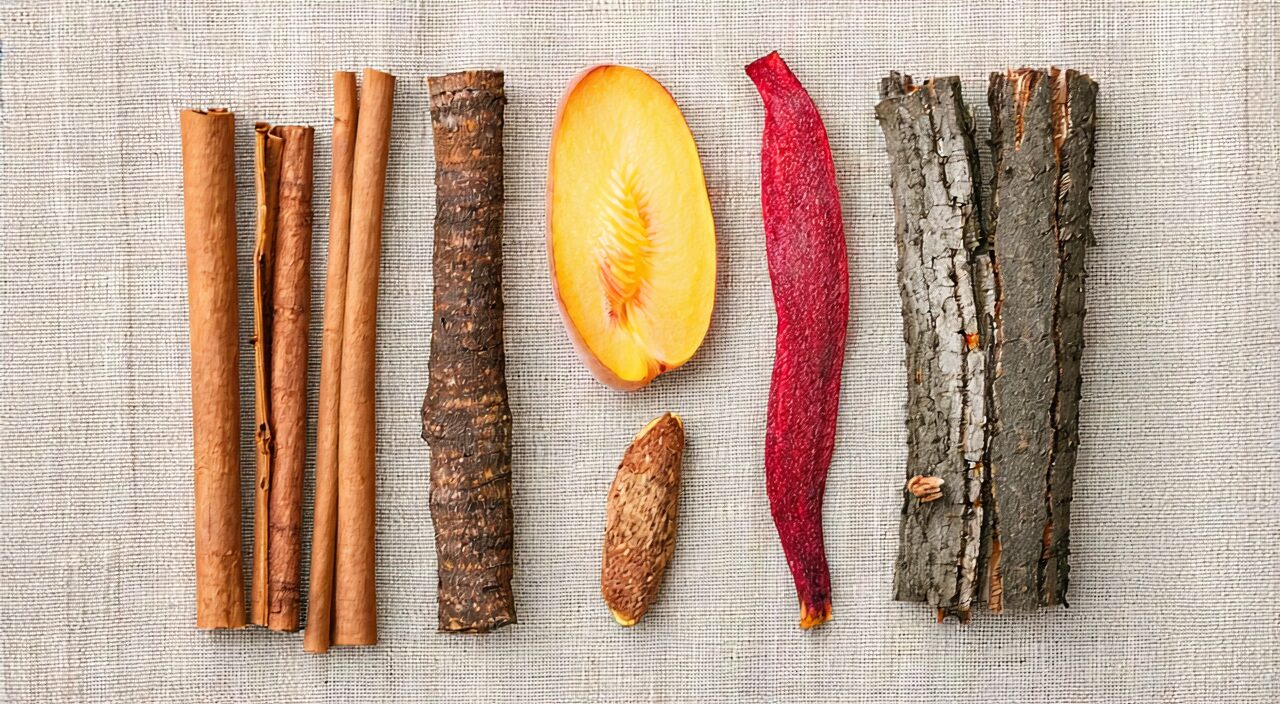
Guizhi Fuling Wan is composed of five herbs, with a very refined combination. The following table shows the common action tendencies of each herb in this formula:
| Herb | Traditional Action Direction |
|---|---|
| Cinnamon Twig (Guizhi) | Warms and unblocks the blood vessels, assists yang qi transformation, and disperses cold-congealed stasis |
| Poria (Fuling) | Fortifies the spleen and leaches dampness, calms the heart and spirit, and prevents blood-stasis-resolving herbs from damaging the spleen and stomach |
| Moutan Cortex (Mudanpi) | Activates blood and dissipates stasis, while also clearing constrained heat in the blood level |
| Peach Kernel (Taoren) | Breaks blood and moves stasis, moistens the intestines and descends stagnation |
| Peony (Shaoyao) | Nourishes blood and harmonizes the nutritive level, relaxes tension and relieves pain, and restrains the dryness of warm-unblocking herbs |
(Note: Peony is usually used as Red Peony Root (Chi Shao) to activate blood and disperse stasis. If there is concurrent blood deficiency and liver hyperactivity, it may be replaced by White Peony Root (Bai Shao), depending on the specific pattern.)
From this, it can be seen that the formula not only activates blood but also supplements with transforming dampness, clearing heat, and nourishing blood, avoiding depletion of qi and blood from purely resolving stasis. This point is important for blood stasis constitutions requiring long-term regulation. Traditionally, it is believed that chronic blood stasis often mixes with dampness and heat or is accompanied by blood deficiency; therefore, such a balanced combination gives Guizhi Fuling Wan particular reference value in chronic lower-burner blood stasis obstruction.
Who May Benefit: Signs Suggesting Blood Stasis

In traditional Chinese medicine, deciding whether to consider blood-activating and stasis-removing approaches is not based on just one or two symptoms but on observing a series of signs known as “blood stasis manifestations.” If several of the following conditions appear concurrently, it may suggest that one could further explore approaches like Guizhi Fuling Wan, but still requiring professional confirmation:
- Fixed lower abdominal pain: Often distending or stabbing pain in the lower abdomen or lower lateral abdomen, discomfort on pressure, possibly worsening at night or after exposure to cold, differing from migratory pain.
- Dark menstrual blood with many clots: Menstrual color tends to be dark purple, mixed with many blood clots, difficult to discharge, pronounced abdominal pain before or during the period, and pain alleviated after clot expulsion.
- Purple-dark tongue body or stasis spots: The tongue body appears dark, even bluish-purple, or has ecchymosis and petechiae on the margins, with enlarged sublingual veins. This is often regarded as an important sign of internal stasis.
- Dry, rough skin or visible red thread-like capillaries: The skin loses its moisture, easily becoming dry and scaly, or spider-like capillary dilation may appear on the cheeks or abdomen; traditionally called “scaly skin.”
- Fixed abdominal masses: Palpable masses in the lower abdomen that feel firm, with unclear borders, and immobile. Imaging such as ultrasound may suggest fibroids or cysts, but diagnosis should not rely on palpation alone.
- Memory decline, mental irritability: Internal blood stasis may affect the heart’s function of governing the mind, manifesting as forgetfulness, emotional fluctuations, and unexplained irritability, especially when accompanied by other blood stasis signs.
These manifestations may occur alone, but more commonly appear in combination. It should be noted that even if some of the above features are present, it does not necessarily mean Guizhi Fuling Wan is suitable, as contraindications described later must be excluded and factors such as tongue and pulse, constitution, etc., must be integrated.
Contraindications and Special Precautions
The following situations are generally not suitable for considering Guizhi Fuling Wan, or can only be evaluated under extremely careful medical supervision:
- Pregnancy and preconception period: Although the formula is included in the “Pregnancy Disease” chapter of the “Golden Chamber”, most later physicians believe that its blood-activating and mass-dissolving actions may disturb the fetus and pose a risk of miscarriage. Women trying to conceive should also avoid self-administration.
- Active bleeding or bleeding tendency: Conditions such as heavy uterine bleeding, menorrhagia, gastrointestinal bleeding, coagulation disorders, thrombocytopenia; using blood-activating herbs may exacerbate bleeding.
- Severe qi and blood deficiency, weak constitution: Sallow complexion, fatigue, weakness, shortness of breath, palpitations, thin-weak pulse; qi and blood should be replenished first, rather than unilaterally activating blood, which might further deplete qi and damage blood.
- Undiagnosed acute pain: Sudden severe abdominal pain, chest pain, etc., require emergency medical attention to rule out acute abdomen, ruptured ectopic pregnancy, cardiac conditions, etc., and must not be self-treated as ordinary blood stasis.
- Lactation, children, and the elderly with frail health: These special populations have different physiological states; their response and risk to blood-activating herbs are hard to predict, requiring experienced TCM practitioner guidance based on pattern differentiation.
- Concurrent use of anticoagulant or antiplatelet drugs: Blood-activating and stasis-resolving formulas may enhance the effects of these medications, increasing the risk of bleeding. The prescribing physician must be informed; combined use should never be done privately.
Additionally, if symptoms persist, change in nature, or are accompanied by weight loss, black stools, abnormal vaginal bleeding, low-grade fever, etc., timely modern medical examinations must be conducted without delay to avoid masking the underlying condition.
Differentiating from Similar Formulas such as Xuefu Zhuyu Decoction

Many people interested in TCM will find that there are quite a few formulas related to “blood.” Besides Guizhi Fuling Wan, Siwu Tang (Four Substance Decoction), Taohong Siwu Tang (Peach Kernel and Carthamus Four Substance Decoction), Xuefu Zhuyu Tang (Blood Mansion Stasis-Expelling Decoction), and Shaofu Zhuyu Tang (Lower Abdomen Stasis-Expelling Decoction) are also frequently mentioned. Although they all work with “blood,” their focus and disease location differ significantly; clarifying this helps avoid confusion.
Siwu Tang (Four Substance Decoction) This is a basic blood-tonifying formula, composed of Dang Gui (Chinese Angelica), Chuan Xiong (Ligusticum), Bai Shao (White Peony), and Shu Di (Prepared Rehmannia). Its main direction is nourishing blood and harmonizing the nutritive level, suitable for states primarily involving blood deficiency with minimal stasis, such as pale complexion, dizziness, and brittle nails. Its blood-activating strength is very weak, so it cannot be expected to resolve obvious stasis masses.
Taohong Siwu Tang (Peach Kernel and Carthamus Four Substance Decoction) Added Taoren (Peach Kernel) and Honghua (Carthamus) to Siwu Tang, strengthening the blood-activating and stasis-resolving effect while tonifying blood. It is commonly used for menstrual irregularities with blood deficiency and stasis, scanty, dark-colored periods with clots. Compared to Guizhi Fuling Wan, it simultaneously reinforces the body and tonifies blood, leaning more toward nourishing and activating blood, but its warming-unblocking effect on the lower burner is less concentrated than that of Guizhi Fuling Wan.
Xuefu Zhuyu Tang (Blood Mansion Stasis-Expelling Decoction) Also based on Taohong Siwu Tang, with the additions of Chai Hu (Bupleurum), Zhi Qiao (Aurantium), Jie Geng (Platycodon), and Niu Xi (Achyranthes), it emphasizes activating blood and moving qi. It traditionally targets “blood stasis in the blood mansion,” i.e., chest and hypochondriac stasis, causing chest oppression, chest pain, stubborn hiccups, internal heat and irritability, palpitations, and insomnia. Its action location is more in the upper burner, within the chest, and its qi-rectifying and constraint-relieving strength is greater, differing from Guizhi Fuling Wan’s focus on lower burner masses and gentle dissolution.
Shaofu Zhuyu Tang (Lower Abdomen Stasis-Expelling Decoction) From “Yi Lin Gai Cuo” (Correction of Errors in the Medical Forest), containing warming herbs such as Xiao Huixiang (Fennel), Gan Jiang (Dried Ginger), and Yan Hu Suo (Corydalis). On the basis of activating blood, it highlights warming the channels, dispersing cold, and relieving pain. It is suitable for cold congealing and blood stasis causing cold pain in the lower abdomen, worse during menstruation, relieved by warmth, accompanied by cold intolerance and cold limbs. Compared to Guizhi Fuling Wan, its warming-dispersing strength is stronger, making it more suitable for lower abdominal stasis pain with a cold nature.
Thus, no formula is a “universal blood-activating formula”; it must be considered in light of the cause, location, accompanying pathogenic factors, and the body’s deficiency-excess state. This information can serve as a reference for communication with a TCM practitioner, not as a basis for self-prescription.
Summary
Guizhi Fuling Wan is a classic formula for internal blood stasis obstruction, characterized by gentle mass dissolution. It mainly addresses blood stasis stagnation in the lower burner. If there are signs such as fixed lower abdominal pain, menstrual blood clots, a dark tongue or stasis spots, and there are no contraindications like bleeding tendency, extreme deficiency, or pregnancy, it may be considered by a TCM practitioner.
At the same time, it differs significantly in clinical application from Xuefu Zhuyu Tang, Shaofu Zhuyu Tang, and Taohong Siwu Tang: Xuefu Zhuyu Tang leans toward qi stagnation and blood stasis in the chest, Shaofu Zhuyu Tang warms and disperses cold congealing, while Taohong Siwu Tang emphasizes both nourishing and activating blood. Understanding these differences is essential for correctly grasping TCM regulatory principles.
Finally, it must be clear that the application of any formula requires rigorous pattern differentiation and necessary modern medical examinations. This article is for educational purposes only and cannot replace a physician’s diagnosis and guidance. If symptoms worsen or new issues arise, seek medical attention promptly.