
What Is Bai Zhi? Medicinal Parts, Identification, and Common Formulas
Bai Zhi is a Chinese herbal medicine that one may come across from time to time. It is the dried root of Angelica dahurica or Angelica dahurica var. formosana. Many people notice this strongly aromatic herb when dealing with colds, headaches, nasal congestion, or seeking traditional health approaches. This article provides an overview of Bai Zhi, including its appearance and identification, medicinal parts, traditional Chinese medicine perspective, modern research, differences from similar herbs, common formulas, and precautions. The aim is to help readers form a relatively complete understanding.
What Does Bai Zhi Look Like? How to Identify It?
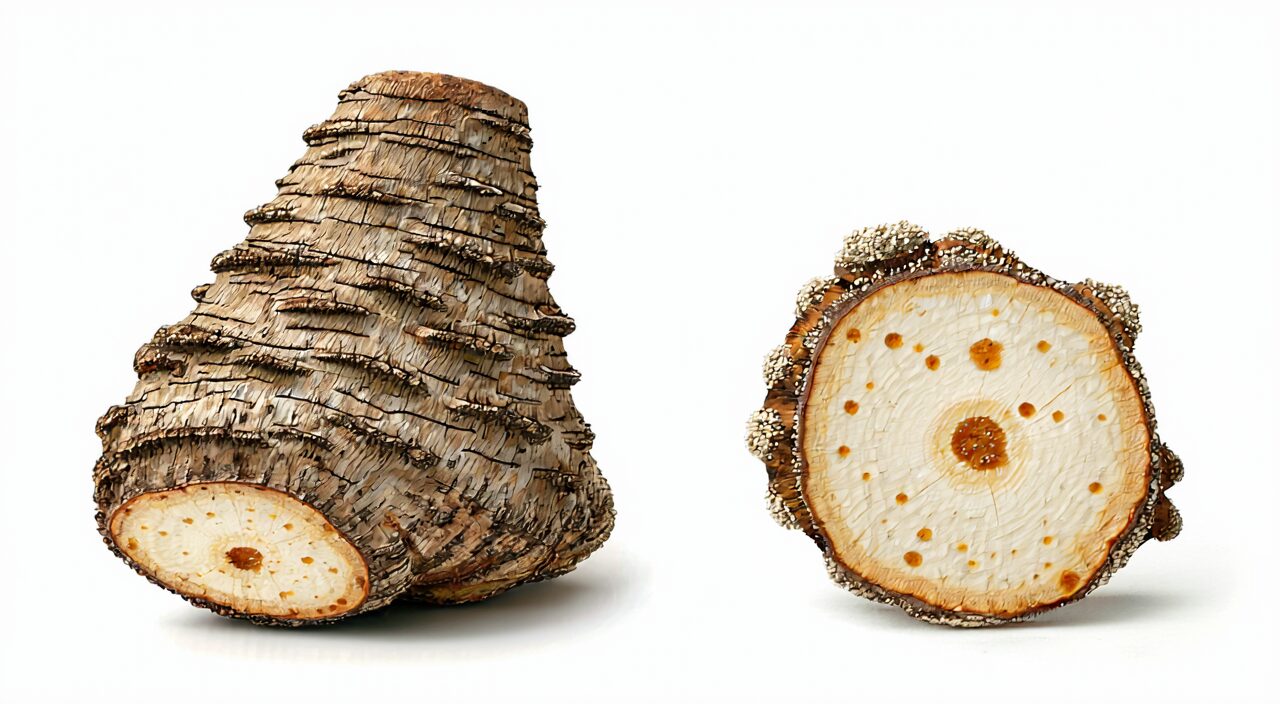
The dried root of Bai Zhi is usually long conical, sometimes slightly quadrangular, typically 10 to 25 cm in length and about 1.5 to 2.5 cm in diameter. The surface color is grayish-brown to yellowish-brown. A distinctive feature is the presence of transverse raised lenticel-like scars on the root surface; these bumps look like small knots or transverse lines and serve as an important identification point. The crown of the root is relatively blunt and rounded, sometimes slightly raised, with a depressed stem scar at the tip, often surrounded by ring patterns. Some roots may have branch root scars or fibrous root scars on the lower part. The texture is firm and not easily broken. When forced open, the cut surface is white or grayish-white with a starchy texture, feeling slightly slick when rubbed with fingers. A distinct brown cambium ring is visible on the cut surface, which appears nearly circular or somewhat square; the cortex is dotted with many small brown oil spots, which are the secretory cavities of Bai Zhi.
The most prominent identifying feature is its strong aroma, which carries a sharp, characteristic spicy fragrance. When tasted, it is slightly bitter and pungent. Those familiar with the scent can often gauge the herb’s quality just by the smell. The prepared slices are usually thick transverse slices, nearly round or oval, also white and starchy, with clearly visible oil spots. Understanding these key points enables preliminary identification of Bai Zhi in daily settings.
What Is the Medicinal Part of Bai Zhi?
The medicinal part of Bai Zhi is its underground root. Traditionally, the main production areas are distributed in Henan (Yu Bai Zhi), Hebei (Qi Bai Zhi), and Zhejiang (Hang Bai Zhi). While there are slight differences among products from different regions, their medicinal usage is the same. Harvesting usually takes place between summer and autumn, when the leaves begin to yellow and wither; at that point, the active compounds in the root have accumulated sufficiently. After digging, the above-ground stems, leaves, fibrous roots, and attached soil are removed, and the roots are dried in the sun or at low temperatures, avoiding high heat to prevent loss of aromatic components. In processing, sulfur fumigation is sometimes used (now decreasingly) to aid storage and appearance, but sulfur-free Bai Zhi is more highly valued. The dried whole root can be used as a medicinal material. Clinically, it is usually sliced and used raw, or it can be dry-fried with bran to make fried Bai Zhi, which slightly moderates its pungent dispersing nature. Understanding the medicinal part and processing methods helps one appreciate the journey of a Chinese herb from original plant to prepared slice.
How Does Traditional Chinese Medicine View Bai Zhi?
In traditional Chinese medicine theory, Bai Zhi is acrid and warm, and enters the Lung, Stomach, and Large Intestine meridians. Over centuries of practice, ancient practitioners summarized several main actions. These actions are still often incorporated into approaches for related conditions today, but they are not appropriate for everyone.
- Release the exterior and disperse cold: When there is externally contracted wind-cold with headache, nasal congestion, and aversion to cold, Bai Zhi is often considered together with herbs such as Fang Feng (Saposhnikovia) and Qiang Huo (Notopterygium) to disperse wind-cold from the exterior.
- Dispel wind and relieve pain: Bai Zhi has an affinity for the upper body, especially the forehead and face along the Yangming meridian. It is traditionally used as a pain-relieving option for frontal headache, supraorbital bone pain, toothache, and wind-damp joint and muscle aches, often combined with Chuanxiong (Szechuan Lovage Root) and Xixin (Asarum).
- Unblock the nasal orifices: This is one of the more familiar uses of Bai Zhi. For conditions such as nasal congestion, turbid nasal discharge, and reduced sense of smell (comparable to chronic sinusitis), Bai Zhi can ventilate Lung qi and open the nasal passages, frequently used with Cang Er Zi (Xanthium) and Xinyi (Magnolia Flower).
- Dry dampness and stop vaginal discharge: Being warm and aromatic, Bai Zhi can dry dampness. For excessive, clear, thin vaginal discharge due to downward pouring of cold-dampness, traditional formulas may use it to astringe and stop discharge. If the discharge is of damp-heat nature, it is typically combined with heat-clearing, damp-drying herbs such as Huang Bai (Phellodendron) to balance the medicinal properties.
- Reduce swelling and promote pus drainage: In the early stage of sores with local redness, swelling, heat, and pain, Bai Zhi can dissipate masses and reduce swelling. When pus has formed but not yet ruptured, or after rupture with poor pus drainage, it can help draw out toxins and discharge pus, promoting recovery. This is reflected in some surgical formulas.
Please note that these are traditional TCM understandings. Whether they suit one’s constitution and specific symptoms still requires assessment in real context and professional judgment.
Modern Research Perspective
Modern scientific research has found that Bai Zhi contains various coumarin compounds, such as imperatorin and isoimperatorin, and is rich in volatile oil. In laboratory and animal studies, these constituents have demonstrated some anti-inflammatory, antipyretic, analgesic, and vasodilatory effects. Notably, furanocoumarins are photosensitizing and can enhance the skin’s absorption of ultraviolet light, which is the basis for the possible photosensitivity reactions associated with Bai Zhi use. These research findings provide some explanations for traditional uses, but they do not directly equate to clinical efficacy. Readers may consider them as background information and should not substitute them for professional medical advice.
Differences Between Bai Zhi, Chuanxiong, and Xinyi
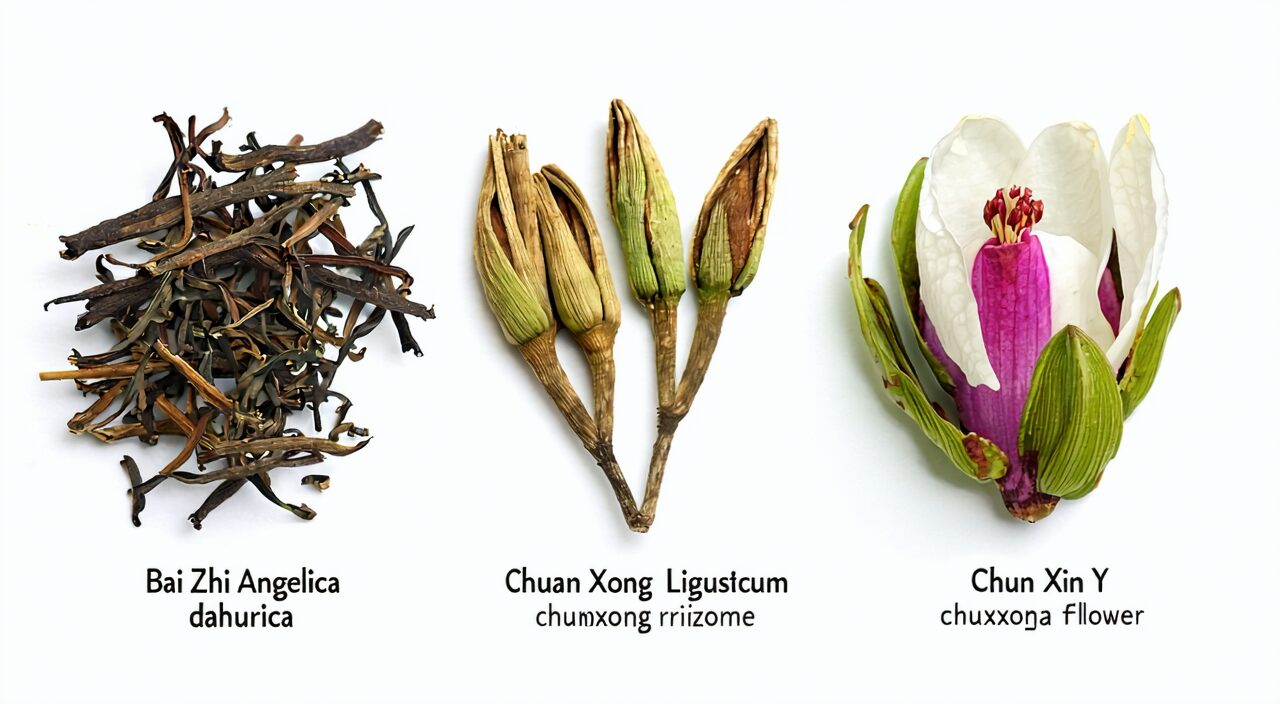
Bai Zhi, Chuanxiong, and Xinyi are all common herbs used in TCM for conditions involving the head, face, and nasal orifices, but they come from different sources and have clearly different therapeutic emphases.
- Source and medicinal part: Bai Zhi is the root of Angelica dahurica or Angelica dahurica var. formosana (Apiaceae); Chuanxiong is the rhizome of Ligusticum chuanxiong (also Apiaceae), appearing as irregular, knobby, fist-shaped masses; Xinyi is the dried flower bud of Magnolia biondii, Magnolia denudata, or Magnolia sprengeri (Magnoliaceae).
- Appearance differences: Chuanxiong is usually fist-shaped with parallel raised ring-like nodes on the surface; its cut surface is yellowish-white or gray-yellow with wavy ring lines and oil spots, and it has a distinct aroma and a bitter, pungent taste with slight tongue-numbing sensation. Xinyi is shaped like a writing brush tip or long oval, covered with grayish-white fuzz, with an aromatic fragrance and a pungent, cool taste. The three can be easily distinguished by visual appearance and scent.
- Application focus: Bai Zhi is acrid and warm, excellent at releasing the exterior, dispersing wind-cold from the Yangming channel, unblocking the nasal orifices, drying dampness, and expelling pus. Chuanxiong emphasizes activating blood, moving qi, dispelling wind, and relieving pain, especially for headaches and menstrual irregularities due to blood stasis and qi stagnation – it goes to the blood level. Xinyi enters the Lung meridian and specializes in ventilating and unblocking the nasal orifices, particularly for nasal congestion, runny nose, and sinusitis; its exterior-releasing and cold-dispersing power is milder than that of Bai Zhi. In many sinusitis formulas, Bai Zhi and Xinyi appear together to enhance the orifice-opening effect, while Chuanxiong often pairs with Bai Zhi in headache formulas, each contributing its strengths.
Which Formulas Use Bai Zhi?
In classical formulas, Bai Zhi is often included as an important ingredient. The following are a few representative traditional formulas, provided for knowledge only and not as a recommendation for anyone to use.
- Chuanxiong Chatiao San (Chuanxiong Tea-Mix Powder): From the “Tai Ping Hui Min He Ji Ju Fang,” this formula includes Chuanxiong, Bai Zhi, Qiang Huo, Xixin, Fang Feng, etc., taken with green tea. Traditionally, it is used for headaches due to externally contracted wind pathogens, where Bai Zhi assists in dispersing wind and relieving pain.
- Cang Er Zi San (Xanthium Powder): From the “Ji Sheng Fang,” composed of Cang Er Zi, Xinyi, Bai Zhi, Bo He (Mint), etc.; a classic option for sinusitis (Bi Yuan). Bai Zhi helps ventilate the nasal passages and expel turbid discharge.
- Wu Ji San (Five Accumulations Powder): From the “He Ji Ju Fang,” widely applicable for cold accumulation and qi accumulation due to external wind-cold and internal damage from raw, cold foods. Bai Zhi combines with Ma Huang (Ephedra) and Gan Jiang (Dried Ginger) to disperse exterior cold. Its applications often involve multiple presentations of cold-damp stagnation.
- Yang He Tang (Yang-Harmonizing Decoction): From the “Wai Ke Zheng Zhi Quan Sheng Ji,” mainly used for yin-type sores (deep abscesses). Bai Zhi works with Shu Di Huang (Prepared Rehmannia), Lu Jiao Jiao (Deer Horn Glue), and Rou Gui (Cinnamon Bark) to disperse cold, unblock stagnation, reduce swelling, and dissipate masses.
These formulas have a long history, and precise ingredient ratios and indications are strictly observed. If one is interested in a particular formula, one should seek professional guidance based on their own situation and a thorough understanding of the formula’s indications.
Precautions When Using Bai Zhi

Although Bai Zhi is a traditionally commonly used herb, some safety precautions should still be observed when using it.
- Risk of photosensitivity: The furanocoumarins in Bai Zhi can make the skin more sensitive to sunlight. Whether taking it internally or applying Bai Zhi products externally, prolonged exposure to strong sunlight should be avoided; minimize sun exposure or practice good physical sun protection. Otherwise, skin redness, swelling, and pigmentation may occur.
- Caution in yin deficiency and blood heat patterns: Bai Zhi is acrid and warm and tends to consume yin and blood. If one often experiences warm palms and soles, dry mouth and throat, a red tongue with little coating, or frequent bleeding – indicating yin deficiency with blood heat – it is generally not advisable to use this herb alone or in large doses. In formulas, it should be paired with herbs that protect yin and body fluids.
- Pregnancy and special populations: Special caution is required during pregnancy. Traditionally, Bai Zhi is considered to have a strong pungent dispersing and moving nature, which may affect the fetus, so self-use should be avoided. Breastfeeding women, children, and other individuals with special constitutions should also decide on its use under professional guidance.
- Topical irritation: Some people may be sensitive to Bai Zhi or its essential oil components when applied topically, experiencing irritation, itching, or rash. It is recommended to test on a small skin area before use.
In summary, no matter what purpose you have in mind for learning about Bai Zhi, it is recommended to consult a TCM practitioner or herbalist first. Do not recklessly self-try based solely on online information or others’ experiences.
Summary
Bai Zhi is a widely used Chinese medicinal herb in traditional Chinese medicine. It can be preliminarily identified by observing root morphology, the starchy cut surface, and its strong aroma. It is commonly used to disperse cold, unblock the orifices, relieve pain, and promote pus drainage. Bai Zhi, Chuanxiong, and Xinyi have both differences and synergies. However, the photosensitivity and constitutional biases of Bai Zhi mean it is not suitable for everyone. It is crucial to fully understand the precautions and seek professional advice before use. This article is for educational reference only and cannot replace professional diagnosis or treatment advice.