
Who Is Huangqi Jianzhong Tang Suitable For? Composition, Benefits, and Precautions

Many friends who pay attention to classical Chinese medicine formulas often notice a modified version called “Huangqi Jianzhong Tang” when looking up “Xiaojianzhong Tang” and wonder: what exactly does adding a single herb, Huangqi (Astragalus), change? Would this direction be more suitable for me? This article focuses on the compositional thinking, traditional benefits, suitable population, and differences between Huangqi Jianzhong Tang and several other common formulas, hoping to help readers form a relatively clear impression.
Understanding the Regulating Approach of Huangqi Jianzhong Tang from the “Jingui Yaolue”
Huangqi Jianzhong Tang originates from the “Jingui Yaolue” (Essential Prescriptions from the Golden Cabinet), chapter on “Blood Impediment and Deficiency-consumption Diseases: Pulse Patterns and Treatment.” It is formed by adding Huangqi (Astragalus) to the base formula Xiaojianzhong Tang. The original text states, “For deficiency-consumption with internal urgency and various insufficiencies, Huangqi Jianzhong Tang governs it.”
Simply put, “internal urgency” refers to a feeling of tightness and discomfort in the abdomen, with dull pain; “various insufficiencies” emphasizes a general deficiency of qi, blood, yin, and yang, but the core still lies in the middle burner (spleen and stomach). Adding Huangqi aims to strengthen the power of supplementing qi, expanding the original formula’s focus from warming the middle and tonifying deficiency to a broader scope of “supplementing qi, warming the middle, tonifying deficiency, and relieving urgency.”
Therefore, traditionally, the application of Huangqi Jianzhong Tang is often understood from the perspective of spleen-stomach deficiency-cold accompanied by pronounced qi deficiency.
Composition and Traditional Use of Huangqi Jianzhong Tang
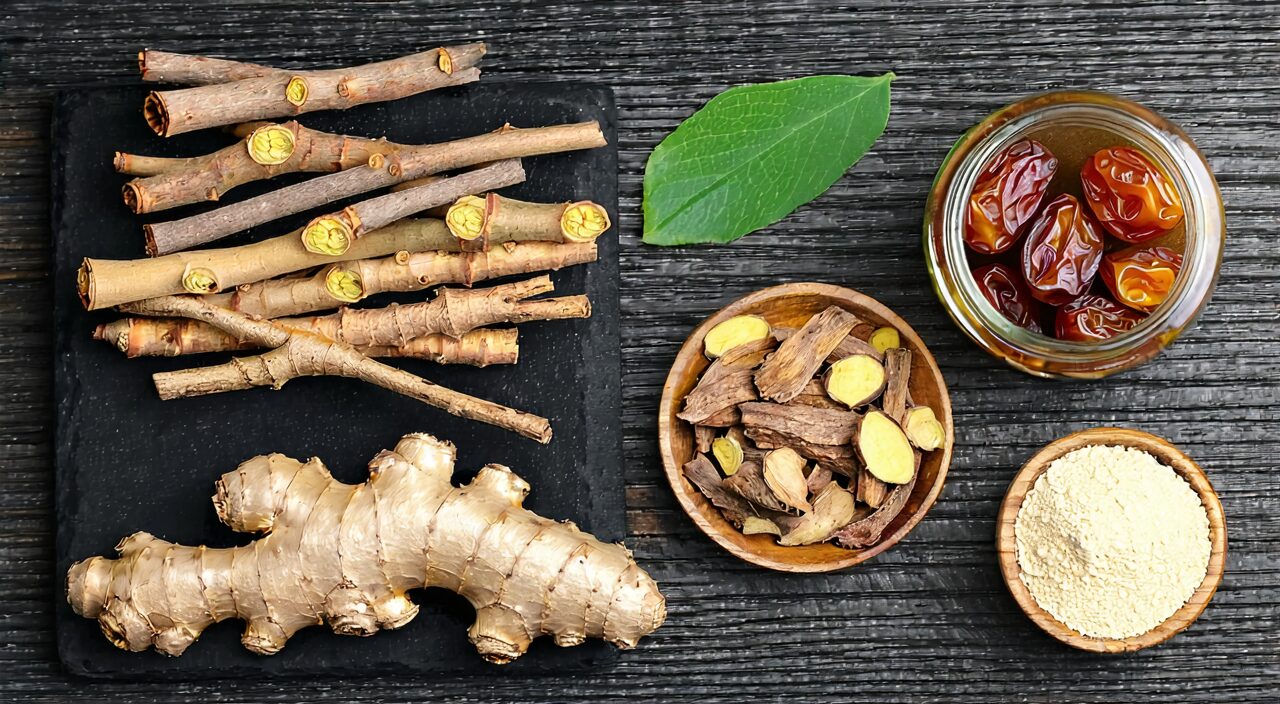
The composition of Huangqi Jianzhong Tang is in the same lineage as Xiaojianzhong Tang, with only one additional herb—Huangqi—yet this shifts the entire formula’s emphasis. The traditional roles of each herb are briefly described below:
| Medicinal Herb | Brief Traditional Role |
|---|---|
| Huangqi (Astragalus) | Supplements qi and raises yang, boosts defensive qi and stabilizes the exterior; commonly used for shortness of breath, fatigue, and spontaneous sweating due to exterior deficiency. |
| Yitang (Maltose) | Supplements the middle, relieves urgency, and moistens dryness; plays a key role in warming the middle and tonifying deficiency. |
| Guizhi (Cinnamon Twig) | Warms and unblocks the channels, assists yang and transforms qi; combined with Baishao, it harmonizes the nutritive and defensive systems. |
| Baishao (White Peony Root) | Nourishes blood and regulates menstruation, softens the liver and relieves pain; alleviates abdominal tension and urgency. |
| Shengjiang (Fresh Ginger) | Warms the middle and stops vomiting, disperses and assists Guizhi in warming and activating the middle burner. |
| Dazao (Chinese Date) | Supplements the middle and boosts qi, nourishes blood and calms the spirit, attending to both qi and blood. |
| Zhigancao (Honey-fried Licorice Root) | Supplements the spleen and harmonizes the stomach, boosts qi and restores the pulse, harmonizes all the other herbs. |
In the formula, Yitang is the sovereign herb that warms the middle and tonifies deficiency; Guizhi and Baishao harmonize qi and blood; Shengjiang and Dazao invigorate the spleen and stomach; Zhigancao sits at the center and harmonizes. With Huangqi added on this foundation, the overall direction shifts more toward supplementing the qi deficiency aspect.
What Presentations May Be Suitable for Huangqi Jianzhong Tang

From the perspective of traditional pattern differentiation, the direction that Huangqi Jianzhong Tang addresses often revolves around several keywords: deficiency, cold, pain, and fatigue. Specifically, the following types of presentations can be understood as indicative directions:
- Long-term feelings of fatigue and weakness, low spirits, and slow recovery of physical strength;
- Dull pain in the stomach cavity or abdomen, pain that prefers warmth and pressure, worsens with cold or on an empty stomach, and is relieved after eating or applying warmth;
- Shortness of breath, reluctance to speak, easily sweating with minor activity, and fear of drafts after sweating;
- Decreased appetite, abdominal bloating after meals, and relatively weak digestive capability;
- A pale or sallow complexion, pale lips, a pale and tender tongue body with a thin white tongue coating.
If these manifestations occur simultaneously, especially when there is both deficiency-cold dull pain in the spleen and stomach that prefers warmth, and pronounced qi deficiency signs such as fatigue, shortness of breath, and spontaneous sweating, then the traditional approach may consider a strategy of warming the middle, tonifying deficiency, and supplementing qi as embodied in Huangqi Jianzhong Tang.
However, it should be noted that individual circumstances are often more complex. Whether it is truly suitable must be comprehensively judged by an experienced Chinese medicine professional based on information including tongue and pulse, and one should not simply apply the formula based on a few symptoms alone.
Under What Circumstances Should Extra Caution Be Exercised
Not all stomach pain or fatigue is suitable for Huangqi Jianzhong Tang. The following types of conditions are traditionally considered to warrant avoidance or great caution:
- Clear signs of excess heat or damp-heat in the body, such as bitter taste and dry mouth, red tongue with yellow greasy coating, sticky foul-smelling stools, and dark yellow urine;
- Prominent manifestations of yin deficiency with fire hyperactivity, such as heat in the palms and soles, afternoon tidal fever, night sweats, dry mouth and throat, and a red tongue with little coating;
- Acute abdominal pain, severe vomiting, diarrhea, fever, etc., when the condition is in an acute attack stage; the cause should first be clearly identified;
- Pregnant women, breastfeeding women, children, and elderly individuals with multiple underlying diseases—these groups have special physiological states, and any formula requires evaluation under professional guidance;
- Abdominal distension and stabbing pain caused by excess patterns such as food accumulation, qi stagnation, or blood stasis are also not within the primary consideration scope of this formula.
If stomach and abdominal discomfort occur repeatedly, or are accompanied by palpitations, chest tightness, black stools, significant weight loss, etc., it is advisable to seek medical attention promptly rather than make a self-judgment.
Differences Between Huangqi Jianzhong Tang, Xiaojianzhong Tang, and Other Formulas
Several formulas are easily confused with Huangqi Jianzhong Tang. Here, their respective emphases are sorted out to help build a framework for differentiation.
Xiaojianzhong Tang: Focuses on warming the middle, tonifying deficiency, harmonizing the interior, and relieving urgency, mainly targeting abdominal tightness and pain caused by deficiency-cold of the middle burner. The dosage of Yitang in the formula is relatively large, giving it strong warming and tonifying power, but its qi-supplementing power is relatively moderate. If there is deficiency-cold abdominal pain without obvious qi deficiency, Xiaojianzhong Tang is already a relatively classic corresponding direction. Only after adding Huangqi does the direction shift to cases where the qi deficiency aspect is more prominent.
Buzhong Yiqi Tang: Focuses on supplementing the middle, boosting qi, and raising the clear yang to correct sinking, commonly used for fatigue, shortness of breath, reluctance to speak, organ prolapse, and chronic diarrhea caused by spleen qi deficiency with sinking. Its power to warm the middle and disperse cold is not strong. Compared with Huangqi Jianzhong Tang, the latter is more inclined toward concurrent spleen-stomach deficiency-cold and qi deficiency, whereas Buzhong Yiqi Tang is more inclined toward qi deficiency with failure of clear yang to ascend.
Fuzi Lizhong Wan: Its power to warm the middle and disperse cold is markedly stronger, commonly used for conditions where spleen yang deficiency is relatively severe, such as cold hands and feet, cold abdominal pain, and watery vomiting and diarrhea—cases where cold manifestations are more prominent. When cold is severe but qi deficiency is not obvious, this direction may be considered.
Si Junzi Tang: As the foundational formula for boosting qi and invigorating the spleen, it is composed of Renshen (Ginseng), Baizhu (White Atractylodes), Fuling (Poria), and Gancao (Licorice). Its nature is gentle and balanced, used for spleen-stomach qi deficiency with a pale sallow complexion, low voice, and weak limbs. It lacks the warming middle, dispersing cold, and pain-relieving urgency agents like Guizhi and Yitang; the direction is completely different and more suitable for simple spleen-stomach qi deficiency without cold signs.
The above comparison of several formulas is intended to illustrate the subtle differences in Chinese medicine regulatory thinking: even when dealing with similar concepts like “stomach,” “qi deficiency,” and “cold,” the differing emphases lead to different choices of direction. No one formula is objectively better; it is simply about which direction more closely matches the individual’s overall condition.
Summary
Essentially, Huangqi Jianzhong Tang belongs to the category of formulas that warm the middle and tonify deficiency. By adding Huangqi on the foundation of Xiaojianzhong Tang, it strengthens the qi-supplementing aspect. It is traditionally used for spleen-stomach deficiency-cold accompanied by pronounced qi deficiency manifestations such as marked fatigue, shortness of breath, and spontaneous sweating. Within the classical formula system, it carries the regulatory thinking for complex deficiency conditions characterized by “deficiency-consumption with internal urgency and various insufficiencies.”
To discern whether this direction is suitable for oneself, the core is to grasp the typical coexistence of “deficiency-cold” and “qi deficiency” features, while excluding unsuitable conditions such as excess heat, damp-heat, and yin deficiency with fire hyperactivity.
The comparison with formulas like Xiaojianzhong Tang, Buzhong Yiqi Tang, Fuzi Lizhong Wan, and Si Junzi Tang is also to see more clearly its positioning in regulating the deficiency patterns of the middle burner. Ultimately, whether to use it and how to modify it is by no means a simple matter of matching symptoms to a formula. It is still recommended to comprehensively evaluate it in conjunction with the judgment of a Chinese medicine professional after a full understanding of one’s constitution and current condition.
This article is for knowledge popularization only and does not constitute any diagnosis or treatment advice. If physical discomfort recurs or persists, please be sure to consult a professional physician.