
Who Is Sang Ju Yin Suitable For? Composition, Effects, and Precautions

Many people tend to experience coughing, dry and itchy throat, and mild fever during seasonal changes, and wonder whether the traditional formula Sang Ju Yin is suitable for them. Sang Ju Yin originates from Wu Jutong’s Systematic Differentiation of Warm Diseases (Wen Bing Tiao Bian) in the Qing Dynasty. In Chinese medicine, it is a representative formula for releasing the exterior with pungent-cool herbs and dispersing wind-heat, often used in the management of early-stage externally contracted wind-heat conditions.
However, not all types of cough are applicable. Understanding its composition, characteristics of action, and contraindications is necessary for a clearer judgment.
Core Concept of Sang Ju Yin: Disperse Wind and Clear Heat, Diffuse the Lung and Stop Coughing

Traditional Chinese medicine does not simply aim to “stop coughing”; it distinguishes based on etiology and disease location. Sang Ju Yin mainly targets conditions where “wind-heat invading the lung” or “warm pathogen attacking the upper body” leads to symptoms such as cough, dry throat, slight thirst, and mild fever. This type of condition often does not involve high fever or large amounts of yellow sputum, but rather a state where wind-heat remains in the exterior and the lung qi fails to diffuse.
From the perspective of formula composition, Sang Ju Yin uses Mulberry Leaf (Sang Ye) and Chrysanthemum Flower (Ju Hua) as the chief herbs, emphasizing the dispersal of wind-heat and clearing of the head and eyes; it is assisted by Forsythia Fruit (Lian Qiao) and Peppermint (Bo He) to enhance heat-clearing and exterior-releasing; then Apricot Seed (Xing Ren) and Platycodon Root (Jie Geng) diffuse and descend the lung qi to stop coughing; Reed Rhizome (Lu Gen) clears heat and generates fluids; and Licorice (Gan Cao) harmonizes the other herbs.
Overall, the formula’s action is relatively light and clearing, not as strong as Yin Qiao San (Lonicera and Forsythia Powder) which has greater potency in clearing heat and resolving toxins. Therefore, traditionally, it is more often used for early-stage wind-heat with cough characterized by dry cough, dry throat, scanty and sticky sputum, or sputum that is slightly yellow but not copious.
Overview of Sang Ju Yin Composition
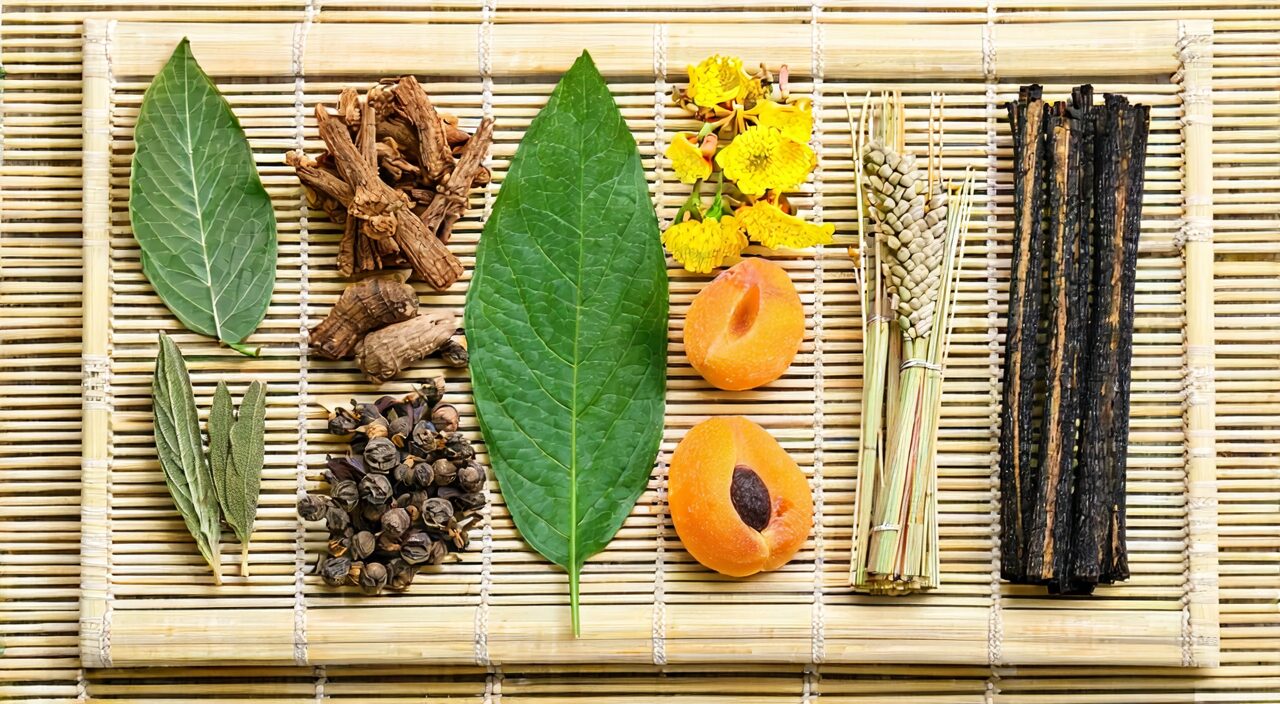
Below is the common medicinal composition of Sang Ju Yin and traditional reference dosages. Specific dosages and proportions vary in ancient and modern versions. Practical application must be adjusted by a professional according to individual conditions; self-prescription without guidance is not recommended.
| Medicinal | Common Reference Dosage (ancient weight converted, for reference only) | Traditional Primary Action |
|---|---|---|
| Mulberry Leaf (Sang Ye) | Approx. 7.5 g | Disperse wind-heat, clear the lung and moisten dryness |
| Chrysanthemum Flower (Ju Hua) | Approx. 3 g | Disperse wind and clear heat, calm the liver and brighten the eyes |
| Apricot Seed (Xing Ren) | Approx. 6 g | Diffuse the lung and stop coughing, direct qi downward and transform phlegm |
| Forsythia Fruit (Lian Qiao) | Approx. 5 g | Clear heat and resolve toxins, disperse wind-heat |
| Peppermint (Bo He) | Approx. 2.5 g | Disperse wind-heat, clear the head and eyes |
| Platycodon Root (Jie Geng) | Approx. 6 g | Diffuse the lung and expel phlegm, benefit the throat and expel pus |
| Reed Rhizome (Lu Gen) | Approx. 6 g | Clear heat and generate fluids, relieve vexation and thirst |
| Licorice (Gan Cao) | Approx. 2.5 g | Harmonize all medicinals, stop coughing and benefit the throat |
This formula overall is light and dispersing, not a drastic remedy. Therefore, predecessors described Sang Ju Yin as a “light pungent-cool formula,” distinguishing it in action intensity from Yin Qiao San, which is called a “moderate pungent-cool formula.”
Groups That Sang Ju Yin May Be Suitable For

The following description is only common manifestations from traditional pattern differentiation experience. Whether Sang Ju Yin is suitable must be determined by a comprehensive assessment of individual constitution, tongue appearance, pulse condition, etc. Do not match a single symptom alone.
Generally, Sang Ju Yin is often considered for the following directions:
- Cough characterized by dry cough or paroxysmal cough, dry and itchy or slightly sore throat, scanty and sticky sputum, or sputum color between yellow and white.
- Accompanied by mild fever, slight aversion to wind or heat, distending or mild headache, dry mouth with desire to drink but not large amounts.
- Tongue edges and tip slightly red, thin white or thin yellow coating, floating and rapid pulse.
- Early-stage wind-heat common cold where cough and dry throat are predominant, and high fever, profuse sweating, and marked thirst indicating qí level heat exuberance have not yet appeared.
If coughing is accompanied by severe throat pain, persistent high fever, large amounts of thick yellow purulent sputum, chest tightness and wheezing, it may already be beyond the scope of Sang Ju Yin. In such cases, a more cautious evaluation of the overall condition is required, and the approach of this formula alone is not appropriate.
Conditions Where Sang Ju Yin Is Not Suitable or Requires Caution

Every formula has its applicable scope; using it in the wrong direction may even worsen discomfort. The following conditions are usually not appropriate directions for Sang Ju Yin:
- Wind-Cold Cough
Cough accompanied by obvious chills, absence of sweating, white and clear thin sputum, clear runny nose, generalized body aches, pale tongue with thin white coating, indicate wind-cold fettering the lung. Sang Ju Yin is cool in nature; using it for wind-cold exterior patterns may damage yang qi and prolong the cough. In such cases, traditionally, formulas biased toward warm-dispersing, such as Zhi Sou San or San Ao Tang, are more often considered.
- Cough Due to Cold-Fluid Retention or Spleen Deficiency with Phlegm-Dampness
Recurrent cough, profuse white and clear thin sputum, easily aggravated by cold or at night, accompanied by poor appetite, loose stools, swollen tongue with tooth marks, etc., are mostly related to spleen deficiency generating phlegm and internal cold-fluid retention. Sang Ju Yin’s clearing and moistening direction does not match the pattern. Xiao Qing Long Tang (Minor Green Dragon Decoction) and other formulas that warm and transform cold-fluid retention may be another line of thinking, but strict pattern differentiation is required.
- Spleen-Stomach Deficiency Cold or Insufficient Yang Qi
Sang Ju Yin contains medicinals that are cool in nature. For people who usually have chills, cold hands and feet, loose stools, or are prone to stomach pain and diarrhea, even if there is a mild cough, caution is needed. Using a cool formula alone may damage spleen-stomach function.
- Pregnant Women, Children, and Frail Elderly
These special populations must use any formula under the guidance of a professional; they should not self-select based on symptoms.
- Those Who Have Developed Severe Symptoms
If persistent high fever, shortness of breath, chest pain, hemoptysis, confusion, etc., appear, the condition is no longer simple wind-heat cough. Seek medical attention immediately and do not rely on any single Chinese medicine formula.
Differences Between Sang Ju Yin and Yin Qiao San
These two formulas are often confused. Both originate from Systematic Differentiation of Warm Diseases and belong to the pungent-cool exterior-releasing category, but their emphases differ.
| Comparison Dimension | Sang Ju Yin | Yin Qiao San |
|---|---|---|
| Disease Location Emphasis | More on lung qi not diffusing; cough prominent, fever may be mild | More on defensive aspect heat toxin relatively severe; fever more pronounced, sore throat, thirst, red tongue tip, etc. |
| Formula Potency | Chief herbs Mulberry Leaf and Chrysanthemum, lighter and clearing medicinal nature, considered “light pungent-cool formula” | Lonicera and Forsythia in relatively larger doses, combined with Schizonepeta, Fermented Soybean, etc.; stronger potency in clearing heat, resolving toxins, and venting exterior pathogens, considered “moderate pungent-cool formula” |
| Selection Approach | When cough and dry throat are primary, and fever is absent or mild, this direction may be preferred | When sore throat, fever, and thirst are primary, and cough is mild, this direction may be considered more |
In clinical pattern differentiation, the two often overlap and require dynamic adjustment.
Brief Differentiation Between Sang Ju Yin and Other Cough-Related Formulas
Besides Yin Qiao San, several other commonly used formulas are also frequently compared with Sang Ju Yin. The following is only a directional illustration and cannot replace pattern differentiation.
- Zhi Sou San (Stop Coughing Powder)
Originating from Medical Insights of the Heart (Yi Xue Xin Wu), it mainly contains Platycodon, Schizonepeta, Aster, Stemona, Cynanchum, etc. It tends to diffuse the lung and stop coughing, disperse wind and release the exterior, with a balanced medicinal nature that is neither cold nor hot. It is often used for the later stage of externally contracted cough, lingering cough, where cold or heat is not pronounced. Compared with Sang Ju Yin, Zhi Sou San has no obvious heat-clearing direction, making it more suitable for coughs where wind pathogen is not fully resolved and cold-heat bias is not strong.
- Xiao Qing Long Tang (Minor Green Dragon Decoction)
A typical formula for warming and transforming cold-fluid retention, suitable for external cold and internal fluid retention, i.e., chills and fever, absence of sweating, cough and wheezing, profuse white clear thin sputum, even inability to lie flat. It is completely opposite to Sang Ju Yin and must never be used for wind-heat cough.
- Chuan Bei Pi Pa Type Formulas
These formulas or patent medicines generally tend to clear heat and moisten the lung, transform phlegm and stop coughing. They are suitable for dry-heat cough or yin deficiency with lung dryness cough, commonly presenting as dry cough with little sputum, dry throat and nose, red tongue with little coating, etc. Although Sang Ju Yin also has heat-clearing and lung-diffusing effects, it leans more toward dispersing wind-heat, while Chuan Bei Pi Pa type formulas emphasize moistening dryness and transforming phlegm. The two may overlap in the aspect of “scanty and sticky sputum,” but the etiological focus on “wind” versus “dryness” differs, requiring careful differentiation.
Precautions When Using Sang Ju Yin-Related Products
Currently, there are some patent Chinese medicines or granules based on the Sang Ju Yin concept on the market, but the composition, dosage, and formulation of different products may vary. Whether using traditional decoctions or modern preparations, note the following points:
- Determining whether the formula matches the pattern requires combining tongue appearance, pulse condition, and overall symptoms. If it is difficult to determine by yourself, it is recommended to consult a Chinese medicine practitioner or relevant professional.
- Even if the pattern is differentiated as wind-heat cough, if the cough persists without relief after a short period of administration, or if new symptoms appear, stop immediately and reassess.
- Severe, prolonged, recurrent cough, or cough accompanied by chest tightness or pain, dyspnea, hemoptysis, weight loss, hoarseness lasting more than two weeks, etc., must be evaluated by modern medical examination as early as possible to rule out other organic problems.
No formula is a guarantee of “complete cure upon taking,” nor should it be regarded as a daily health beverage. Sang Ju Yin in traditional use is often applied short-term and discontinued once the pattern is resolved. Overuse of cold cool herbs may instead damage lung qi and spleen-stomach.
Summary
Sang Ju Yin is one of the representative formulas in traditional Chinese medicine for releasing the exterior with pungent-cool herbs and diffusing the lung to stop coughing. It is often used for early-stage wind-heat with cough, dry throat, scanty sticky sputum, mild fever, etc., with a relatively light and clearing medicinal nature. Its composition is mainly Mulberry Leaf and Chrysanthemum, supported by Apricot Seed, Forsythia, Platycodon, etc. The overall action intensity is milder than Yin Qiao San. Strict differentiation from wind-cold cough, cold-fluid retention cough, and other conditions is necessary.
For those who are unsure whether it is suitable, especially people who usually have spleen-stomach deficiency cold, or cough with profuse clear thin sputum, or relatively high fever, or belong to special constitutions, self-selection is not recommended. The use of any Chinese medicine formula must be based on accurate pattern differentiation. This article is only a popular science review from the perspective of traditional understanding and cannot replace professional diagnosis and personalized advice. Actual choices should combine individual conditions and professional guidance.