
Who is Si Jun Zi Tang Suitable For? Ingredients, Benefits and Contraindications Explained

In traditional formulas, Si Jun Zi Tang is often regarded as the starting point for tonifying qi and strengthening the spleen. Many people hear this name when they feel tired, have poor appetite, or feel bloated after meals. However, not all fatigue is related to it, nor does it mean it is suitable for everyone.
This article will cover the composition, traditional uses, suitable constitutional presentations, contraindications of Si Jun Zi Tang, and how it differs from several similar common formulas. It aims to help readers clearly understand what it may be suitable for while avoiding misuse.
The Position of Si Jun Zi Tang in Traditional Chinese Medicine
Si Jun Zi Tang originates from the “Taiping Huimin Heji Ju Fang” (Formulary of the Pharmacy Service for Benevolent Relief) in the Song Dynasty. Traditionally, it is classified as a qi-tonifying formula, with its core action being to boost qi and strengthen the spleen.
In TCM, “spleen and stomach qi deficiency” does not refer solely to a problem with the digestive organs, but encompasses the overall functional state from digestion and absorption to energy production. When this fundamental process is weak, people tend to experience fatigue, reduced appetite, irregular bowel movements, etc.
Many subsequent qi-tonifying formulas have evolved from Si Jun Zi Tang. Therefore, understanding it also helps to grasp the starting point of a category of regulatory strategies. However, it should be noted that the use of a formula must take into account an individual’s constitution and symptom manifestations at the time; no single formula is suitable for everyone.
Composition of Si Jun Zi Tang and the Action of Each Herb
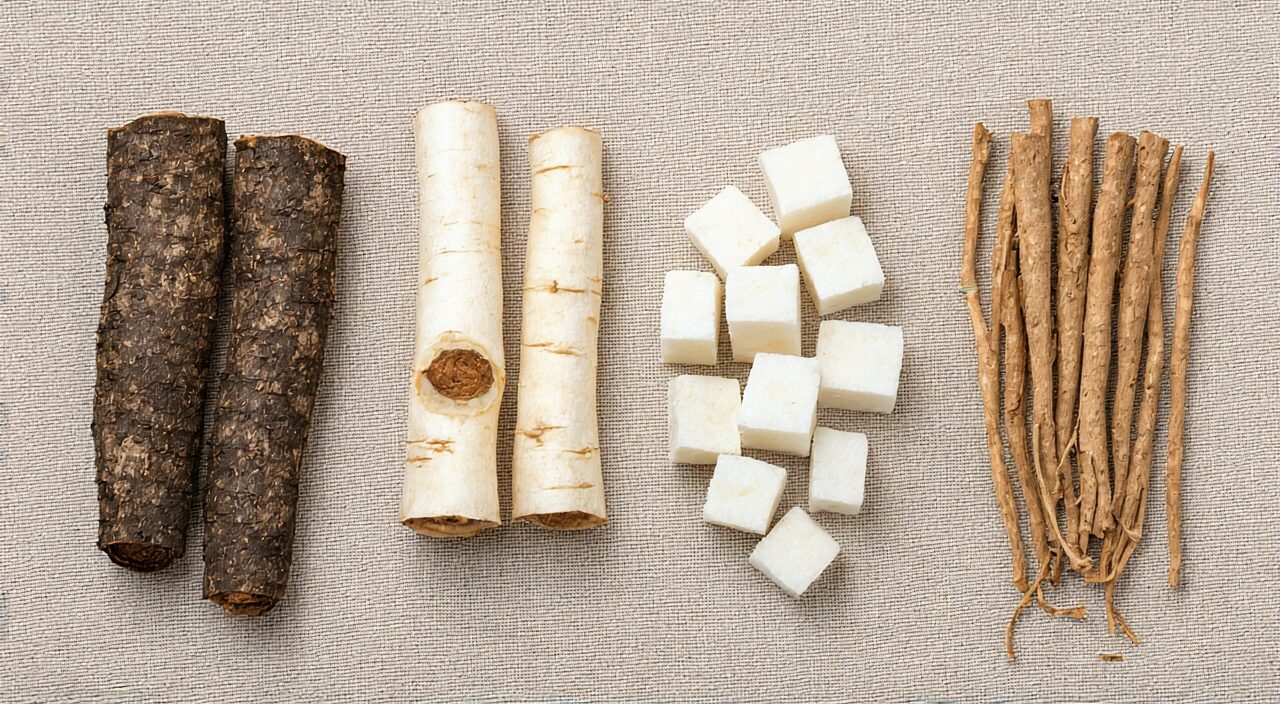
Si Jun Zi Tang consists of four common herbs. Its overall nature and flavor are gentle, tending toward sweet and warm. From the perspective of traditional compatibility, it takes into account both the generation and circulation of qi. It does not pursue immediate results but focuses on gradually restoring spleen and stomach function.
| Herb | Traditional Action |
|---|---|
| Ren Shen (Ginseng) | Greatly tonifies the original qi, strengthens the spleen and lungs |
| Bai Zhu (Atractylodes) | Strengthens the spleen and replenishes qi, dries dampness and promotes urination |
| Fu Ling (Poria) | Promotes urination and drains dampness, strengthens the spleen and calms the heart |
| Zhi Gan Cao (Honey-fried Licorice) | Tonifies the spleen and harmonizes the stomach, moderates and harmonizes the actions of all herbs |
In practice, Ren Shen is sometimes replaced with Dang Shen (Codonopsis) according to specific conditions to moderate the overall strength. The combination of these four herbs is not simply a pile of qi-tonifying substances; it concurrently strengthens the spleen, eliminates dampness, and harmonizes the middle burner, thereby preventing stagnation during the process of tonification.
Suitable Individuals from the Perspective of Spleen and Stomach Qi Deficiency
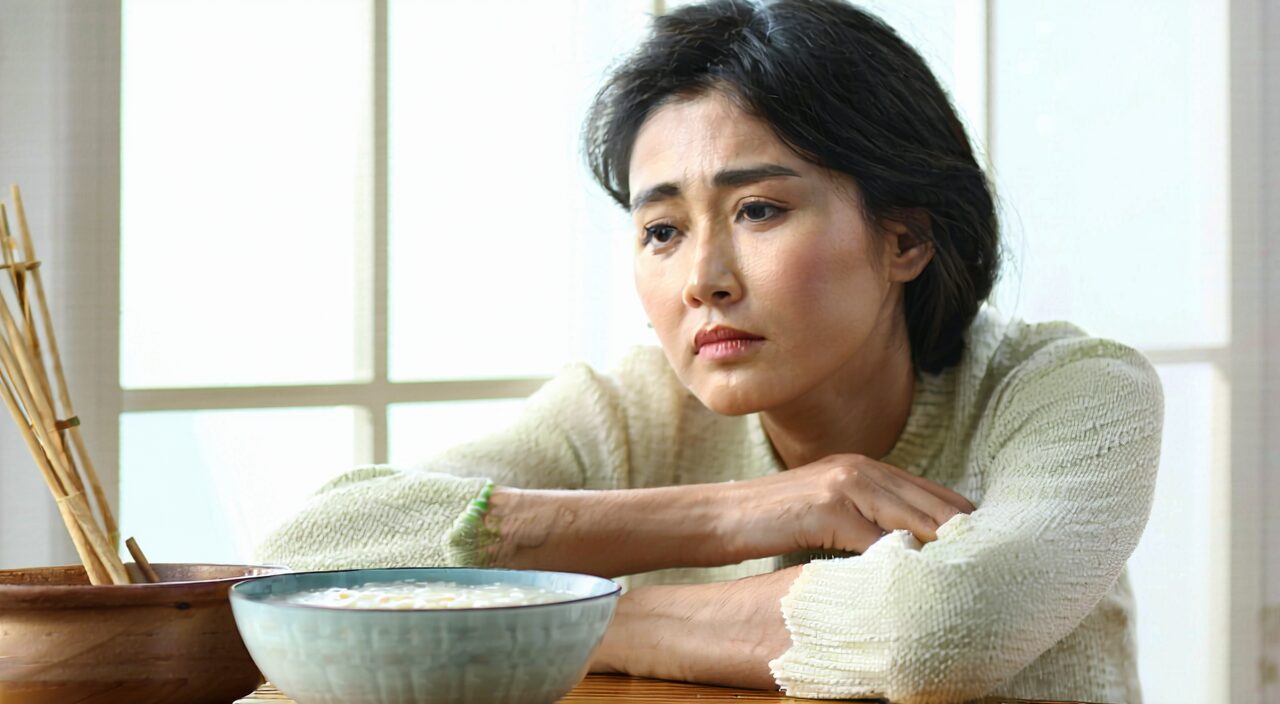
Traditionally, Si Jun Zi Tang is often used for regulating spleen and stomach qi deficiency. This type of constitution may present with the following manifestations, but not all are required; it is usually a comprehensive assessment:
- Reduced appetite and fatigue: Eating little or feeling sleepy and lacking energy after meals.
- Shortness of breath and reluctance to speak: Speaking with a low voice, feeling out of breath with slight activity, and not wanting to talk much.
- Lackluster complexion: A yellowish or lackluster facial complexion, with lighter lip color.
- Loose stools: Unformed, soft, and mushy stools that tend to stick to the toilet bowl.
- Tongue and pulse presentation: The tongue body is pale, possibly enlarged with teeth marks, and the tongue coating is thin and white; the pulse tends to be slow and weak.
If the fatigue is short-term and caused by occasional overwork or dieting, it may not fall within the scope of spleen and stomach qi deficiency. When the above manifestations persist for a longer time and are not easily restored by rest, TCM often considers the approach of replenishing qi and strengthening the spleen, with Si Jun Zi Tang being one of the basic options.
Situations Requiring Caution or Where It Is Not Suitable
Not everyone who is tired or has digestive issues is suitable for Si Jun Zi Tang. The following conditions are generally outside its traditional scope of use and may even worsen discomfort:
- Obvious excess heat or damp-heat: For example, bitter taste in the mouth, bad breath, thick yellow greasy tongue coating, sticky foul-smelling stools, and a tendency to develop red swollen acne. In such cases, tonifying qi is likely to make damp-heat more difficult to resolve.
- Yin deficiency with fire hyperactivity: Heat in the palms and soles, dry mouth and throat, night sweats, red tongue with little coating. If sweet-warm qi-tonifying herbs are used in this type of deficiency-heat condition, it may make the deficiency fire more pronounced.
- Acute stage of external contraction: During external pathogenic discomforts such as colds, fever, sore throat, etc., tonifying formulas are traditionally not used at this time to avoid interfering with the body’s expulsion of external pathogens.
- Acute digestive problems: Such as severe abdominal pain, persistent vomiting, diarrhea accompanied by fever, blood in the stool, or black tarry stools. These require prompt clarification of the cause and are not suitable for self-regulation with qi-tonifying formulas.
- Special populations: During pregnancy, breastfeeding, for children, or when using other medications simultaneously, the situation is more complex; one should consult a professional rather than self-judging the use.
If there is long-term marked fatigue accompanied by palpitations, chest tightness, unexplained weight loss, or persistently low mood and loss of interest, it is advisable to seek a doctor’s evaluation to rule out other issues that need priority attention.
Comparison with Several Common Formulas
Si Jun Zi Tang is often compared with other formulas and can easily be confused with Liu Jun Zi Tang, Bu Zhong Yi Qi Tang, Shen Ling Bai Zhu San, and Ba Zhen Tang. Understanding their differences can help with further discernment.
Si Jun Zi Tang vs. Liu Jun Zi Tang
Liu Jun Zi Tang adds Chen Pi (tangerine peel) and Ban Xia (pinellia) to the base of Si Jun Zi Tang. Chen Pi regulates qi, and Ban Xia dries dampness and transforms phlegm. Therefore, while Liu Jun Zi Tang tonifies qi and strengthens the spleen, it puts more emphasis on improving phlegm-dampness and qi stagnation.
If spleen and stomach qi deficiency is accompanied by obvious excessive phlegm, tendency to nausea, chest and epigastric stuffiness, and a white greasy tongue coating, Liu Jun Zi Tang may be more suitable than Si Jun Zi Tang alone. In other words, Si Jun Zi Tang is more of a basic qi tonic, while Liu Jun Zi Tang is more focused on tonifying qi, transforming phlegm, and regulating qi.
Si Jun Zi Tang vs. Bu Zhong Yi Qi Tang
Bu Zhong Yi Qi Tang centers on Huang Qi (astragalus), Sheng Ma (cimicifuga), Chai Hu (bupleurum), etc. While tonifying qi, it places emphasis on raising yang qi. Traditionally, it is often used for central qi sinking, manifested as chronic diarrhea, anal prolapse, a sense of stomach drooping, uterine prolapse, or low-grade fever and fatigue of unknown origin.
Si Jun Zi Tang, on the other hand, is more focused on preserving the middle and strengthening the spleen, without a significant lifting action. If the main problem is a sensation of organ drooping or qi sinking downward due to qi deficiency, Bu Zhong Yi Qi Tang may receive more attention.
Si Jun Zi Tang vs. Shen Ling Bai Zhu San
Shen Ling Bai Zhu San also contains the base of Si Jun Zi Tang, and adds Shan Yao (Chinese yam), Lian Zi (lotus seed), Yi Yi Ren (coix seed), Sha Ren (amomum), etc. While tonifying qi, it strengthens the functions of fortifying the spleen, draining dampness, and stopping diarrhea.
It is suitable for those with more pronounced dampness on top of spleen and stomach qi deficiency, manifesting as loose and watery stools, increased frequency, eating little but easily bloated, and even mild edema. In comparison, Si Jun Zi Tang is more gentle and focuses on basic tonification, while Shen Ling Bai Zhu San has a stronger effect on regulating diarrhea due to spleen deficiency with predominant dampness.
Si Jun Zi Tang vs. Ba Zhen Tang
Ba Zhen Tang is a combined formula of Si Jun Zi Tang and Si Wu Tang. On the basis of tonifying qi, it adds blood-tonifying herbs such as Dang Gui (Chinese angelica), Shu Di Huang (prepared rehmannia), Bai Shao (white peony root), and Chuan Xiong (ligusticum). It is suitable for dual deficiency of qi and blood, presenting with both spleen and stomach qi deficiency fatigue and low food intake, and blood deficiency symptoms like pale or sallow complexion, dizziness, palpitations, and reduced menstrual flow.
If there is only spleen qi deficiency without obvious signs of blood deficiency, Si Jun Zi Tang may be more direct, while Ba Zhen Tang would add unnecessary blood-tonifying components.
The differences between these formulas indicate that even though they all belong to the tonifying category, each has its own emphasis. It is necessary to consider an individual’s specific symptoms and constitutional characteristics, and one should not make a choice based merely on a vague symptom.
Key Points to Note When Understanding Traditional Formulas
Although Si Jun Zi Tang is a basic formula, in practice it often needs to be adjusted according to individual circumstances. Traditional TCM rarely uses the original formula unchanged for a long period; rather, it modifies it as symptoms change:
- When there is dampness, the dosages of Fu Ling and Bai Zhu may be increased;
- When qi stagnation is obvious, Chen Pi may be added;
- When there is blood deficiency, Dang Gui may be added;
- When cold signs are obvious, Gan Jiang (dried ginger) may be added.
All these modifications must be carried out based on actual pattern differentiation.
Furthermore, formulas come in various forms, not limited to decoctions. In traditional usage, it is also common to make them into pills or powders. Different dosage forms have different characteristics in terms of absorption speed, strength of action, and convenience. Regardless of the form, it is recommended to make a comprehensive judgment based on product instructions, individual circumstances, and professional advice. The traditional efficacy of a formula should not be directly equated with the actual effect of a particular product.
Summary
As a basic formula for boosting qi and strengthening the spleen, Si Jun Zi Tang is traditionally suitable for people with spleen and stomach qi deficiency, with typical manifestations including reduced appetite and fatigue, shortness of breath and reluctance to speak, lackluster complexion, and loose stools. However, it is generally not suitable for those with excess heat, damp-heat, yin deficiency with fire hyperactivity, or those in an acute state of discomfort.
It differs from Liu Jun Zi Tang, Bu Zhong Yi Qi Tang, Shen Ling Bai Zhu San, and Ba Zhen Tang in emphasis, respectively focusing on transforming phlegm and regulating qi, raising yang qi, fortifying the spleen and draining dampness, and dual-topic tonifying of qi and blood. Selection should be based on individual differences.
For long-term recurring fatigue and digestive issues, especially when accompanied by significant low mood, weight changes, or other warning signals from the body, professional evaluation should be sought as a priority rather than self-prescribing a formula. This article is for educational reference only and cannot replace professional diagnosis or treatment advice.