
Who is Wuling Powder Suitable For? Composition, Effects and Contraindications

When looking into Chinese medicine resources for edema, difficult urination or recurrent water-dampness retention, the name Wuling Powder tends to appear again and again. Recorded in the Treatise on Cold Damage, it remains one of the commonly referenced formulas for managing water-dampness related issues.
However, Wuling Powder is not suitable for every condition associated with water-dampness. Clarifying its composition, traditional uses, suitable populations and contraindications makes it possible to better understand where it fits into the broader picture. This article approaches it from the perspective of transforming qi and promoting urination and regulating water-dampness metabolism, and provides comparisons with several similar formulas for reference.
Understanding the Core Logic of Wuling Powder from Transforming Qi and Promoting Urination
In traditional Chinese medicine, water-dampness retention is often understood through the relationship between qi and water. The normal distribution and excretion of body fluids rely on the driving force of yang qi and the qi-transforming function of the bladder.
When qi transformation is impaired and water-dampness accumulates internally, signs such as difficult urination, localized edema, and thirst without a desire to drink may appear. The traditional action of Wuling Powder is precisely to help restore this qi transformation process so that water-dampness can be excreted normally; it is therefore often classified as a formula that “transforms qi and promotes urination.”
Composition of Wuling Powder
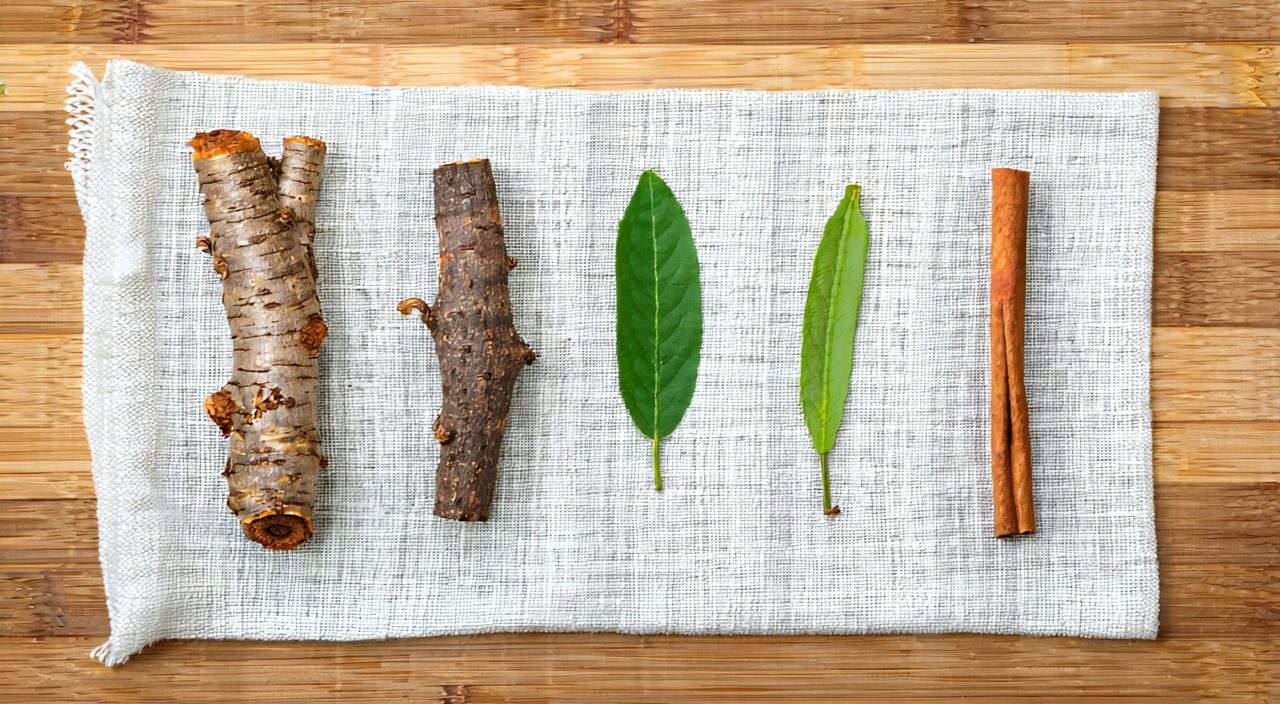
Wuling Powder consists of five herbs with a concise yet distinct structure. The following is a reference for the basic formula composition; in practice, dosages are adjusted according to individual situations:
| Medicinal | Traditional Action Focus |
|---|---|
| Alisma (Ze Xie) | Promotes urination and drains dampness, primarily acting on the lower jiao |
| Poria (Fu Ling) | Strengthens the spleen and percolates dampness, promotes urination without damaging healthy qi |
| Polyporus (Zhu Ling) | Promotes urination and drains dampness, stronger than Poria |
| Atractylodes (Bai Zhu) | Strengthens the spleen and dries dampness, aids in transforming and transporting water-dampness |
| Cinnamon Twig (Gui Zhi) | Warms and unblocks yang qi, assists bladder qi transformation |
Together, these five ingredients guide water-dampness out through the urine while simultaneously supporting spleen-stomach transportation and yang qi propulsion, creating a structure that promotes urination without significantly depleting healthy qi. Traditionally, this is seen as one of the classic combinations for addressing water-dampness retention and impaired qi transformation.
Traditional Indications for Wuling Powder
The core problem Wuling Powder addresses is internal water-dampness retention and impaired bladder qi transformation. Based on this direction, historical records often mention the following types of presentations. Whether it is suitable still needs to be determined according to individual constitution and specific circumstances.
Difficult Urination and Edema
Whether it is difficult urination and reduced urine output caused by water accumulation in the lower jiao, or limb puffiness and eyelid swelling related to fluid retention, Wuling Powder has been considered as a reference approach. By restoring qi transformation and facilitating urine output, it helps reduce excess water-dampness in the body.
Thirst with Desire to Drink but Immediate Vomiting of Ingested Water
In some cases, a person feels thirsty, but soon after drinking they experience nausea and even vomit the water, accompanied by difficult urination. Traditionally this is seen as “water reversal,” indicating water-dampness accumulation and blockage of qi transformation. Wuling Powder can help promote fluid metabolism and relieve this type of discomfort.
Diarrhea Caused by Water-Dampness
When water-dampness spills into the intestines, leading to loose stools and increased frequency but without severe abdominal pain, it is sometimes approached from the perspective of promoting urination to solidify the stool. By increasing water excretion through urine, Wuling Powder reduces the abnormal retention of water in the intestines, thus helping the stool to form.
Note that this is only suitable for the type where water-dampness predominates and does not apply to all cases of diarrhea.
Other Signs of Internal Water-Fluid Retention
Some presentations such as dizziness, chest tightness, epigastric stuffiness and a heavy sensation in the body are traditionally thought to be related to water-fluid retention. If accompanied by signs such as difficult urination or a white, slippery tongue coating, Wuling Powder may be considered as one of the directions for understanding the condition.
However, these presentations have complex causes; one should never self-diagnose and use the formula on one’s own.
Who May Not Be Suitable for Wuling Powder
Recognizing unsuitable situations is often more important than knowing who it is suited for. Wuling Powder leans towards promoting urination and unblocking yang; if the constitution or disease mechanism does not match, it may actually worsen the discomfort. The following situations are traditionally considered contraindications or warrant special caution:
- Yin deficiency with fluid depletion: Signs such as dry mouth and throat, red tongue with little coating, dry skin, and five-center heat indicate insufficient body fluids. Wuling Powder promotes urination and drains dampness, which may further consume fluids and aggravate yin deficiency.
- Heat excess damaging fluids: After high fever with dehydration or heavy sweating with noticeable fluid loss, simply promoting urination is inappropriate; replenishing fluids should be the priority.
- Acute severe water-electrolyte imbalances: For example, obvious dehydration and electrolyte disturbances caused by severe vomiting or diarrhea require timely modern medical intervention; diuretic formulas should not be used on one’s own.
- Pregnant or breastfeeding women and those with special constitutions: These require more individualized assessment; it is not advisable to refer to general usage directions on one’s own.
- Long-standing chronic edema of unknown cause: Edema may be a manifestation of problems in multiple systems such as the heart, kidneys or liver. A professional diagnosis should be sought first rather than directly choosing a diuretic formula.
The above are summaries of traditional understanding. The actual suitability must be determined by combining individual symptoms, constitution, and the specific judgment of a professional.
Differences from Several Similar Formulas
Wuling Powder is often compared with formulas such as Fangji Huangqi Decoction, Linggui Zhugan Decoction, Zhuling Decoction, and Huoxiang Zhengqi Powder, because they all relate to water-dampness metabolism, yet differ in their emphasis and applicable scenarios. The following comparison can help form a clearer concept, but cannot replace professional pattern differentiation.
Wuling Powder vs. Fangji Huangqi Decoction
Fangji Huangqi Decoction leans towards edema caused by exterior deficiency failing to secure the exterior, where water-dampness overflows into the skin, often accompanied by sweating, aversion to wind, heavy body sensation, and qi deficiency fatigue. By contrast, Wuling Powder focuses on impaired bladder qi transformation; edema can appear throughout the body, but the core is internal water-dampness retention and difficult urination, without prominent qi deficiency signs.
If edema is accompanied by marked fatigue and easy sweating, one might need to consider the Fangji Huangqi Decoction direction; if difficult urination and internal water-fluid retention are the main issues, it is closer to the traditional scope of Wuling Powder.
Wuling Powder vs. Linggui Zhugan Decoction
Linggui Zhugan Decoction primarily warms yang and transforms fluid retention while strengthening the spleen and promoting urination. It is commonly used for water-fluid retention caused by middle-yang insufficiency, with typical manifestations such as a feeling of fullness and stuffiness below the heart, qi rushing upward to the chest, and dizziness upon standing. Wuling Powder, on the other hand, is more focused on water accumulation in the lower jiao, with difficult urination as the key sign, and the scope of water-fluid retention is broader.
Simply put, Linggui Zhugan Decoction emphasizes water-fluid retention in the middle jiao rebelling upward, while Wuling Powder emphasizes unresolved water accumulation in the lower jiao.
Wuling Powder vs. Zhuling Decoction
Zhuling Decoction also promotes urination, but it simultaneously clears heat and nourishes yin. It is often used for situations where water and heat bind together with yin already damaged, such as painful, difficult urination, thirst, irritability, and a red tongue with little coating. Wuling Powder, in contrast, is more suited to cold-dampness or water-dampness retention without obvious heat signs; the tongue coating is often white and slippery or thin and white.
If heat signs and yin deficiency are both present, Zhuling Decoction may be the direction that draws more attention.
Wuling Powder vs. Huoxiang Zhengqi Powder
Huoxiang Zhengqi Powder is commonly used for concurrent external contraction of wind-cold and internal damage from dampness stagnation, with presentations such as chills and fever, headache, chest tightness, nausea, vomiting, abdominal pain and diarrhea. Its treatment principle is to release the exterior and transform dampness while regulating qi and harmonizing the middle. Wuling Powder, on the other hand, mainly addresses internal fluid metabolism disharmony without obvious exterior pattern characteristics.
If the presentation involves gastrointestinal discomfort of dampness stagnation accompanied by external contraction, Huoxiang Zhengqi Powder may be a more suitable reference; if it is only internal dampness stagnation and difficult urination, Wuling Powder is a better fit.
Thus, there is a clear pathomechanism boundary between Wuling Powder and its related formulas; different formulas apply to different types of water-dampness issues. Actual selection should integrate constitution, symptoms and professional judgment; one should not match formulas mechanically based on just one or two signs.
Summary
As a classic diuretic formula, Wuling Powder is traditionally used mainly for presentations caused by impaired bladder qi transformation and internal water-dampness retention, such as difficult urination, edema, vomiting upon drinking, and water-dampness diarrhea. Its composition centers on promoting urination and draining dampness combined with unblocking yang and transforming qi, giving it a clear direction of action. However, it is not suitable for all water-dampness related conditions.
Those with yin deficiency and fluid depletion, heat excess damaging fluids, acute dehydration, and special populations such as pregnant women are generally unsuitable. Compared with formulas such as Fangji Huangqi Decoction, Linggui Zhugan Decoction, Zhuling Decoction and Huoxiang Zhengqi Powder, Wuling Powder has distinct differences in pathomechanism emphasis and scope of application.
This article is for informational reference only, helping readers gain a preliminary understanding of the composition, traditional uses, and common contraindications of this classic formula. It cannot replace professional diagnosis or treatment advice. If related symptoms persist, recur, or are accompanied by other discomforts, it is recommended to promptly seek help from a physician or relevant professional for a safe and individualized management plan.