
Xuan Fu Dai Zhe Tang: Who Is It Suitable For? Composition, Benefits and Precautions Explained

In daily life, some people often feel incessant belching after meals, a sensation of something stuck in the chest, or repeatedly experience nausea and regurgitation, sometimes even feeling as though phlegm is constantly lodged in the throat. If these conditions persist for an extended period, many will seek traditional approaches for relief. Xuan Fu Dai Zhe Tang is one such classic formula frequently mentioned. But precisely who is it suitable for? What specific herbs does it contain? What misconceptions should be avoided when considering it, and how does it differ from similar formulas? This article will explain each aspect in detail, helping readers form a clearer understanding.
Formula Origin and Traditional Application Thinking
Xuan Fu Dai Zhe Tang originates from the Treatise on Cold Damage (Shang Han Lun) by Zhang Zhongjing in the Eastern Han Dynasty. The original text states: “In cases of cold damage, after applying sweating, vomiting, or purging, once the condition is resolved yet epigastric hardness and fullness with persistent belching remains, Xuan Fu Dai Zhe Tang governs it.”
Here, “epigastric hardness and fullness” refers to a feeling of stuffiness, distension, and mild firmness when pressing the upper abdomen; “belching” refers to repeated burping or eructation. The description points to a situation where, after an external pathogen has been addressed, the stomach is left with a sensation of stuffiness and continuous belching.
Traditional Chinese medicine holds that this reflects damaged stomach qi, internally generated phlegm turbidity, and qi mechanism failing to descend but instead rebelling upward. Therefore, the design principle of Xuan Fu Dai Zhe Tang revolves around “descending rebellious qi, transforming phlegm, boosting qi, and harmonizing the stomach,” allowing the upward-rebelling qi to descend while also supporting the recovery of stomach qi.
Composition and Formula Rationale
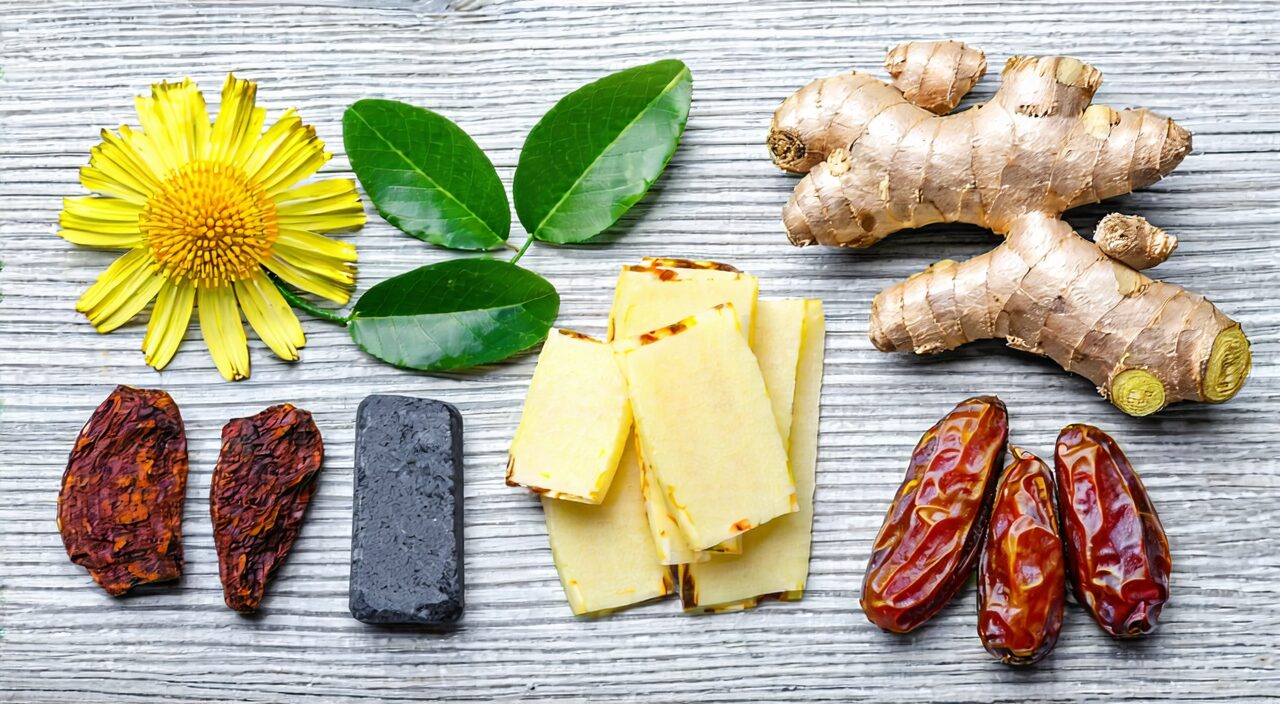
Main Composition
Xuan Fu Dai Zhe Tang consists of seven herbs, traditionally combined in certain proportions. Refer to the table below for details:
| Herb | Reference Dosage (Traditional Ratio) | Role in the Formula |
|---|---|---|
| Inula Flower (Xuan Fu Hua) | Approx. 9 g | Directs qi downward, dissolves phlegm, descends rebellious qi and stops belching |
| Hematite (Dai Zhe Shi) | Approx. 3 g (relatively small dose) | Heavily anchors and descends rebellious qi, assists stomach qi in moving downward |
| Pinellia Rhizome (Ban Xia) | Approx. 9 g | Dries dampness, transforms phlegm, descends rebellious qi and stops vomiting |
| Fresh Ginger (Sheng Jiang) | Approx. 15 g | Warms the stomach, disperses water retention, harmonizes the stomach and descends rebellious qi |
| Ginseng (Ren Shen) | Approx. 6 g | Boosts qi and supplements the center, protects the spleen and stomach |
| Honey-Fried Licorice Root (Zhi Gan Cao) | Approx. 9 g | Boosts qi, harmonizes the center, moderates and coordinates all herbs |
| Jujube (Da Zao) | Approx. 4 pieces | Supplements the spleen and nourishes the stomach, assists ginseng in boosting qi |
Note: The above dosages are traditional reference ranges and should be adjusted based on individual presentation. Self-formulating is not advised.
Combination Rationale
Inula Flower and Hematite are the core herbs of the formula. Inula Flower is known for being the “only flower that descends while all flowers ascend”; it directs qi downward, dissolves phlegm, and is particularly effective at relieving belching and a choking sensation caused by phlegm-qi rebelling upward. Hematite is heavy in nature and can anchor and descend rebellious qi, but its dosage must remain relatively low to avoid damaging stomach qi. One light and one heavy, the two work together to guide rebellious qi downward.
Pinellia Rhizome and Fresh Ginger form another key pairing: Pinellia transforms phlegm and dissipates masses, harmonizes the stomach and descends rebellious qi; Fresh Ginger warmly disperses water retention and stops vomiting. Together, they not only strengthen the effect of descending rebellious qi and stopping vomiting but also reduce the toxicity of Pinellia.
Ginseng, Licorice, and Jujube are dedicated to fortifying the qi of the middle burner and restoring the normal descending and ascending function of stomach qi. The entire formula simultaneously attacks and supplements: it resolves phlegm and descends rebellious qi without harming stomach qi, and boosts qi and supplements the center without encouraging phlegm-dampness. This embodies the rigorous yet balanced principles of classical formula design.
Suitable Presentations and Constitutional Direction
Not everyone who experiences belching or nausea is suitable for Xuan Fu Dai Zhe Tang. In traditional pattern differentiation, it is more inclined to address a state marked by “relative stomach qi deficiency, internal obstruction of phlegm turbidity, and rebellious qi mechanism.” Specifically, the following presentations may point in this direction:
- Frequent belching, often loud, which typically worsens after eating; sometimes continuous hiccuping.
- Nausea and regurgitation, with a sensation of food or gas rising from the stomach, though not necessarily vomiting every time.
- Epigastric stuffiness and fullness, as if something is blocked there; there may be slight resistance on pressure, but no severe pain.
- A feeling of phlegm lodging in the throat or chest, often sensing the presence of phlegm that is difficult to expectorate, or bringing up thin, white phlegm.
- Occasionally accompanied by signs of weakened spleen and stomach function such as reduced appetite, loose stools, and easy fatigability.
If the above manifestations are fairly evident, some may, under the guidance of a professional TCM practitioner, consider this formula as a direction for understanding. However, it must be emphasized that these are only externally visible clues. Chinese medicine stresses “synthesis of the four diagnostic methods”; a few symptoms alone are insufficient. Constitutional presentation, tongue appearance, and pulse condition all influence the judgment, and one should never self-diagnose or self-prescribe.
Situations Requiring Caution or Avoidance
Although Xuan Fu Dai Zhe Tang can descend rebellious qi and harmonize the stomach, its properties lean toward warming and supplementing, making it unsuitable for all vomiting or belching problems. The following situations require special attention:
- Vomiting due to excess heat or pronounced heat signs
If the vomitus has a sour, foul odor, accompanied by bitter taste in the mouth, dry mouth, red tongue body, and yellow, greasy tongue coating, this is usually due to internal heat or damp-heat. Xuan Fu Dai Zhe Tang’s warming nature may fuel the heat and worsen the discomfort.
- Stomach yin deficiency
Commonly seen with a burning sensation in the stomach, dry mouth with a desire to drink, appetite may still be present but the body is thin, red tongue with little or no coating. This condition requires nourishing stomach yin. In this formula, ginseng and pinellia are relatively warm and drying, and hematite is heavy and descending, which may further deplete yin fluids.
- Acute severe vomiting
For frequent vomiting caused by food poisoning or acute infections, the underlying cause must first be identified and addressed. Directly applying this formula is not appropriate.
- Special populations
Pregnant women, breastfeeding women, children, and the frail elderly: Because hematite contains mineral components and pinellia must be processed to reduce toxicity, self-use carries risks and should only be decided after strict evaluation by a professional physician.
Furthermore, if symptoms like belching and regurgitation persist or recur for a long time and are accompanied by the following warning signs, one should seek medical examination promptly to rule out organic diseases of the esophagus or stomach without delay:
- Significant weight loss
- Difficulty swallowing
- Black stools or vomiting blood
Comparative Reference with Adjacent Formulas
In TCM regulation thinking, several formulas are frequently mentioned alongside Xuan Fu Dai Zhe Tang, but they target different pathomechanisms and must be carefully distinguished.
Ban Xia Xie Xin Tang (Pinellia Heart-Draining Decoction)
Ban Xia Xie Xin Tang also comes from the Treatise on Cold Damage and is often used for epigastric fullness, nausea, borborygmus, and diarrhea. Its core feature is “intermingled cold and heat.” There is not only epigastric stuffiness from stomach qi disharmony but often accompanied by borborygmus and diarrhea, with a tongue coating that is both yellow and white. Xuan Fu Dai Zhe Tang’s core is “phlegm-qi rebelling upward with stomach deficiency,” where belching is prominent, diarrhea is rare, the fullness is relatively hard, and the tongue coating is mostly white and slippery. One tends toward mixed cold-heat and fullness, the other toward deficiency with rebellious phlegm obstruction.
Zuo Jin Wan (Left Metal Pill)
Zuo Jin Wan contains only two herbs, Coptis and Evodia, and is commonly used for vomiting, acid swallowing, bitter taste, hypochondriac pain, and irritability caused by liver fire invading the stomach. Its approach is to clear liver fire and descend rebellious qi to stop vomiting, targeting heat patterns and transverse rebellion of liver qi. Xuan Fu Dai Zhe Tang, in contrast, focuses on transforming phlegm and descending qi and has no intention of clearing liver fire. It is suited for belching and stuffiness rather than burning acid reflux as the main presentation.
Wu Zhu Yu Tang (Evodia Decoction)
Wu Zhu Yu Tang is used for deficiency cold in the stomach with turbid yin rebelling upward, manifesting as vomiting shortly after eating, clear-water vomitus, or possibly with vertex headache, cold extremities, and aversion to cold. Its warming and dispersing power is relatively strong, emphasizing dispelling cold and descending rebellious qi. The cold signs in Xuan Fu Dai Zhe Tang are not as pronounced as those indicating Wu Zhu Yu Tang; it is more about phlegm-qi binding, without a clear need for warming the liver and dispersing cold.
Er Chen Tang (Two-Cured Decoction)
Er Chen Tang is a basic formula for transforming phlegm, composed of Pinellia, Tangerine Peel, Poria, and Licorice. It mainly addresses chest oppression, nausea, cough with profuse phlegm, and epigastric distension due to phlegm-dampness stagnation. Its action is relatively gentle, centered on drying dampness, transforming phlegm, rectifying qi, and harmonizing the middle, with almost no tonifying effect. Xuan Fu Dai Zhe Tang, on the other hand, also supplements the center and boosts qi, with a stronger force for descending rebellious qi and stopping belching, making it more suitable for qi-rebellion presentations such as belching and hiccough.
The differences in thinking among these formulas reflect the TCM concept of “treating the same disease with different methods” — even if surface symptoms appear similar, the chosen approach can vary greatly if the internal pathomechanisms differ. Therefore, deciding to use a certain formula based solely on one or two symptoms is never advisable.
Summary
As a classic formula from the Treatise on Cold Damage that descends rebellious qi, transforms phlegm, boosts qi, and harmonizes the stomach, Xuan Fu Dai Zhe Tang has traditionally been used to address belching, regurgitation, nausea, and epigastric stuffiness caused by stomach deficiency with phlegm obstruction and stomach qi rebelling upward. Through the sinking and descending properties of Inula Flower and Hematite, the phlegm-transforming effects of Pinellia and Fresh Ginger, combined with the supplementing power of Ginseng, Licorice, and Jujube, it forms a characteristic composition that simultaneously attacks and supplements.
However, not all belching or vomiting is suitable. Situations involving excess heat, yin deficiency, acute vomiting, and special populations like pregnant women must be avoided. At the same time, compared with formulas like Ban Xia Xie Xin Tang, Zuo Jin Wan, Wu Zhu Yu Tang, and Er Chen Tang, the core characteristic of Xuan Fu Dai Zhe Tang is “phlegm-qi rebelling upward with stomach qi deficiency,” each having its own clearly defined scope of application.
All content is shared solely for the purpose of traditional culture and knowledge and does not constitute any medical advice. If similar discomforts occur, always seek pattern differentiation and guidance under the supervision of a professional physician; never self-apply herbal formulas.