
Who Is Polyporus Decoction Suitable For? Composition, Effects, and Contraindications Explained

When exploring classic formulas in Traditional Chinese Medicine, many people encounter Polyporus Decoction (Zhu Ling Tang). It may not be as widely known as some tonic formulas, but it has traditionally been considered a key approach when addressing the combination of dampness and heat pathogens intertwined with yin deficiency. This article will unfold from the perspectives of the formula’s composition, traditional understanding of its effects, characteristics of individuals who might be suitable, and situations requiring caution. We will also attempt to contrast it with several commonly used formulas that appear similar, helping you build a comprehensive understanding.
Traditional Positioning and Origin of Polyporus Decoction
Polyporus Decoction originates from the Treatise on Cold Damage. It is a classic formula for promoting urination, but its function extends beyond that.
Traditionally, it is believed to target the state of “water and heat binding together with damaged yin fluids.” This means the body has retained water-dampness, is internally disturbed by heat pathogens, and simultaneously suffers from a certain degree of fluid depletion. Simply promoting urination might further damage yin, while solely nourishing yin could exacerbate water-dampness. Polyporus Decoction attempts to balance these two opposing aspects in its composition, which is why successive generations of physicians have held it in high regard.
Composition of Polyporus Decoction and the Role of Each Herb
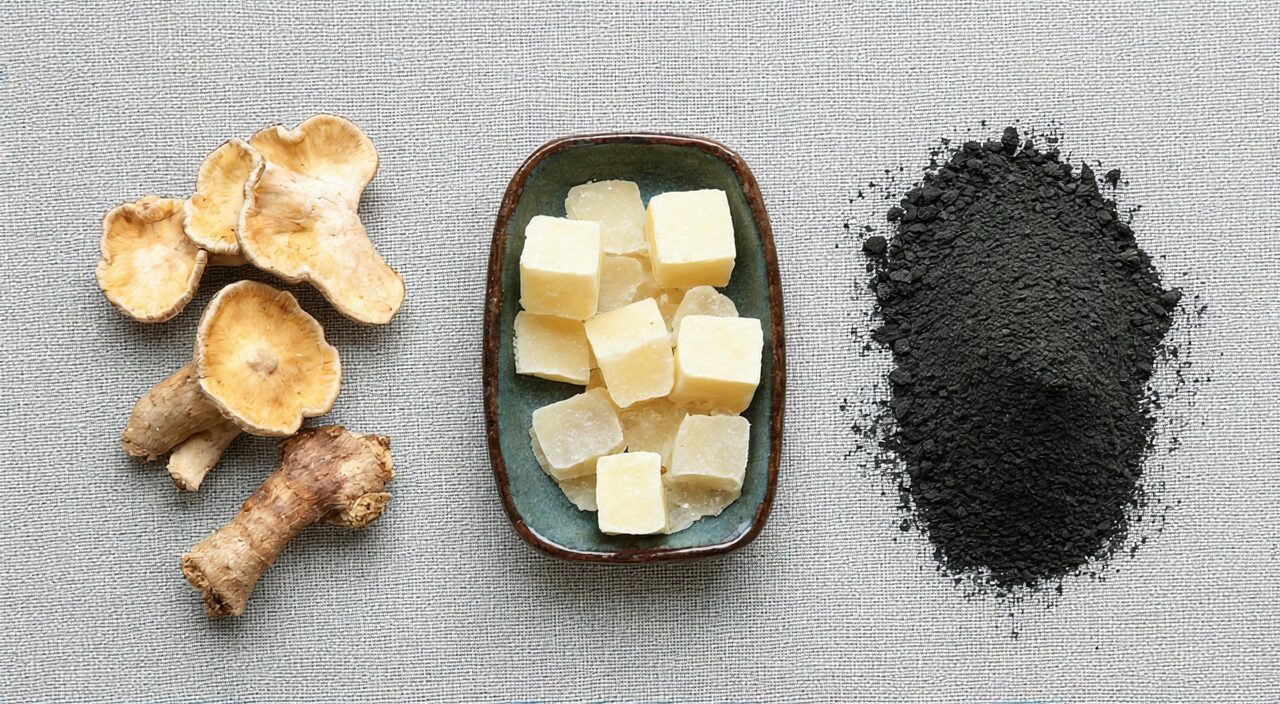
Polyporus Decoction consists of five medicinal herbs, making its formula quite concise. Understanding the role of each herb helps in grasping its overall direction.
| Medicinal Herb | Traditional Functional Direction | Brief Analysis of its Role in the Formula |
|---|---|---|
| Polyporus (Zhu Ling) | Promotes urination and leaches out dampness | Serves as the sovereign herb, primarily unblocking water pathways to target water-dampness accumulation |
| Poria (Fu Ling) | Strengthens the spleen, promotes urination, and calms the heart | Assists Polyporus in strengthening dampness-leaching while also considering the spleen and stomach |
| Alisma (Ze Xie) | Promotes urination, leaches dampness, and drains heat | Helps expel water-dampness and has a certain effect on clearing heat from the lower burner |
| Talcum (Hua Shi) | Clears heat, promotes urination, and relieves summer-heat | Cold and slippery in nature, it can clear damp-heat and unblock urination |
| Donkey-Hide Gelatin (E Jiao) | Tonifies blood, nourishes yin, and moistens dryness | Added among diuretic herbs with the intention of nourishing yin-blood to prevent fluid damage from diuresis |
From this table, we can see that the formulation strategy of Polyporus Decoction involves three parallel actions: “promoting urination and leaching dampness + clearing heat + nourishing yin.” Among these, Polyporus, Poria, Alisma, and Talcum all act on water metabolism, while the addition of Donkey-Hide Gelatin provides supplementation for the yin aspect. This combination makes it particularly suitable for complex situations involving water-dampness, internal heat, and a relative weakness of yin fluids.
Potential Suitable Directions for Polyporus Decoction
It must be emphasized that the following descriptions are based on observation perspectives from Traditional Chinese Medicine and cannot be equated with direct modern disease diagnoses or treatment plans. If you experience long-term physical discomfort, you should first seek professional evaluation.
Core Manifestation Characteristics
Traditionally, the syndrome suitable for Polyporus Decoction often includes the following key elements, which usually appear together:
- Urinary Issues: Dysuria (unsmooth urination, dribbling), or possibly frequent urination, urgency, pain, or dark yellow urine with a burning sensation during urination.
- Thirst and Irritability: Dry mouth with a desire to drink, but drinking does not fully quench the thirst, possibly accompanied by slight irritability, heat sensation in the palms and soles, or a subjective feeling of heat and restlessness in the chest.
- Sleep Impact: Due to irritability and internal heat, there may be restless sleep, easy waking, or excessive dreaming, though this is not the sole core indicator.
- Tongue and Pulse Reference: The tongue body tends to be red, with a tongue coating that might be yellowish and greasy or thin; the pulse often presents as thready and rapid or wiry and thready.
- Lower Burner Damp-Heat and Water-Dampness Accumulation: This can manifest as discomfort in the urinary system, a bearing-down sensation in the lower abdomen, or mild edema of limited severity, accompanied by signs of heat.
If a person presents with the above manifestations, especially urinary abnormalities coexisting with dry mouth and irritability heat, Polyporus Decoction may traditionally be considered as a direction for understanding. For example, in cases of recurring urinary system issues accompanied by heat in the palms and soles, thirst, and a red tongue, which might correspond to yin deficiency with damp-heat in TCM pattern differentiation, the approach of Polyporus Decoction would have reference significance.
Other Traditional Application Scenarios
Beyond typical lower burner symptoms, some physicians have also historically used Polyporus Decoction for situations where heat pathogens damage the yin collaterals resulting in hematuria, or certain cases of cough or vomiting associated with internal water retention combined with yin deficiency. However, these represent more complex applications requiring careful consideration by the practitioner.
Contraindications and Unsuitable Populations for Polyporus Decoction
Every formula has boundaries of use. Polyporus Decoction tends toward cool and diuretic, requiring special attention to the following points:
- Not suitable for those with obvious spleen and kidney yang deficiency
Individuals who are typically sensitive to cold, have cold hands and feet, experience lower back and knee soreness, loose stools, mental fatigue, and a pale, puffy tongue with tooth marks generally belong to a yang qi insufficiency pattern. Talcum and Alisma in Polyporus Decoction are relatively cold and can easily further damage yang qi, potentially worsening diarrhea or fatigue.
- Cannot be used for cold-damp edema
If edema presents with a pale complexion, heavy limbs, clear and copious urination rather than dark yellow urine, and a white greasy tongue coating, it belongs to cold-dampness. A formula that clears heat and promotes urination should not be used. Polyporus Decoction targets damp-heat, which is the opposite direction of cold-dampness.
- Insufficient for isolated severe fluid or yin-blood depletion
Although Donkey-Hide Gelatin nourishes yin, if dryness signs are extremely prominent—such as dry eyes, dry skin, severe constipation, a glossy tongue without coating—and there is no obvious water-dampness stagnation, the diuretic strength of Polyporus Decoction could still worsen dryness. In such cases, the focus should be on replenishing yin and increasing fluids.
- Extreme caution required during pregnancy and special physiological periods
Due to its strong diuretic and heat-clearing effects, the use of this formula during pregnancy must be evaluated under the strict guidance of an experienced physician. Consideration is also needed during breastfeeding and menstruation.
- Severe or persistent unrelieved symptoms require medical evaluation first
If urinary abnormalities are accompanied by high fever, lower back pain, visible hematuria (blood in urine), severe urination pain, or persistent vomiting, significant weight loss, or black stools, one must not self-prescribe based on formula indications alone. It is essential to consult a doctor promptly to rule out organic pathology.
Furthermore, Donkey-Hide Gelatin is quite cloying and greasy. Individuals with weak spleen and stomach, prone to indigestion or heavy phlegm-dampness, may need appropriate modifications of the formula rather than using the original prescription directly.
Differences Between Polyporus Decoction and Several Similar Formulas
Among commonly encountered classical formulas, Five-Ingredient Powder with Poria (Wu Ling San), Red Door Drain Powder (Dao Chi San), Yinchenhao Decoction (Yin Chen Hao Tang), and Poria, Cinnamon Twig, Atractylodes, and Licorice Decoction (Ling Gui Zhu Gan Tang) also involve water-dampness, urination issues, or heat signs, but each has distinct emphases. Understanding the differences helps avoid confusion.
Polyporus Decoction vs. Five-Ingredient Powder with Poria
This is the most easily confused pair. Five-Ingredient Powder with Poria also originates from the Treatise on Cold Damage and is composed of Polyporus, Poria, Alisma, Atractylodes, and Cinnamon Twig.
- Five-Ingredient Powder with Poria: Primarily focuses on warming yang to transform qi and move water. Cinnamon Twig warmly unblocks yang qi, and Atractylodes strengthens the spleen and dries dampness. The entire formula is warm-natured and used for taiyang water-accumulation syndrome or bladder qi transformation impairment, presenting with dysuria, thirst with immediate vomiting upon drinking (water reversal), and a white slippery tongue coating, without significant heat signs or yin deficiency.
- Polyporus Decoction: Primarily focuses on clearing heat, promoting urination, and nourishing yin. The warm Cinnamon Twig and Atractylodes are removed, replaced with the cold Talcum and the yin-nourishing Donkey-Hide Gelatin to target water and heat binding with yin damage, presenting with a slightly red tongue and irritability heat.
In short, if the presentation is purely one of cold and deficiency, Five-Ingredient Powder with Poria may align more closely with traditional thinking; if damp-heat and yin deficiency coexist, Polyporus Decoction is more likely to be considered.
Polyporus Decoction vs. Red Door Drain Powder
Red Door Drain Powder consists of Rehmannia Root, Akebia Stem, raw Licorice Root tip, and Lophatherum Leaf. Its direction is to clear heart fire, promote urination, and nourish yin, commonly used for exuberant heart channel heat transmitted to the small intestine, presenting with mouth and tongue sores, dark urine with stabbing pain, and heart-chest irritability heat.
- Red Door Drain Powder: Leans more towards heart fire descending into the small intestine causing urinary tract heat and pain, nourishing yin with Rehmannia Root.
- Polyporus Decoction: Leans more towards lower burner water-heat binding with yin damage, possessing stronger diuretic power.
Although both clear heat, promote urination, and nourish yin, their disease locations and rationale differ.
Polyporus Decoction vs. Yinchenhao Decoction
Yinchenhao Decoction, composed of Yinchenhao (Artemisia Capillaris), Gardenia, and Rhubarb, is a crucial formula for clearing heat, benefiting dampness, and reducing jaundice. It is used for damp-heat jaundice with yellowing of the body and eyes, dark yellow urine, and a yellow greasy tongue coating.
- Yinchenhao Decoction: Focuses on liver and gallbladder damp-heat causing jaundice, with a purgative action to drain heat.
- Polyporus Decoction: Generally does not take jaundice as its main indication and is more concerned with dysuria and yin deficiency with internal heat.
Polyporus Decoction vs. Poria, Cinnamon Twig, Atractylodes, and Licorice Decoction
Poria, Cinnamon Twig, Atractylodes, and Licorice Decoction combines Poria, Cinnamon Twig, Atractylodes, and Licorice. It belongs to the category of warming yang to transform thin mucus, strengthening the spleen, and leaching dampness. It targets insufficiency of middle yang with phlegm-fluid retention internally, leading to stuffiness in the chest and flanks, dizziness, palpitations, shortness of breath, and a white slippery tongue coating.
- Poria, Cinnamon Twig, Atractylodes, and Licorice Decoction: Typical pattern of cold fluid retention internally, using Cinnamon Twig for warming and transformation.
- Polyporus Decoction: Targets damp-heat with yin deficiency, related to water-heat binding with concomitant yin damage.
The above comparisons are for reference only. In actual clinical practice, combined formulas and modifications often occur. Individuals must not self-differentiate syndromes and switch formulas on their own.
Reminders Before Using the Polyporus Decoction Approach
The application of TCM formulas highly depends on individualized pattern differentiation. Even for similar symptoms, differences in the underlying properties of cold, heat, deficiency, and excess can lead to completely different choices.
The “water-heat binding with yin damage” syndrome pattern for Polyporus Decoction requires professional judgment, including a comprehensive evaluation of observation, listening, inquiry, and palpation. This article serves only as a compilation of traditional knowledge to help interested readers establish a framework of understanding. If you intend to adopt related health regulation directions, it is recommended to consult a qualified TCM professional, analyze based on constitution and specific circumstances, and avoid risks arising from self-misjudgment.
Summary
As a classic formula for promoting urination, clearing heat, and nourishing yin, Polyporus Decoction features an ingenious design that targets the complex state of internal water-dampness stagnation turning into heat and damaging yin fluids. From its composition, the combination of Polyporus, Poria, Alisma, Talcum, and Donkey-Hide Gelatin allows it to address typical manifestations such as dysuria, thirst, and irritability heat. However, it is unsuitable for cold syndromes, yang deficiency, or simple yin exhaustion; strict pattern differentiation is necessary for its use.
By contrasting it with other formulas, we can see more clearly where Polyporus Decoction sits within the traditional formula system. Whether it is the warming transformation of Five-Ingredient Powder with Poria or the heart-clearing nature of Red Door Drain Powder, both remind us that choosing a TCM formula is not simply matching symptoms but rather a balanced consideration based on the overall condition. It is hoped that this article provides you with a relatively objective and restrained starting point for understanding this classical formula.