
Who Is Banxia Xiexin Tang Suitable For? Composition, Benefits, and Contraindications

Many people come across Chinese medicine because of bloating, heartburn, acid reflux, borborygmus, or bowel irregularities, and “Banxia Xiexin Tang” is a frequently mentioned formula. It’s neither purely warming nor purely cooling, often leaving people unsure whether it’s right for them.
This article, based on traditional Chinese medicine formula theory, compiles the composition, core actions, more likely suitable presentation characteristics, important cautions, and differences from formulas like Xiao Chai Hu Tang and Huang Lian Tang, helping readers establish a basic understanding framework.
Why Banxia Xiexin Tang Is Described as “Harmonizing Cold and Heat”
Banxia Xiexin Tang originates from the Treatise on Cold Damage, originally designed for “epigastric fullness” following erroneous purgation in Shaoyang disease. Traditional Chinese medicine holds that in such cases the disease location is mainly the spleen and stomach, with a pathological characteristic of mixed cold and heat — that is, after dysfunction of the spleen and stomach, there is a cold aspect and a heat aspect, and qi movement becomes obstructed in the middle burner, causing a feeling of blockage in the epigastric region.
From the overall formula strategy, it neither simply dispels cold nor simply clears heat, but must address both opposing states simultaneously. Hence it is often summarized as “harmonize cold and heat, acrid opening and bitter descending.”
- Acrid opening: uses acrid herbs to disperse stagnated qi.
- Bitter descending: uses bitter herbs to direct rebellious qi downward and clear.
This combination gives Banxia Xiexin Tang its specific scope of application in addressing presentations such as epigastric fullness, nausea, borborygmus, and irregular bowel movements.
Composition of Banxia Xiexin Tang and the Role of Each Herb
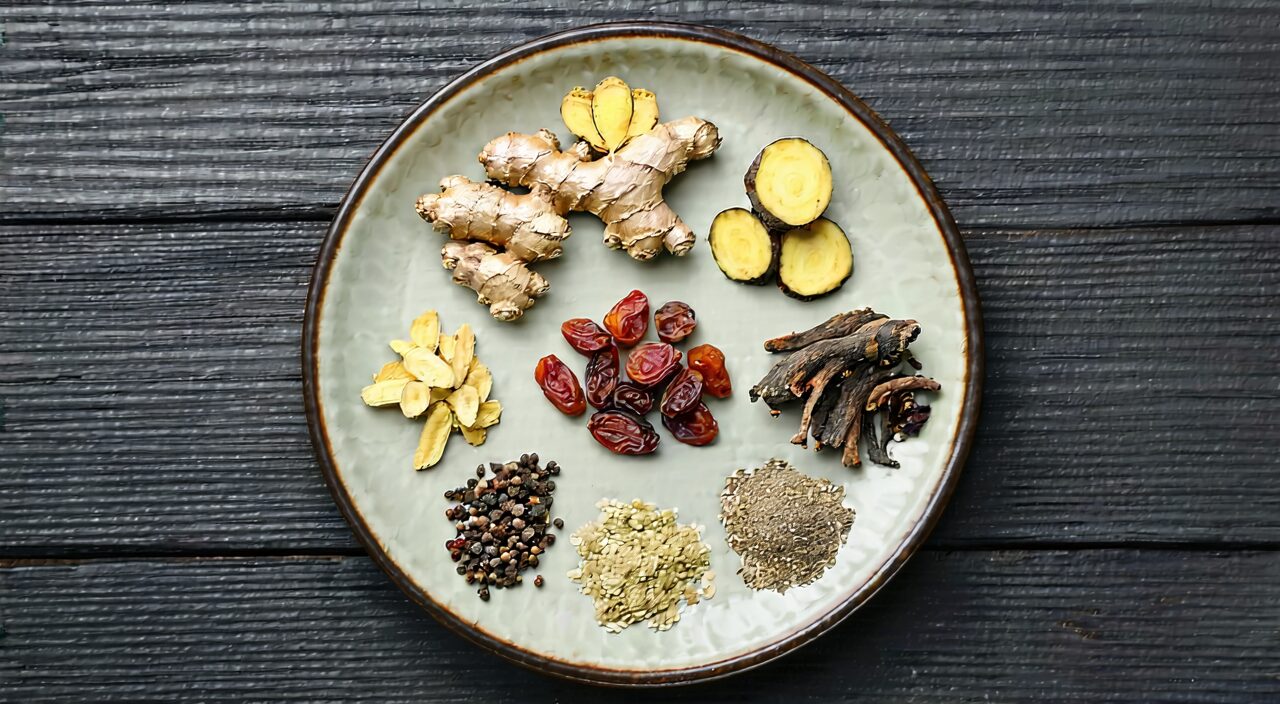
Understanding a formula starts with its composition. Banxia Xiexin Tang consists of seven herbs, each playing a different role in the overall combination:
| Herb | Approximate Role in Traditional Understanding |
|---|---|
| Pinellia (Ban Xia) | Acridly disperses and resolves clumps, descends rebellious qi to stop vomiting, considered the chief herb. |
| Dried Ginger (Gan Jiang) | Warms the middle and disperses cold, addressing the cold aspect of the spleen and stomach. |
| Scutellaria (Huang Qin) | Clears heat and dries dampness, addressing the heat aspect of the stomach and intestines. |
| Coptis (Huang Lian) | Bitter-cold clears heat, particularly adept at clearing heat in the middle burner. |
| Ginseng (Ren Shen) | Tonifies the qi of the spleen and stomach, helps restore transport and transformation. |
| Jujube (Da Zao) | Tonifies the middle and boosts qi, harmonizes the properties of other herbs. |
| Licorice (Gan Cao) | Tonifies the spleen and harmonizes the middle, also moderates the effects of all herbs. |
These seven herbs together form a structure that combines both cold and heat, tonification and drainage. The acrid-warm nature of Pinellia and Dried Ginger balances the bitter-cold of Scutellaria and Coptis, while Ginseng, Jujube, and Licorice protect the qi of the middle burner, preventing excessive depletion during regulation.
Note that this only introduces the traditional formula rationale; whether to use it and at what proportions must be decided under professional judgment.
Core Directions of Action of Banxia Xiexin Tang
Traditional Chinese medicine summarizes the actions of Banxia Xiexin Tang around “acrid opening and bitter descending, harmonizing cold and heat,” often associated with the following directions:
- Opening the glomus and dispersing clumps: Here “glomus” refers to a feeling of fullness and blockage in the epigastric area (roughly the stomach region), not hard when pressed but a subjective sensation of oppressive fullness.
- Descending rebellious qi to stop vomiting: For nausea, retching, or mild vomiting due to rebellious stomach qi, Pinellia and Dried Ginger in the formula direct qi downward.
- Clearing above and warming below: In traditional pattern differentiation, some patients may present heat sensations in the stomach, bitter taste, yellow tongue coating, yet also cold abdominal sensations, borborygmus, and loose stools, indicating cold-heat intermingling, and Banxia Xiexin Tang is commonly used in such conflicting scenarios.
These directions are not pharmacological descriptions in the modern medical sense but are used to explain why this formula is selected under specific symptom combinations in traditional practice.
Who Is Banxia Xiexin Tang Suitable For: Indications Based on Symptom Characteristics
Many people wonder “who is Banxia Xiexin Tang suitable for?” In traditional pattern-differentiation thinking, it is more accurate to ask: under which combination of presentations might it be considered a potential direction. Generally, the following characteristics correspond more readily with the thinking behind Banxia Xiexin Tang.
Predominant Discomfort of Epigastric Fullness and Oppression
A pronounced sensation of blockage and fullness in the epigastric region, without pain or only mild pain, no obvious hard mass upon pressure, yet a persistent feeling of something stuck there.
This fullness often worsens after eating or may occur without an obvious pattern.
Gastrointestinal Presentations of Mixed Cold and Heat
It is common to see simultaneous “heat” signs and “cold” signs. For example:
- Above: bitter taste, acid reflux, vexation;
- Below: loud gurgling sounds, unformed stools or even diarrhea.
Looking at a single symptom may lead to misjudgment, but when combined, they align well with the acrid opening and bitter descending approach of Banxia Xiexin Tang.
Nausea, Borborygmus, and Bowel Irregularity
Nausea, retching, or dry heaving, accompanied by rumbling intestines, increased flatulence, and slightly frequent, loose, or sticky stools often indicate disruption of middle burner qi movement. Banxia Xiexin Tang is traditionally commonly used to regulate gastrointestinal qi dynamics.
It must be reiterated that the above are only features summarized from symptom combinations in traditional medicine and are not the sole basis for determining suitability. Whether it is truly appropriate must be combined with tongue diagnosis, pulse diagnosis, and overall constitution, and decided by an experienced TCM professional. Self-matching symptoms without guidance is not recommended.
Situations Where Banxia Xiexin Tang May Not Be Suitable
Every formula has its contraindications, and Banxia Xiexin Tang is no exception. The following conditions warrant extra caution.
Pure Stomach Cold Pattern
If there is cold pain in the epigastric area relieved by warmth and pressure, aggravated by cold, no thirst, no bitter taste, loose stools but no burning sensation or bad breath, this scenario is more akin to simple spleen-stomach yang deficiency with cold.
Traditionally, such cases might lead to formulas like Li Zhong Tang or Xiang Sha Liu Jun Zi Tang, not the combined cold-heat approach of Banxia Xiexin Tang.
Pure Stomach Heat or Excess Heat Pattern
When the main features are distinct stomach burning, dry mouth, bad breath, gum swelling and pain, constipation, red tongue with dry yellow coating, and no cold signs, TCM may consider clearing stomach heat, draining heat etc. Using Banxia Xiexin Tang’s acrid-warm ingredients in such a context could aggravate the condition.
Severe Acute Abdomen and Special Populations
Sudden severe abdominal pain, persistent vomiting, fever, board-like abdominal rigidity with refusal to press, or black stool, significant weight loss may indicate acute abdomen or gastrointestinal bleeding. Such circumstances require immediate medical attention and should not be self-managed with any herbal formula.
Pregnancy, Lactation, and Special Health Conditions
Women who are pregnant, planning pregnancy, or breastfeeding have unique physical conditions and may respond differently to herbal substances. Without adequate professional evaluation, self-use of Banxia Xiexin Tang or any formula is contraindicated.
If you have chronic illnesses or are taking Western medications, inform your practitioner to avoid inappropriate interactions.
Differences Between Banxia Xiexin Tang and Xiao Chai Hu Tang
Both Banxia Xiexin Tang and Xiao Chai Hu Tang (Minor Bupleurum Decoction) are classic formulas from the Treatise on Cold Damage related to Shaoyang and middle burner qi dynamics, but their emphases are distinctly different.
- Xiao Chai Hu Tang’s core strategy is to harmonize the Shaoyang. Its typical presentations include alternating chills and fever, chest and rib-side fullness and discomfort, taciturnity with no desire to eat, vexation, and frequent nausea. The disease location is in the semi-exterior semi-interior chest and rib-side region, with Bupleurum as the chief herb.
- Banxia Xiexin Tang’s main battlefield is the middle burner spleen and stomach, with epigastric fullness as the core. There is no alternation of chills and fever indicating an exterior pattern, nor chest and rib-side fullness.
Simply put, if a person mainly experiences rib-side fullness, bitter taste, dry throat, and intermittent chills and fever, Xiao Chai Hu Tang is traditionally more likely to be considered. If epigastric blockage, nausea, borborygmus, and diarrhea are central without obvious exterior signs, Banxia Xiexin Tang may be more relevant.
Although they share some herbs, the main patterns and directions differ, and they cannot be readily substituted for each other.
Comparison of Banxia Xiexin Tang with Huang Lian Tang, Zuo Jin Wan, and Xiang Sha Liu Jun Zi Tang
Cross-comparison helps clarify the positioning of Banxia Xiexin Tang. Below is a brief comparison with several common formulas.
| Formula | Core Strategy | Typical Presentation Focus | Main Difference from Banxia Xiexin Tang |
|---|---|---|---|
| Huang Lian Tang | Clears above and warms below, facilitates communication between Heart and Kidney | Upper heat and lower cold with abdominal pain, nausea | Larger dose of Huang Lian (Coptis), adds Gui Zhi (Cinnamon Twig), removes Huang Qin (Scutellaria), focusing on abdominal pain rather than epigastric fullness |
| Zuo Jin Wan | Clears and drains liver fire, descends rebellious qi to stop vomiting | Acid reflux, regurgitation, rib pain, bitter taste | Fewer herbs, focused action targeting liver fire invading the stomach; does not address qi deficiency or mixed cold and heat |
| Xiang Sha Liu Jun Zi Tang | Tonifies qi, strengthens the spleen, regulates qi and transforms dampness | Epigastric bloating, poor appetite, loose stools without obvious heat signs | Warm in nature, contains no heat-clearing herbs; unsuitable for bitter taste, yellow tongue coating, etc. |
From the comparison above, it can be seen that Banxia Xiexin Tang’s uniqueness lies in addressing a “contradictory” state rather than simple deficiency, cold, heat, or dampness. This is why it cannot be simply replaced by other formulas.
Summary
As a representative formula for harmonizing cold and heat through acrid opening and bitter descending, Banxia Xiexin Tang is traditionally used more for symptom combinations of epigastric fullness, nausea, borborygmus, diarrhea, or irregular bowel movements — a picture of mixed cold and heat in the stomach and intestines.
Its composition includes the acrid-warm Pinellia and Dried Ginger and the bitter-cold Scutellaria and Coptis, supplemented with spleen-stomach tonics to re-establish middle burner qi balance in a complicated state.
However, this formula strategy has clear boundaries. Pure stomach cold, pure stomach heat or excess heat, acute abdomen, pregnancy, etc., may not suit this direction. When facing severe, persistent, or recurrent gastrointestinal discomfort, a clear diagnosis under professional medical guidance is essential. Self-matching symptoms to any formula is not advisable.
This article is provided only as an introduction to traditional knowledge about Banxia Xiexin Tang, to help readers gain another understanding perspective; it does not constitute any medical advice or recommendation.