
Who Is Bi Xie Fen Qing Yin Suitable For? Composition, Benefits, and Precautions

Many people come across the formula name “Bi Xie Fen Qing Yin” (Dioscorea Hypoglauca Decoction to Separate the Clear) when reading classical Chinese medical texts or overseas TCM resources, especially concerning issues like turbid urine, white turbidity, or chyluria. The name itself reveals the core strategy: separating the clear from the turbid.
However, precisely because it sounds so targeted, many people directly assume it applies to their own situation, overlooking the underlying constitutional prerequisites.
This article will focus on the composition of Bi Xie Fen Qing Yin, its traditional understanding, main suitable indications, situations where it is not appropriate, and its differences from formulas like Zhu Ling Tang, Wu Ling San, Long Dan Xie Gan Tang, and Jin Gui Shen Qi Wan, helping readers establish a clearer framework for assessment.
Understanding the Strategy of Bi Xie Fen Qing Yin from “Separating the Clear and Transforming Turbidity”
In traditional Chinese medicine, when confronting issues like turbid urine or white turbidity, the approach is not uniform; rather, a distinction is made between cold, heat, deficiency, and excess.
The direction addressed by Bi Xie Fen Qing Yin is often summarized as “deficiency cold in the lower jiao, with damp turbidity failing to transform.” This means the problem is not just dampness but is accompanied by insufficient yang qi, particularly weakened qi transformation function of the kidneys and bladder.
In this state, the body’s ability to separate the clear from the turbid declines, and refined substances fail to be secured and descend in a mixed fashion, easily leading to urine that is turbid like rice-water or thick like paste.
Within Bi Xie Fen Qing Yin, Bi Xie (Dioscoreae Hypoglaucae Rhizoma) serves as the chief herb, excelling at draining dampness and separating the clear to eliminate turbidity, particularly adept at addressing damp turbidity in the lower jiao; it is simultaneously combined with herbs that warm the kidneys and astringe, achieving the goal of addressing both the root and branch.
This is fundamentally different from formulas that mainly clear heat and drain dampness: the former emphasizes “cold dampness,” while the latter targets “damp heat.” If the direction is reversed, not only will there be no benefit, but it may increase discomfort.
Composition of Bi Xie Fen Qing Yin and the Role of Each Herb
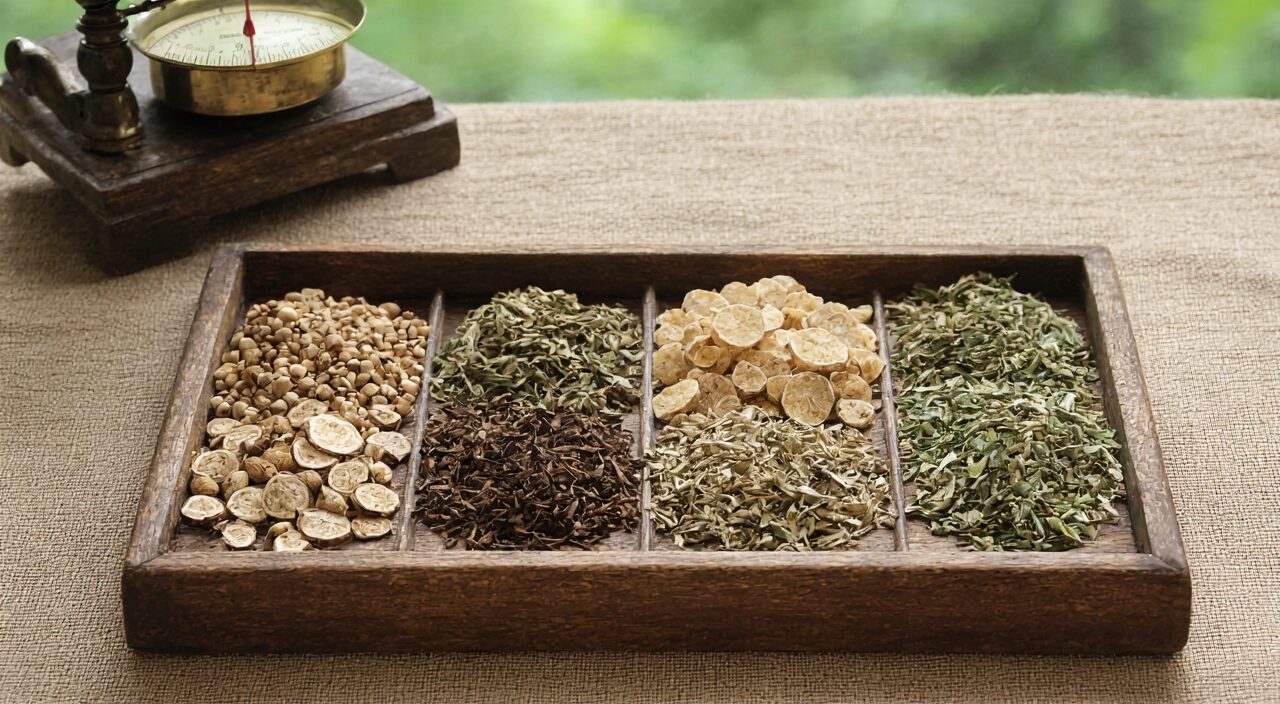
The classic formulation of this prescription is relatively concise, with each herb coordinating to form a structure that warms the kidneys, drains dampness, and separates the clear to transform turbidity. Below is a table summarizing the common ingredients and their traditional roles in the formula.
| Herb | Traditional Role and Direction |
|---|---|
| Bi Xie (Dioscoreae Hypoglaucae Rhizoma) | Drains dampness and eliminates turbidity; the main herb in the formula, specifically addressing unresolved damp turbidity in the lower jiao and turbid urine. |
| Yi Zhi Ren (Alpiniae Oxyphyllae Fructus) | Warms the kidneys and astringes, helping to reduce the leakage of refined substances while warming the lower origin. |
| Wu Yao (Linderae Radix) | Warms the kidneys, disperses cold, moves qi and alleviates pain, assisting in enhancing qi transformation in the lower jiao. |
| Shi Chang Pu (Acori Tatarinowii Rhizoma) | Transforms dampness and opens the orifices, cooperating with Bi Xie to strengthen the ability to separate the clear and eliminate turbidity. |
| Fu Ling (Poria) | Fortifies the spleen and percolates dampness, assisting in transforming and transporting water dampness from the middle jiao. |
| Gan Cao (Glycyrrhizae Radix) | Harmonizes all the herbs while also considering the spleen and stomach. |
Some versions may include additional modifications, but the core structure remains unchanged. The overall nature of the formula tends toward warm; although it contains dampness-draining herbs, its foundational tone is warm rather than cold, which is a very important point.
Situations Where It May Be More Suitable
From a TCM perspective, Bi Xie Fen Qing Yin is often used for the following directions, but whether it is specifically suitable must still be determined based on individual circumstances. The descriptions below represent only the traditional scope of use and are not diagnostic criteria.
Turbid Urine Mainly Presenting as “White Turbidity”
This is the core reference direction for this formula. White turbidity typically refers to urine that is whitish and turbid, or sediment that appears after urination, but without noticeable dysuria or burning sensations. If the urine is turbid like milk or rice water, without urgency or stabbing pain, traditionally it may be considered from the perspective of damp turbidity pouring downward and failure to separate clear from turbid. Bi Xie Fen Qing Yin is a choice worth understanding.
Accompanied by Soreness and Weakness of the Lower Back and Knees, Aversion to Cold, and Cold Extremities
People with deficiency cold in the lower jiao, besides turbid urine, often easily experience:
- Soreness of the lower back and weakness in the legs
- Aversion to cold and low spirit
- In women, thin, clear, and profuse leukorrhea that persists continuously
These manifestations may also appear in a similar constitutional background. At such times, simply draining dampness may further damage yang qi, whereas Bi Xie Fen Qing Yin takes into account both warming the kidneys and draining dampness.
Frequent Urination or Post-void Dribbling
Some individuals with deficiency cold of the lower origin have insufficient bladder qi transformation, which may present as:
- Increased urinary frequency and increased nocturia
- A sensation of incomplete emptying after urination
If these are simultaneously accompanied by turbid urine and are not dominated by heat and pain, traditionally they may also be considered as one reference direction.
It should be noted that such situations may also be related to various factors such as prostate issues, and comprehensive evaluation is necessary.
Situations Requiring Caution or That Are Less Suitable
Although Bi Xie Fen Qing Yin targets turbidity, not all “turbidity” can be treated with it. The following types of situations require special attention and should not be casually applied.
Urinary Issues Involving Damp Heat Pouring Downward
If turbid urine is accompanied by the following manifestations, it leans more towards damp heat:
- Obvious urinary frequency, urgency, and pain
- Burning sensation in the urethra
- Dark yellow or even reddish urine color
- Yellow, greasy tongue coating
Under these circumstances, using the relatively warm Bi Xie Fen Qing Yin might fuel heat and aggravate discomfort. Such directions are more suitable for formulas that clear heat and drain dampness, and specific differentiation by a professional is needed.
Acute Urinary Tract Infection Without Prior Evaluation
Sudden onset of severe urinary frequency and pain, fever, and lower back pain may indicate an acute infection. In such cases, medical attention should be sought promptly, and it is not appropriate to self-administer any herbal formula as a management strategy before a clear diagnosis is made. Bi Xie Fen Qing Yin is not a choice for the acute phase.
Special Physiological Conditions
The following populations have complex constitutions; they must not casually apply this formula on their own. Even if symptoms seem to match, they should first consult a TCM practitioner:
- Pregnant or breastfeeding women
- Children
- Elderly or debilitated individuals
- Individuals with severe chronic diseases
Additionally, when taking other medications, potential herb-drug interactions must be considered and evaluated by a professional.
Long-term, Recurrent, and Unexplained Urinary Abnormalities
If turbid urine persists, recurs repeatedly, or is accompanied by blood in the urine, weight loss, abdominal masses, severe abdominal pain, or difficulty urinating, relevant medical examinations must first be conducted to rule out other diseases. At such times, one cannot rely solely on the strategy of “separating the clear and transforming turbidity” to address the issue.
Horizontal Comparison with Similar Formulas
Many people ask: since they all deal with urinary abnormalities or internal water dampness, what are the differences between Bi Xie Fen Qing Yin and Zhu Ling Tang, Wu Ling San, Long Dan Xie Gan Tang, and Jin Gui Shen Qi Wan? Placing them side by side for comparison allows a clearer view of their respective emphases.
Bi Xie Fen Qing Yin vs. Zhu Ling Tang
Zhu Ling Tang takes Zhu Ling (Polyporus), Fu Ling (Poria), Ze Xie (Alismatis Rhizoma), E Jiao (Asini Corii Colla), and Hua Shi (Talcum) as its core. Traditionally, it is used for water and heat binding together with concurrent yin damage. Its characteristic is that it drains water, clears heat, and nourishes yin simultaneously. It suits presentations of difficult urination, thirst, irritability, or a tendency toward hematuria, with a red tongue body and scant coating.
This direction leans toward the interaction of “water and heat,” precisely the opposite of Bi Xie Fen Qing Yin’s “deficiency cold damp turbidity in the lower jiao.” In terms of cold-warm properties, Zhu Ling Tang is cool and moistening, whereas Bi Xie Fen Qing Yin is warm and drying—the distinction is extremely clear.
Bi Xie Fen Qing Yin vs. Wu Ling San
Wu Ling San is a representative formula for bladder water accumulation in the Taiyang meridian pattern. It emphasizes transforming qi and promoting water, composed of Gui Zhi (Cinnamomi Ramulus), Bai Zhu (Atractylodis Macrocephalae Rhizoma), Fu Ling, Zhu Ling, and Ze Xie. It targets water dampness retention caused by impaired qi transformation, manifesting as difficult urination, thirst with desire to drink but immediate vomiting upon drinking, and edema.
Wu Ling San uses a combination of warm and cold herbs, generally leaning toward unblocking yang and transforming qi; it does not have a marked emphasis on warmly supplementing the kidney source. Bi Xie Fen Qing Yin, however, focuses more on the failure of damp turbidity to transform under conditions of lower jiao deficiency cold, specifically targeting “turbidity.” Although both address water dampness, the details of disease location and nature differ.
Bi Xie Fen Qing Yin vs. Long Dan Xie Gan Tang
Long Dan Xie Gan Tang is a potent formula for clearing and draining excess fire from the liver and gallbladder and for damp heat pouring downward. Typical manifestations include bitter taste in the mouth, hypochondriac pain, painful urinary dripping with turbidity, damp heat genital itching, and a red tongue with a yellow, greasy coating. Its presentation is urgent, excess in nature, and exhibits prominent heat signs, which is fundamentally different from the deficiency cold, lingering state addressed by Bi Xie Fen Qing Yin.
One primarily clears and drains, while the other primarily warms and transforms—the directions are completely opposite and must not be confused.
Bi Xie Fen Qing Yin vs. Jin Gui Shen Qi Wan
Jin Gui Shen Qi Wan (Kidney Qi Pill) supplements kidney yang and generates kidney qi. It is commonly used for lower back and knee soreness and weakness, urinary difficulties or frequent urination, and aversion to cold with cold extremities caused by insufficient kidney yang. It emphasizes “supplementation,” restoring qi transformation by warming and tonifying kidney yang, but does not possess the specific dampness-draining power of separating the clear and eliminating turbidity.
Bi Xie Fen Qing Yin, while warming the kidneys, is clearly combined with herbs that drain dampness and transform turbidity. If there is purely kidney yang deficiency with clear, copious urine rather than turbid urine, Jin Gui Shen Qi Wan may be more fitting than Bi Xie Fen Qing Yin; if damp turbidity is prominent and white turbidity does not clear, then Bi Xie Fen Qing Yin is more targeted.
From these several comparisons, it can be seen that formulas which seemingly can all be used for “urinary abnormalities” correspond to vastly different TCM pattern differentiation directions behind them. Therefore, even if one has some understanding of their own symptoms, it is not advisable to use a formula simply by matching the name; selection is best made under professional guidance.
Several Common Misunderstandings When Understanding This Formula
Some readers may mistakenly think that Bi Xie Fen Qing Yin can be used whenever urine is turbid, or treat it as a universal cleanser for the urinary system. In fact, it is not suitable for all types of turbidity. If pattern differentiation is inaccurate and it is used for damp-heat excess patterns, situations such as bitter taste in the mouth, dry throat, and aggravated burning sensation during urination may occur.
Another point is that some people confuse Bi Xie Fen Qing Yin with simple diuretic herbs. In traditional Chinese medicine, draining dampness and separating the clear to transform turbidity are not the same thing: the former emphasizes clearing the water passages, while the latter places more emphasis on restoring the function of separating clear and turbid, involving the levels of securing, astringing, and warming transformation. This is also why the formula uses warm, astringent herbs like Yi Zhi Ren and Wu Yao, rather than solely relying on Fu Ling and Bi Xie to promote urination.
Furthermore, upon seeing the words “separate the clear,” some people may associate it with descending turbidity and detoxifying, and may be prone to self-increase the dosage or use it long-term, both of which are not recommended. Any herbal formula should be used in stages based on an understanding of constitution and symptom changes. Long-term or excessive use may deviate from the original intention and actually affect the body’s own regulatory capabilities.
Summary
Bi Xie Fen Qing Yin is a traditional Chinese medicine formula designed to address lower jiao deficiency cold, internal damp turbidity accumulation, and failure to separate clear from turbid. Its feature lies in the simultaneous application of warming the kidneys, draining dampness, and separating the clear to transform turbidity. It is mainly used for situations that may manifest as white turbid urine, soreness and coldness in the lower back and knees, and an absence of significant heat signs. When using it, it is especially important to exclude damp-heat pouring downward and acute urinary tract infections, and it should not be used as a universal formula for all turbid urine.
Through comparison with formulas such as Zhu Ling Tang, Wu Ling San, Long Dan Xie Gan Tang, and Jin Gui Shen Qi Wan, it can be seen more clearly that similar symptoms may correspond to completely different TCM patterns, and choosing the wrong direction can be counterproductive. Therefore, suitability for Bi Xie Fen Qing Yin cannot be determined based on a single symptom alone; it must be comprehensively assessed in conjunction with the tongue, pulse, overall presentation, and individual constitution.
This article provides knowledge reference solely from the perspective of traditional formula studies and cannot replace professional diagnosis or treatment advice. If related symptoms recur, persist without relief, or are accompanied by significant discomfort or anxiety, it is recommended to promptly seek help from a qualified healthcare professional.