
Comparison of Dampness-Resolving and Spleen-Fortifying Chinese Patent Medicines: Which One to Choose Among Shen Ling Bai Zhu San, Er Chen Wan, and Xiang Sha Liu Jun Zi Wan?

Many friends who are concerned about weight management and body conditioning, after learning about concepts such as “dampness” and “spleen deficiency,” often notice that there are multiple dampness-resolving and spleen-fortifying Chinese patent medicines on the market. Among them, Shen Ling Bai Zhu San, Er Chen Wan, and Xiang Sha Liu Jun Zi Wan are frequently compared. When facing these traditional formulas, the biggest confusion is often not “which one is the best,” but rather “based on my situation, which direction is more suitable.” This article attempts to sort out the composition, functional emphasis, and common applicable conditions of the three from a traditional Chinese medicine perspective, helping you form a preliminary judgment framework.
Starting from common manifestations of “spleen deficiency with dampness exuberance”

Traditional Chinese medicine often understands the body’s water-dampness metabolism from the perspective of “the spleen governs transportation and transformation.” When spleen qi is deficient and its transportation function declines, water-dampness tends to linger, which may manifest in the body as:
- Easy puffiness or edema
- Weight that feels sticky and hard to lose
- Loose or unformed stools
- Heavy body, especially afternoon fatigue
- Excessive and clear, thin vaginal discharge
- Swollen tongue body with teeth marks and a white, greasy tongue coating
However, even though it is the same “heavy dampness,” the accompanying symptoms often vary from person to person:
- Some tend toward qi deficiency, becoming short of breath with slight exertion, fatigue, and poor appetite;
- Some tend toward phlegm-dampness accumulation, with constant phlegm in the throat, abdominal distension, and nausea;
- Others, on a foundation of spleen deficiency, also have significant qi movement stagnation, manifesting as bloating whenever they eat, belching, upward rebellious stomach qi, and stomach pain that feels better with pressure.
It is precisely these differences that give different formulas their respective emphases. The following text will take Shen Ling Bai Zhu San, Er Chen Wan, and Xiang Sha Liu Jun Zi Wan as examples to analyze their positioning from a traditional understanding, not as any treatment recommendation.
Traditional positioning and composition differences of the three patent medicines
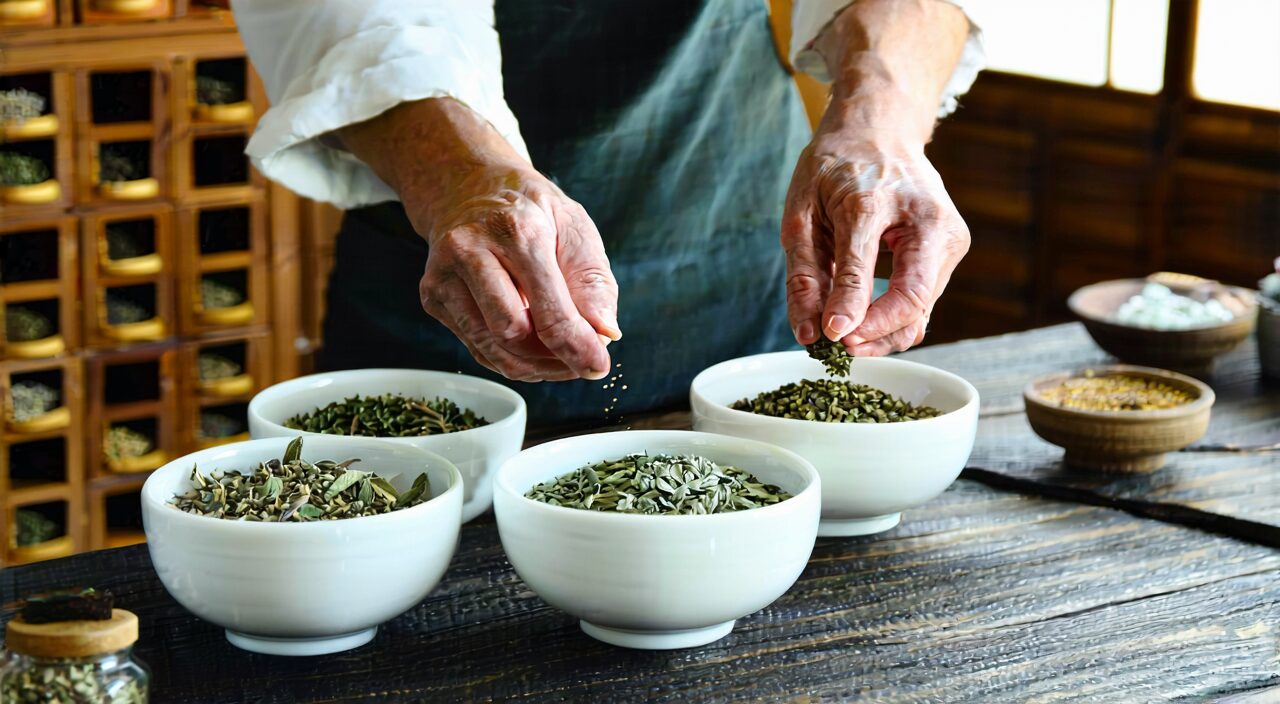
Shen Ling Bai Zhu San: Balancing Spleen Qi Fortification and Dampness Percolation
Shen Ling Bai Zhu San is a classic formula originating from the Taiping Huimin Heji Ju Fang (Prescriptions of the Bureau of People’s Welfare Pharmacies). Traditionally, it is often used for conditioning patterns of spleen qi deficiency with dampness. Its main ingredients include ginseng (or Codonopsis root), Bai Zhu (white atractylodes rhizome), Fu Ling (poria), Shan Yao (Chinese yam), Lian Zi (lotus seed), Bai Bian Dou (white hyacinth bean), Yi Yi Ren (coix seed), Sha Ren (amomum fruit), Jie Geng (platycodon root), and Gan Cao (licorice root).
From the formula composition:
- Ginseng, Bai Zhu, Fu Ling, and Gan Cao fortify spleen qi and provide the driving force for transporting and transforming water-dampness;
- Shan Yao, Lian Zi, Bai Bian Dou, and Yi Yi Ren, on the basis of fortifying the spleen, strengthen the action of blandly leaching out dampness while possessing astringent properties, which may be more suitable for spleen-deficiency-induced loose stools or watery diarrhea, and thin, clear vaginal discharge;
- Sha Ren awakens the spleen, transforms dampness, moves qi, and harmonizes the stomach;
- Jie Geng carries the medicinals upward and assists in diffusing lung qi to regulate the water passages.
Therefore, in traditional understanding, Shen Ling Bai Zhu San is often used when dampness turbidity accumulates internally based on spleen-lung qi deficiency. Common manifestations include poor appetite, shortness of breath, fatigue, loose stools, sallow complexion, a pale, swollen tongue with teeth marks, a white, greasy coating, and a slow, weak pulse. If accompanied by mild edema, or long-term overweight with soft, flabby muscles and easy fatigue, it can also be considered as a direction for further exploration.
Er Chen Wan: Regulating Qi, Transforming Phlegm, Drying Dampness, and Harmonizing the Stomach
The core formula of Er Chen Wan consists of Ban Xia (pinellia rhizome), Chen Pi (tangerine peel), Fu Ling (poria), and Gan Cao (licorice). Drying dampness and transforming phlegm is its prominent feature:
- Ban Xia dries dampness, transforms phlegm, descends rebellious qi, and stops vomiting;
- Chen Pi regulates qi, relaxes the middle, dries dampness, and transforms phlegm;
- Fu Ling fortifies the spleen and percolates dampness;
- Gan Cao harmonizes all the medicinals.
The entire formula has a concise structure, specifically targeting patterns of phlegm-dampness congestion and impeded qi movement. Er Chen Wan is traditionally suitable for phlegm-dampness constitution. Typical manifestations may include a body shape that is overweight, especially with a soft, puffy abdomen; oily face; heavy, sticky sweating; chest tightness with profuse phlegm; a sticky or sweet taste in the mouth; a preference for rich, fatty, and sweet foods; a white, greasy or thick, greasy tongue coating; and a slippery pulse. In such cases, simply fortifying spleen qi may not be strong enough, and it is necessary to strengthen the action of transforming phlegm and regulating qi.
It should be noted that Er Chen Wan is biased toward warmth and dryness. For those with yin deficiency with dry cough, blood-streaked sputum, or those who have dampness but also fluid deficiency with obvious dry mouth and tongue, extra caution is needed. It should not be used on one’s own without pattern differentiation.
Xiang Sha Liu Jun Zi Wan: Fortifying Spleen Qi, Boosting Qi, Moving Qi, and Transforming Dampness
Xiang Sha Liu Jun Zi Wan is composed of the Six Gentlemen Decoction (Liu Jun Zi Tang: ginseng, Bai Zhu, Fu Ling, Gan Cao, Chen Pi, Ban Xia) plus Mu Xiang (costus root) and Sha Ren (amomum fruit). It more closely combines fortifying spleen qi and boosting qi with regulating qi and transforming dampness, simultaneously addressing qi movement blockage in the middle burner and dampness arising from spleen deficiency.
Traditionally, Xiang Sha Liu Jun Zi Wan is commonly used for spleen-stomach qi deficiency, cold-dampness encumbering, and qi stagnation in the middle burner. In addition to manifestations of spleen deficiency with dampness exuberance, the symptoms often include notably:
- Epigastric and abdominal distension and fullness, worsened after meals
- Belching, hiccuping, nausea, and a desire to vomit
- Dull stomach pain that is relieved by pressure
- Diarrhea with undigested food
If heavy dampness is accompanied by severe bloating with slight movement or after eating, along with aversion to cold and cold hands and feet, Xiang Sha Liu Jun Zi Wan is often more commonly considered.
Preliminary differentiation of selection direction from common symptom perspectives
To help readers establish a rough comparative approach, one can observe from several typical dimensions (please note, this is only a reference framework for self-assessment and cannot replace professional pattern differentiation):
- If dampness manifestations are mainly of “deficiency,” with weak breath, loose stools, easy fatigue, minimal visible edema, and no significant spleen-stomach bloating: Shen Ling Bai Zhu San is traditionally more commonly focused on. It is biased toward supplementing spleen-lung qi, percolating dampness without damaging yin, and is relatively gentle in nature.
- If dampness manifestations are mainly “phlegm,” with body heaviness, profuse phlegm, sticky mouth, abdominal obesity, thick greasy tongue coating, nausea with the urge to vomit, and not obvious qi deficiency: Er Chen Wan is often mentioned as a direction for drying dampness and transforming phlegm, and is suitable for short-term use to clear phlegm-dampness; long-term overuse is not recommended.
- If dampness is simultaneously accompanied by marked “qi stagnation,” with post-meal bloating, belching, stomach pain, prominent sensation of distension, and also manifestations of spleen deficiency: Xiang Sha Liu Jun Zi Wan may be the choice more people learn about. It both fortifies spleen qi, transforms dampness and harmonizes the stomach, and can move qi and relieve distension, making it more suitable for a state of deficiency mixed with stagnation.
For a more intuitive view, a simple table can show the directional emphases of the three:
| Formula | Traditional Emphasis | Common Applicable Constitution or Symptom Characteristics |
|---|---|---|
| Shen Ling Bai Zhu San | Boost qi, fortify spleen, percolate dampness, stop diarrhea | Spleen-lung qi deficiency with dampness; fatigue, loose stools, edema, thin clear vaginal discharge |
| Er Chen Wan | Dry dampness, transform phlegm, regulate qi, harmonize the middle | Relatively severe phlegm-dampness; profuse phlegm, chest tightness, nausea, thick greasy coating, abdominal obesity |
| Xiang Sha Liu Jun Zi Wan | Fortify spleen, harmonize stomach, move qi, transform dampness | Spleen deficiency with qi stagnation; epigastric and abdominal distension and fullness, belching, dull stomach pain, indigestion |
Let me emphasize once more that such a classification is only a reference. In reality, many people have complex situations that may involve qi deficiency, phlegm-dampness, and qi stagnation simultaneously. In that case, one cannot simply apply it mechanically; it is necessary to weigh based on the main contradiction at that moment.
Overall matters to pay attention to before taking
Regardless of which direction you choose, the following general precautions are crucial:
- Follow the product instructions: Different dosage forms and manufacturers may have different processing methods and dosages. You should strictly follow the usage and dosage on the product insert; do not arbitrarily increase or decrease the amount.
- Dietary coordination: Traditional Chinese medicine strongly emphasizes the coordination of dietary therapy with formulas. During the period of taking such patent medicines, it is generally recommended to have a light diet, reduce raw, cold, greasy, sweet, and rich foods and alcohol, as these foods may aggravate dampness or damage the spleen and stomach, affecting the conditioning effect.
- Observe body reactions: In the early stage of taking, pay attention to changes in bowel movements, digestion, and mental state. If dry mouth, dry throat, constipation, heat signs, or other discomfort occur, you should promptly stop and consult a Chinese medicine practitioner.
- Exercise caution in special situations: Pregnant women, lactating women, infants and young children, those with chronic diseases, or those taking other medications must use under the guidance of a doctor and should not make decisions on their own.
- Do not blindly take long-term: Even for relatively gentle formulas like Shen Ling Bai Zhu San, it does not mean they can be taken indefinitely for “maintenance.” If symptoms do not improve after a period, or new discomfort appears, the direction should be reassessed.
When combination with other medicinals or adjusting direction may be needed
Some dampness-related weight issues, indigestion, or fatigue may not simply be due to spleen deficiency with dampness exuberance behind them. For example, if there is long-term poor sleep, tendency to anxiety, and high stress, Chinese medicine may understand it from the perspectives of dual deficiency of heart and spleen or liver constraint with spleen deficiency. Simply resolving dampness and fortifying the spleen may not be symptomatically appropriate.
Moreover, if obvious heat signs appear, such as:
- Bitter taste in the mouth, bad breath
- Yellow, greasy tongue coating
- Yellow urine
- Sticky, foul-smelling stools
It may belong to damp-heat, rather than simple cold-dampness or qi deficiency with dampness. At this time, formulas like Er Chen Wan or Xiang Sha Liu Jun Zi Wan, which tend toward warmth and dryness, are very likely unsuitable and require combination with heat-clearing and dampness-draining medicinals. Of course, this must be determined by an experienced Chinese medicine practitioner; do not mix medications on your own.
For severe, long-term, recurrent sleep problems, or those accompanied by obvious anxiety, depression, palpitations, chest tightness, pain, or breathing abnormalities, these are no longer in the simple scope of “dampness” conditioning, and priority should be given to consulting a doctor or mental health professional for a comprehensive evaluation.
Summary
Shen Ling Bai Zhu San, Er Chen Wan, and Xiang Sha Liu Jun Zi Wan, although all related to the traditional direction of resolving dampness and fortifying the spleen, have different formula rationales and applicable emphases:
- Shen Ling Bai Zhu San emphasizes spleen-lung qi deficiency with internal water-dampness retention;
- Er Chen Wan focuses on drying dampness, transforming phlegm, regulating qi, and harmonizing the stomach;
- Xiang Sha Liu Jun Zi Wan targets more the state of spleen deficiency with qi stagnation and epigastric-abdominal distension and fullness.
The key to choosing a direction lies in carefully perceiving at which level your main discomfort lies—more deficiency, more phlegm, or more distension. However, because individual constitution and symptoms are often intertwined, the differentiation ideas provided in this article can only serve as a rough understanding and cannot replace the pattern differentiation process based on observation (inspection, listening/smelling, inquiry, palpation). Before using any Chinese patent medicine, it is recommended to combine the product instructions, your real situation, and seek the judgment of a Chinese medicine or pharmacy professional to avoid blind application.