
Who is Fuzi Lizhong Wan Suitable For? Composition, Effects and Contraindications

When experiencing abdominal cold pain and cold hands and feet, many people think of the classic formula Fuzi Lizhong Wan. It is indeed a renowned prescription for warming the middle jiao and strengthening the spleen, but it also requires extra caution because it contains aconite (Fuzi).
From the perspective of traditional Chinese medicine, this article organizes its composition, common applications, groups for whom it may not be suitable, and differences from several similar formulas, helping you understand it more objectively.
Understanding Its Approach Through “Spleen-Stomach Yang Deficiency”

In traditional Chinese medicine, the spleen and stomach govern transportation and transformation and are the foundation of postnatal constitution. When the body’s yang qi is insufficient, leading to internal cold generation or direct attack by cold pathogens, it often manifests as spleen-stomach yang deficiency.
Typical sensations usually include:
- Dull pain in the stomach or abdomen
- Comfort when applying a hot water bottle or pressing on the area
- Intolerance to cold, cold hands and feet
- Loose or even watery stools
- Poor appetite
- Mental fatigue
Fuzi Lizhong Wan is precisely designed around the direction of “warming the middle jiao to disperse cold and strengthening the spleen to boost qi.” It is not targeted at a specific disease, but is regarded as an important regulatory approach when the pattern differentiation belongs to spleen-stomach yang deficiency.
Formula Composition and the Role of Each Herb
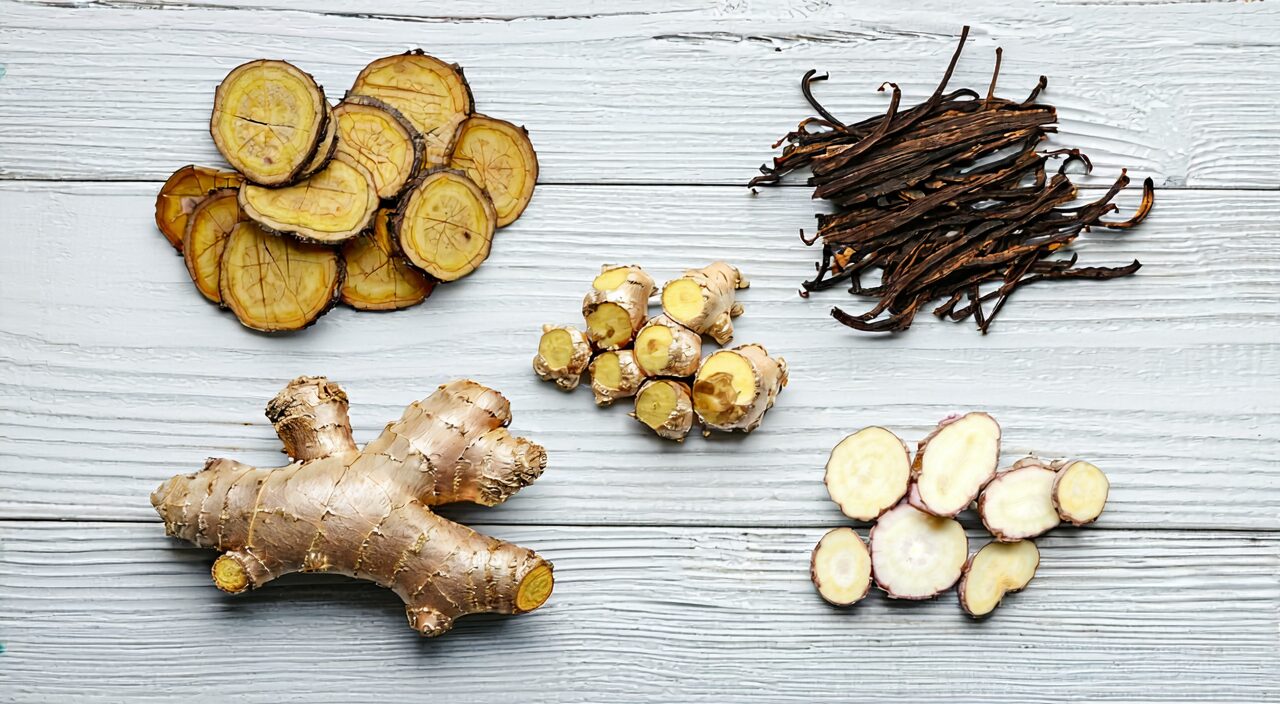
The origin of Fuzi Lizhong Wan can be traced back to the Lizhong Decoction in the Treatise on Cold Damage. After adding aconite, the strength of warming yang and dispersing cold is enhanced. Traditionally, it is mainly composed of the following five herbs:
| Herb | Approximate Role in the Formula |
|---|---|
| Aconite (Fuzi) | Warms and strengthens yang qi, expels cold pathogens; it is the key herb in the formula |
| Dried Ginger (Gan Jiang) | Warms the middle jiao and disperses cold, assisting aconite in warming the spleen and stomach |
| Ginseng (Ren Shen) | Tonifies spleen qi and restores the transportation and transformation functions of the spleen and stomach |
| White Atractylodes (Bai Zhu) | Strengthens the spleen and dries dampness, helping improve loose stools and fatigue |
| Honey-fried Licorice (Zhi Gan Cao) | Tonifies the middle jiao and boosts qi, harmonizes the other herbs |
Aconite holds an important position in this formula, but it is also an herb that requires special attention. It must undergo strict processing and dosage control; raw aconite is highly toxic and must never be used casually. In traditional application, its use is generally managed by professionals based on specific constitution and symptoms.
Groups Who May Be Suitable

Based on traditional usage experience, Fuzi Lizhong Wan is commonly used in the following situations where spleen-stomach yang deficiency is relatively obvious:
- Cold pain in the stomach and abdomen, where the pain sensation lessens with warmth or pressure and worsens with cold exposure
- Usually feeling cold, cold hands and feet, especially a cold feeling in the abdomen, waist, and back
- Loose or unformed stools, easy to have diarrhea, and feeling weak after bowel movements
- Reduced appetite, eating very little, and even discomfort upon consuming cold items
- Low spirits, noticeable fatigue, pale or sallow complexion
It needs to be reminded again that these manifestations only provide a reference direction and cannot be self-diagnosed. Individual constitutions vary greatly; even with some of the above manifestations, other issues may be intermingled, requiring comprehensive assessment.
Contraindications or Situations Requiring Caution
Fuzi Lizhong Wan leans towards warming and tonifying. The following situations are usually considered unsuitable or require caution:
- Those with heat signs: Such as burning sensation in the stomach, dry mouth, bad breath, dry stools, red tongue with yellow coating, indicating internal heat or yin deficiency with fire hyperactivity; improper use may worsen the discomfort
- Those with obvious yin deficiency: Hot palms and soles, night sweats, dry throat and mouth; using warm and drying substances may damage yin in such individuals
- Those with internal damp-heat: Yellow, greasy tongue coating, abdominal distension and fullness, sticky and sluggish stools; this is not a yang deficiency cold pattern and is unsuitable
- Pregnant women, children, and special physiological states: Must be evaluated by experienced professionals; self-experimentation is not advisable
- Long-term chronic issues with unknown causes: If abdominal pain, fatigue, or weight loss persist or gradually worsen, the cause needs to be identified first; one cannot rely solely on personal feeling to self-regulate
Additionally, the aconite in the formula has a certain toxicity. Even though it undergoes standardized processing, it still needs to be used under professional guidance. It is not advisable to arbitrarily increase the dosage or take it long-term. In traditional experience, such situations typically warrant close observation when adjusting formulas and dosages.
Differences from Several Similar Formulas
Sometimes, presentations of spleen-stomach yang deficiency can easily be confused with other conditions, and several other formulas are also frequently mentioned, but their focuses differ.
Xiao Jian Zhong Tang (Minor Construct the Middle Decoction)
- Composition characteristics: Uses maltose as the chief herb, combined with cinnamon twig, white peony, etc.
- Main direction: Warms the middle jiao, tonifies deficiency, and relaxes spasms to stop pain.
- Suitable direction: More inclined towards “deficiency taxation with internal urgency,” commonly seen in spasmodic abdominal pain that prefers warmth and pressure, possibly accompanied by palpitations and irritability.
- Difference from Fuzi Lizhong Wan: The warming yang strength is relatively weaker; it focuses more on nourishing the qi and blood of the middle jiao, suitable for those with milder deficiency-cold but paroxysmal abdominal pain that feels better with pressure.
Si Ni Tang (Frigid Extremities Decoction)
- Composition characteristics: Composed of aconite, dried ginger, and honey-fried licorice; it is the representative formula for restoring yang to rescue from counterflow.
- Suitable direction: More acute and severe cases, commonly seen in icy cold limbs, barely perceptible pulse, and diarrhea with undigested food, indicating yang qi collapse.
- Difference from Fuzi Lizhong Wan: It is not used for daily regulation, nor is it targeted at general spleen-stomach yang deficiency. Although Fuzi Lizhong Wan contains aconite, its overall tendency is to gently regulate the spleen and stomach; they are not equivalent.
Xiang Sha Liu Jun Zi Tang (Aucklandia and Amomum Six Gentlemen Decoction)
- Main direction: Leans towards strengthening the spleen and harmonizing the stomach, regulating qi and transforming phlegm.
- Suitable direction: Commonly used for spleen deficiency accompanied by qi stagnation and phlegm-dampness, such as gastric stuffiness, belching, poor appetite, loose stools, and white greasy tongue coating.
- Difference from Fuzi Lizhong Wan: More suitable for individuals whose main presentations are distension, oppression, and phlegm-dampness, without obvious cold pain or chills, differing from the prominent cold manifestations targeted by Fuzi Lizhong Wan.
Jin Gui Shen Qi Wan (Golden Cabinet Kidney Qi Pill)
- Main direction: Focuses on warming and tonifying kidney yang.
- Suitable direction: Often used for soreness and weakness of the lower back and knees, coldness in the lower half of the body, difficult or frequent urination caused by insufficient kidney yang; its target is the lower burner.
- Difference from Fuzi Lizhong Wan: Although it warms yang, its approach differs from warming the spleen to disperse cold. Some individuals may have both spleen-stomach yang deficiency and kidney yang deficiency simultaneously; in such cases, combined consideration is needed, and it is rare to use Fuzi Lizhong Wan alone to address both.
Overall, the directions of these formulas each have their own emphasis. Which one is more appropriate needs to be determined based on constitution, symptoms, and professional judgment; one cannot decide based on just one or two symptoms.
Summary
Fuzi Lizhong Wan is an important formula in traditional Chinese medicine for warming the middle jiao and strengthening the spleen. Its approach mainly revolves around spleen-stomach yang deficiency. The key to suitability lies not in the disease name, but in whether the overall constitution exhibits clear characteristics of cold and yang deficiency. Even in cases conforming to spleen-stomach yang deficiency, careful evaluation based on specific details is needed.
At the same time, because the formula contains aconite, even greater caution should be exercised during use. For any long-term, recurrent, or worsening abdominal discomfort, especially when accompanied by black stools, vomiting, significant weight loss, or severe pain, it is recommended to seek professional diagnosis promptly rather than attempting self-regulation. This article only serves as popular science reference of traditional knowledge and does not constitute any form of medication advice. Actual choices still need to combine individual circumstances and professional opinions.