
Who Should Take Guizhi Tang? Composition, Effects, and Contraindications

Guizhi Tang (Cinnamon Twig Decoction) is the first formula in the Treatise on Cold Damage (Shang Han Lun), and many people interested in Chinese medicine have heard of it. Yet, when it comes to daily regulation or the early stage of an externally contracted illness, what often causes confusion is: Is this situation actually suitable for Guizhi Tang? And how is it different from Mahuang Tang (Ephedra Decoction) or Gegen Tang (Kudzu Decoction)?
This article will clarify, from the perspective of traditional Chinese medicine, the composition of Guizhi Tang, the traditional understanding of its suitable presentations, the groups for whom it is not appropriate, and the differences between closely related formulas.
Understanding Guizhi Tang Through “Releasing the Muscle Layer and Harmonizing the Ying and Wei”

In Chinese medicine, Guizhi Tang is not regarded simply as a formula to promote sweating. Traditionally, it is understood to assist the body’s recovery by “releasing the muscle layer (jie ji) and promoting sweating (fa biao), while harmonizing the ying (nutritive) and wei (defensive).”
The so-called “disharmony between the ying and wei” can be understood in simple terms as an incoordination in the circulation of qi, blood, and fluids at the body surface and in the function of defense. For example:
- Feeling uncomfortable at the slightest draft of wind
- Being prone to sweating, yet feeling chilled after sweating
The strategy of Guizhi Tang is not to force sweating, but rather to combine acrid-warm and sour-astringent medicinals so that while inducing a mild sweat, it simultaneously protects body fluids. Therefore, it is more suitable for external invasions occurring in a state of “exterior deficiency,” rather than situations with high fever without sweating and severe body aches.
Composition of Guizhi Tang and the Role of Each Herb
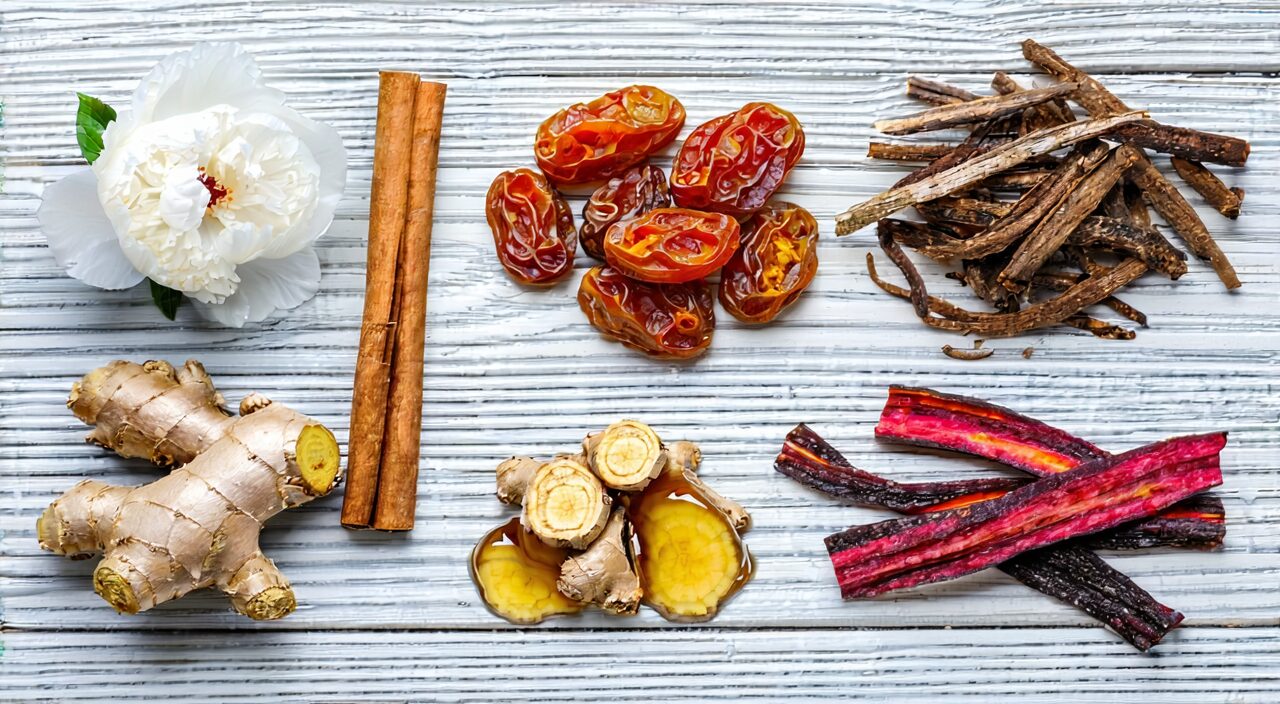
Guizhi Tang consists of five herbs; its structure is extremely refined. The following is the basic composition; actual dosage must be determined by a professional according to individual circumstances:
| Medicinal | Traditional Role |
|---|---|
| Guizhi (Cinnamon Twig) | Acrid-warm, unblocks yang, assists the wei, disperses cold |
| Baishao (White Peony Root) | Sour-astringent, restrains the yin, harmonizes the ying, relaxes tension |
| Shengjiang (Fresh Ginger) | Assists Guizhi to disperse cold, harmonizes the stomach |
| Dazao (Jujube) | Supplements the center, boosts qi, harmonizes the other medicinals |
| Zhigancao (Honey-fried Licorice Root) | Boosts qi, harmonizes the center, moderates the properties of the other herbs |
The pairing of Guizhi and Baishao is regarded as the core of this formula: one disperses, one restrains, enabling sweating without damaging fluids, and stopping sweating without trapping pathogens. Shengjiang, Dazao, and Zhigancao care for the spleen and stomach, providing the source for sweat formation.
Who Is Guizhi Tang Suitable For?

From the perspective of traditional pattern differentiation, Guizhi Tang is more suitable for people presenting with “exterior deficiency due to externally contracted wind-cold.” In the early stages of an external invasion, this population often shows the following characteristics:
- Aversion to wind, aversion to cold, but the body temperature may not be very high, or there is only mild fever
- Light sweating over the body, or a tendency to sweat easily in daily life, with the aversion to wind becoming more pronounced after sweating
- Headache, stiffness and discomfort in the back of the neck
- Nasal congestion, clear runny nose
- Generalized muscle soreness and fatigue
Simply put, if someone has been invaded by wind-cold and has sweating but the exterior does not resolve, aversion to wind is relatively prominent, fever is not severe, and there is no obvious sore, red, swollen throat, then traditionally Guizhi Tang may be considered as a direction to explore.
Additionally, people with a constitution that tends to be weak, who easily suffer from repeated external invasions, and whose digestive capacity is not strong are also often viewed as the susceptible foundation for Guizhi Tang syndrome.
It must be emphasized that these are only reference points in traditional pattern differentiation. Whether the formula is suitable must still be determined by combining tongue diagnosis, pulse diagnosis, and the overall condition; one cannot simply match one or two symptoms.
Situations Where Guizhi Tang Is Not Appropriate
If the following conditions are present, traditional understanding holds that one should not self-administer Guizhi Tang, and professional advice should be sought:
- High fever, absence of sweating, severe body aches – this often belongs to the Mahuang Tang pattern and is not suitable for Guizhi Tang
- Significant sore, red, swollen throat, thirst with a preference for cold drinks, coughing of yellow phlegm, and other wind-heat manifestations
- Constitutional heavy damp-heat, such as a red tongue with a yellow, greasy coating, tendency to acne, bitter taste in the mouth, bad breath
- Marked bleeding tendencies, or conditions with exuberant internal heat
- Pregnant women, children, those with chronic medical histories, or people already taking other medications
Moreover, if the external invasion has already penetrated deeper to the Shaoyang or Yangming stages, presenting with alternating chills and fever, fullness and distress in the chest and hypochondrium, constipation, abdominal fullness and pain, then using Guizhi Tang alone is also not appropriate. In these cases, formula selection must be re-evaluated under professional guidance based on pattern differentiation.
Differences Between Guizhi Tang and Similar Formulas
Many people easily confuse Guizhi Tang, Mahuang Tang, Gegen Tang, Xiao Qinglong Tang (Minor Bluegreen Dragon Decoction), and Yuping Feng San (Jade Wind-Barrier Powder). Below is a simple comparison based on traditional application directions to help establish basic discernment.
Mahuang Tang vs. Guizhi Tang
Mahuang Tang also originates from the Treatise on Cold Damage and is traditionally used for “exterior excess due to externally contracted wind-cold.” The key differences are:
- Mahuang Tang presentation: Generally no sweating, more severe aversion to cold, pronounced body aches, floating and tight pulse
- Guizhi Tang presentation: Presence of sweating, prominent aversion to wind, floating and relaxed or floating and weak pulse
One tends toward excess, the other toward deficiency – the directions are completely opposite.
Gegen Tang vs. Guizhi Tang
Gegen Tang can be understood as Guizhi Tang with the addition of Gegen (Kudzu) and Mahuang (Ephedra). It is often used when wind-cold fetters the exterior and the channel qi is not flowing smoothly, causing marked stiffness and pain in the neck and upper back.
If, after an external invasion, stiffness and pain of the neck and back are particularly prominent, and there is no sweating, with aversion to wind, possibly accompanied by mild diarrhea or loose stools, then Gegen Tang may traditionally be considered rather than simple Guizhi Tang.
Xiao Qinglong Tang vs. Guizhi Tang
Xiao Qinglong Tang focuses on “exterior cold with interior fluid retention.” In addition to exterior cold manifestations such as aversion to cold and fever, it often features:
- Cough, wheezing
- Copious clear, watery phlegm
- Inability to lie flat and other symptoms of retained fluids
This differs from Guizhi Tang’s approach of solely harmonizing the ying and wei and releasing the muscle layer; it leans more toward warming the lungs and transforming retained fluids.
Yuping Feng San vs. Guizhi Tang
Yuping Feng San is composed of Huangqi (Astragalus), Baizhu (White Atractylodes), and Fangfeng (Siler). Its traditional emphasis is “boosting qi and securing the exterior,” and it is suitable for people who normally easily suffer from repeated external invasions, aversion to wind, and spontaneous sweating, but with no significant external pathogen present. It leans toward prevention and consolidation.
Guizhi Tang is more often used at the stage when an external pathogen has already been contracted and the exterior is deficient. One emphasizes supplementation and consolidation, while the other emphasizes releasing the exterior and harmonizing; the timing of use is different.
Summary
As a classical formula, Guizhi Tang is traditionally understood mainly through the approach of releasing the muscle layer, promoting sweating, and harmonizing the ying and wei. It is suitable for presentations of externally contracted wind-cold with exterior deficiency: aversion to wind and sweating, mild fever, headache, nasal congestion, and body aches. However, people with high fever without sweating, marked sore throat, or those manifesting wind-heat external invasions are generally not appropriate candidates.
This article serves only as Chinese medicine knowledge education, helping overseas readers sort out the composition of Guizhi Tang, its traditional application boundaries, and its differences from Mahuang Tang, Gegen Tang, Xiao Qinglong Tang, Yuping Feng San, and other formulas. Each person’s constitution and symptom presentation varies; whether it is suitable still requires professional pattern differentiation. Do not self-diagnose or self-medicate. If symptoms persist, worsen, or are accompanied by other discomforts, it is recommended to consult a doctor or professional promptly.