
Who is Jinkui Shenqi Wan Suitable For? Composition, Efficacy and Contraindications

Many people, when choosing traditional Chinese patent medicines, encounter the name Jinkui Shenqi Wan and are often confused about which constitution type it suits, and how it differs from Liuwei Dihuang Wan. This article, from the perspective of TCM syndrome differentiation, sorts out the composition, traditional indications, which manifestations may point to kidney yang deficiency, as well as contraindications and differences from similar formulas.
Basic Positioning of Jinkui Shenqi Wan: Warming and Tonifying Kidney Yang
In TCM formula theory, Jinkui Shenqi Wan is usually classified as a classic formula for warming and tonifying kidney yang. It is not a pure yang-tonifying formula, but generates a small fire on the basis of supplementing yin, embodying the principle that “one skilled at tonifying yang must seek yang within yin.”
Therefore, it is often regarded as a formula that helps warm and assist kidney qi, transform qi and move water. Traditionally, it is commonly used for conditions related to kidney yang deficiency and impaired qi transformation.
It should be clear that what is discussed here is more about the theoretical framework of the formula. Whether it is suitable for a specific individual still depends on their constitution, current manifestations, and professional judgment. This article only provides general knowledge for understanding and cannot replace diagnosis or treatment advice.
Composition of Jinkui Shenqi Wan
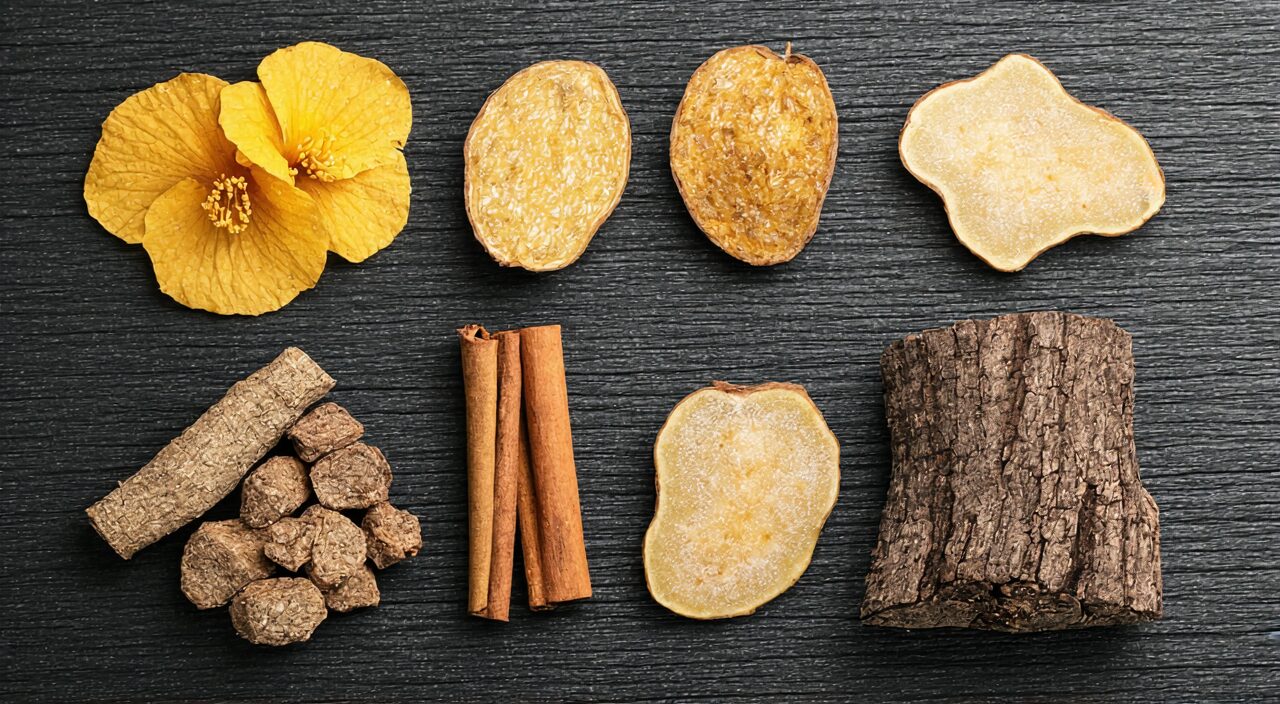
The classic composition of Jinkui Shenqi Wan includes dried Rehmannia root (Dihuang), Chinese yam (Shanyao), dogwood fruit (Shanzhuyu), water-plantain (Zexie), Poria (Fuling), tree peony bark (Mudanpi), cassia twig (Guizhi), and aconite (Fuzi).
Among them, dried Rehmannia root nourishes kidney yin; dogwood fruit and Chinese yam assist in supplementing the kidney and strengthening the spleen; water-plantain, Poria, and tree peony bark drain dampness and turbidity; cassia twig and aconite warm and tonify kidney yang to assist qi transformation. This combination reflects the characteristics of supplementing with draining and seeking yang within yin.
| Herb | Traditionally Considered Main Action Direction |
|---|---|
| Dried Rehmannia root (Gandihuang) | Nourishes kidney yin |
| Chinese yam (Shanyao) | Supplements kidney, consolidates essence, strengthens spleen |
| Dogwood fruit (Shanzhuyu) | Tonifies liver and kidney, astringes essence |
| Water-plantain (Zexie) | Drains water and dampness, purges kidney turbidity |
| Poria (Fuling) | Strengthens spleen and drains dampness |
| Tree peony bark (Mudanpi) | Clears liver fire, cools blood |
| Cassia twig (Guizhi) | Warms and unblocks yang qi, assists bladder qi transformation |
| Aconite (Fuzi) | Warms and tonifies the fire of the life gate, disperses cold and assists yang |
It is not difficult to see from the formula structure that Jinkui Shenqi Wan is not simply warming and tonifying, but takes into account both kidney yin and kidney yang while also promoting water passages. Therefore, traditionally it is more biased toward states of deficient cold and dampness in the lower body and weakness of qi transformation.
Who is Jinkui Shenqi Wan Suitable For? Looking at Directions from Common Manifestations

Traditional Chinese medicine often understands the applicable scope of Jinkui Shenqi Wan from the perspective of “kidney yang deficiency.” Kidney yang can be regarded as the foundation of the body’s functions such as warming, propelling, and qi transformation. When kidney yang is insufficient, it may manifest as a series of tendencies toward deficiency cold and weakened water metabolism.
Below are some commonly mentioned manifestations, but each person’s constitutional combination is different. One should not self-judge based only on one or two symptoms.
Aversion to Cold, Soreness and Weakness of the Lower Back and Knees
People with kidney yang deficiency are often more afraid of cold than those around them, especially coldness in the lower back and lower body, accompanied by soreness, weakness, and fatigue of the lower back and knees, which worsen after exertion. Traditionally, Jinkui Shenqi Wan may be suitable for this kind of lower back and knee discomfort belonging to yang deficiency pattern.
Increased Nocturia, Clear and Copious Urine
Because of insufficient yang qi, the water-qi transformation ability weakens. At night when yin qi is relatively strong, there is a tendency for increased frequency of nighttime urination and clear, copious urine. This kind of nocturia often does not have obvious stabbing pain or burning sensation, and is more like a deficiency pattern manifestation.
Lower Limb Edema, Prone to Water Retention
When kidney yang is insufficient, water-dampness cannot be transformed, and dampness tends to descend. Some people may have mild lower limb edema in the afternoon or after prolonged standing, with pitting on pressure. Traditionally, this type of edema may gradually improve when yang qi is restored and qi transformation returns to normal. Jinkui Shenqi Wan is often considered one of the approaches in this direction.
Low Spirits, Mental Fatigue and Lack of Strength
Yang qi governs activity, and kidney yang is the root of the whole body’s yang qi. If the overall state shows listlessness, easy fatigue, and relatively slow response, without obvious manifestations of stagnant heat or phlegm heat, TCM may consider regulating from the direction of warming and tonifying kidney yang. Jinkui Shenqi Wan is one of the reference formulas.
It should be emphasized that the above manifestations appearing alone may not necessarily mean kidney yang deficiency. Often multiple signals need to be combined and comprehensively judged together with tongue and pulse diagnosis. If accompanied by signs of deficiency heat such as heat in the palms and soles, dry mouth and throat, irritability, insomnia, night sweats, the direction may be completely different.
Contraindications for Using Jinkui Shenqi Wan
Although the traditional application scope of Jinkui Shenqi Wan is clear, it is not suitable for all cases of kidney deficiency or decline in physical strength. The following conditions are often considered directions that require avoidance or extremely careful judgment:
- Yin Deficiency with Fire Effulgence Constitution: If the main manifestations are heat in the palms and soles, night sweats, dry mouth and tongue, irritability, red tongue with little coating, etc., indicating internal heat generated by yin deficiency, using warming yang products may aggravate the deficiency fire. In such cases, the direction of nourishing yin to subdue fire is more important, rather than Jinkui Shenqi Wan.
- Obvious Damp-Heat or Acute Infection Phase: When there is yellow, thick, greasy tongue coating, sticky and uncomfortable bowel movements, dark yellow urine with hot pain, or during cold and fever, acute inflammation, it is generally considered that tonification should not be used rashly when damp-turbidity or pathogens are exuberant. Especially careful with warming and tonifying formulas.
- Specific Physiological Stages and Special Populations: Pregnant women, lactating women, children, and those with particularly complex constitutions should not self-assess for use. In these cases, the body’s homeostasis is relatively special, and the direction needs to be decided after thorough evaluation by professionals.
- Acute and Severe Symptoms such as Persistent Abdominal Pain, Vomiting, Black Stool: If, in addition to some manifestations similar to kidney yang deficiency, there are also warning signs such as severe abdominal pain, persistent vomiting, black stool, visible weight loss, a doctor should be consulted immediately rather than self-seeking formula regulation.
Differences between Jinkui Shenqi Wan and Similar Formulas
Many people confuse Jinkui Shenqi Wan, Liuwei Dihuang Wan, Guifu Dihuang Wan, Yougui Wan, and Fuzi Lizhong Wan. The following is a brief comparison from the perspective of TCM principles to help establish initial distinctions.
Jinkui Shenqi Wan vs. Liuwei Dihuang Wan
- Liuwei Dihuang Wan: Composed of six herbs, biased toward nourishing kidney yin. It is mainly used for constitution with kidney yin deficiency and deficiency fire flaring up, typically manifesting as soreness and weakness of the lower back and knees but accompanied by tidal fever, night sweats, dry throat, etc.
- Jinkui Shenqi Wan: Adds cassia twig and aconite to the Liuwei Dihuang base, forming a formula that simultaneously tonifies yin and yang with an emphasis on warming yang and transforming qi, more suitable for those with yang deficiency signs such as aversion to cold, edema, and increased nocturia.
The two differ in direction: one tends to tonify yin, the other warms yang. They should not be confused.
Jinkui Shenqi Wan vs. Guifu Dihuang Wan
The herbal composition of Guifu Dihuang Wan is very close to Jinkui Shenqi Wan, the main difference being the use of cinnamon bark instead of cassia twig, and often using prepared Rehmannia root instead of dried Rehmannia root.
- Guifu Dihuang Wan: Its warming action is generally considered more directed at subduing fire and returning it to its origin, focusing on decline of the life gate fire.
- Jinkui Shenqi Wan: Tends more toward transforming qi and moving water.
In practical application, a comprehensive consideration needs to be made based on cold signs and water-dampness conditions.
Jinkui Shenqi Wan vs. Yougui Wan
- Yougui Wan: Centers on warming and tonifying kidney yang, pure tonification without draining, with stronger essence-filling power. It is often suitable for kidney yang depletion and insufficient essence-blood with relatively severe cold signs and no obvious water-dampness.
- Jinkui Shenqi Wan: Tonification with draining, can also promote water discharge, more biased toward constitutions with yang deficiency accompanied by internal water-dampness.
Although both involve kidney yang, the degree of mixed deficiency and excess differs, and the selection approach varies.
Jinkui Shenqi Wan vs. Fuzi Lizhong Wan
- Fuzi Lizhong Wan: Mainly acts on spleen and stomach yang deficiency, targeting middle jiao deficiency cold, such as abdominal cold pain, preference for warmth and pressure, vomiting, diarrhea, etc.
- Jinkui Shenqi Wan: Focuses on lower jiao kidney yang and qi transformation.
The former emphasizes spleen yang, while the latter emphasizes kidney yang, with different sites and functional levels. Although there may be overlapping manifestations such as external aversion to cold and fatigue, the essential syndrome differentiation is different.
The theoretical directions of different formulas sometimes intersect, but the emphasis of constitutional imbalance varies. When considering specific matching, it is advisable to comprehensively weigh syndrome differentiation based on tongue and pulse, symptom spectrum, and professional knowledge.
Summary
In traditional understanding of Chinese medicine, Jinkui Shenqi Wan is often seen in the regulation approach for kidney yang deficiency and impaired qi transformation, suitable for constitutional tendencies of deficiency cold and non-transformation of water-dampness. Typical signals include aversion to cold, soreness and weakness of the lower back and knees, increased nocturia, lower limb edema, etc. However, its nature is warm, so it is not suitable for those with yin deficiency fire effulgence, internal exuberance of damp-heat, and special populations.
Compared with formulas such as Liuwei Dihuang Wan, Guifu Dihuang Wan, Yougui Wan, and Fuzi Lizhong Wan, Jinkui Shenqi Wan has its own emphasis in the direction of tonification, the proportion of water and fire, and whether there is draining of turbidity. Clarifying these differences helps establish a more accurate directional sense from the perspective of Chinese medicine.
This article is only for general reference and cannot replace professional diagnosis or treatment advice. Before any specific use, it is recommended to consider your own condition, product instructions, and consult a professional.