
Who Is Liuwei Dihuang Wan Suitable For? Composition, Benefits, and Contraindications Explained

When it comes to TCM tonification, many people think of Liuwei Dihuang Wan, but it is not suitable for all types of “kidney deficiency.” Liuwei Dihuang Wan mainly focuses on kidney Yin deficiency and nourishing Yin to tonify the kidney. If the pattern is not accurately identified, it might cause more discomfort. This article will clarify its composition, formulation principles, traditional benefits, and the groups it may or may not suit, and compare it with several common Dihuang Wan variations to help understand how to differentiate and choose.
What Is Liuwei Dihuang Wan
Liuwei Dihuang Wan originated from Qian Yi’s Xiao’er Yaozheng Zhijue (Key to Therapeutics of Children’s Diseases) in the Song dynasty. It was derived from the Kidney Qi Pill by removing the warming and yang herbs to emphasize its Yin-nourishing effect. Traditional Chinese medicine commonly understands it from the perspective of nourishing kidney Yin and replenishing kidney essence. It primarily targets a state of insufficient body fluids and internal disturbance of deficiency heat, rather than all types of “kidney deficiency” being universally applicable.
Source and Composition of Liuwei Dihuang Wan
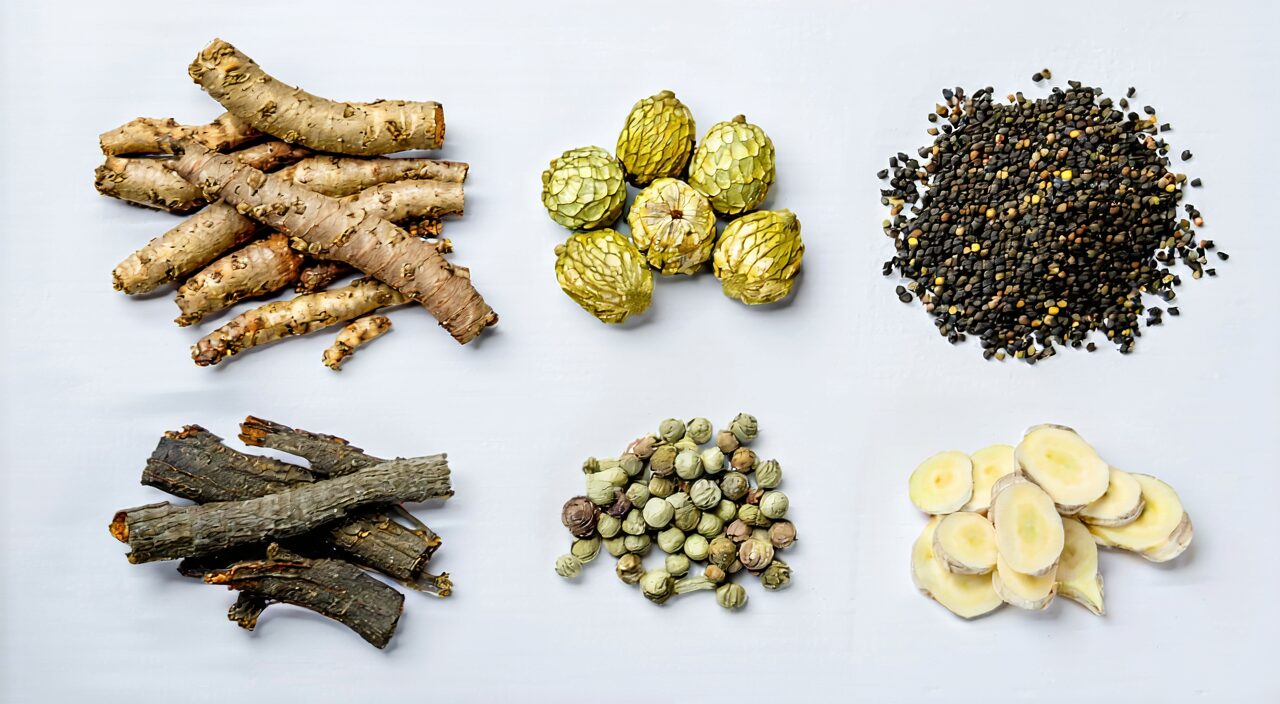
Liuwei Dihuang Wan consists of six herbs with a clear structure. Below are the herbs and their main roles in the formula:
| Herb | Role in Formula | Brief Understanding |
|---|---|---|
| Shu Di Huang (Prepared Rehmannia Root) | Sovereign herb | Nourishes Yin, tonifies the kidney, and replenishes essence; the core herb for nourishing kidney Yin. |
| Shan Zhu Yu (Cornus Fruit) | Minister herb | Tonifies the liver and kidney, and has astringent and securing properties; assists Shu Di Huang in strengthening tonification. |
| Shan Yao (Chinese Yam) | Minister herb | Tonifies the spleen and consolidates essence; supports the acquired foundation and ensures that tonification does not lead to stagnation. |
| Ze Xie (Alisma) | Assistant herb | Promotes urination and drains turbidity; prevents Shu Di Huang from being overly cloying. |
| Mu Dan Pi (Moutan Bark) | Assistant herb | Clears liver fire; restrains the warm and astringent nature of Shan Zhu Yu. |
| Fu Ling (Poria) | Assistant herb | Strengthens the spleen and leaches out dampness; works with Shan Yao to enhance transformation and transport, and avoids tonification that obstructs the spleen. |
Formulation Principle: Three Tonifying and Three Dispersing
The formulation of Liuwei Dihuang Wan is often summarized as “three tonifying and three dispersing”:
- Three tonifying: Shu Di Huang tonifies the kidney, Shan Zhu Yu nourishes the liver, and Shan Yao strengthens the spleen. By simultaneously regulating the liver, spleen, and kidney, the goal is to nourish Yin and tonify the kidney.
- Three dispersing: Ze Xie drains kidney turbidity, Mu Dan Pi clears liver fire, and Fu Ling percolates spleen dampness. They provide an outlet on top of supplementation, preventing obstruction from pure tonification.
This combination emphasizes tonification as the primary action, with dispersing elements integrated within tonification. It leans toward a gentle, moistening, Yin-nourishing approach, suitable for patterns of Yin-fluid depletion with a tendency toward deficiency fire exuberance.
How to Understand the Traditional Benefits of Liuwei Dihuang Wan
From the perspective of traditional Chinese medicine, Liuwei Dihuang Wan is believed to help nourish kidney Yin and replenish true Yin. When kidney Yin is depleted and fails to restrain Yang, manifestations such as internal disturbance of deficiency heat, lack of nourishment to the lower back, and insufficient moisture to the upper orifices may appear. Based on this, it is often used to address patterns related to kidney Yin deficiency, such as soreness and weakness of the lower back and knees, dizziness, tinnitus, dry mouth and throat, tidal fever, night sweats, and hot palms and soles. It must be emphasized that this refers to a traditional regulation approach under the premise that the pattern differentiation matches kidney Yin deficiency; it should not be equated to directly treating a specific modern disease.
Who Is Liuwei Dihuang Wan Suitable For

Liuwei Dihuang Wan may be more suitable for those whose primary tendency is kidney Yin deficiency. Common manifestations include:
- Soreness and weakness of the lower back and knees
- Dizziness and tinnitus
- Dry throat and mouth
- Night sweats
- Hot palms and soles
- Facial heat sensation
- Vexation and restlessness due to deficiency
The tongue may appear thin, red, and with little coating.
However, whether it is truly suitable must be determined by a TCM professional familiar with the individual’s constitution, in conjunction with the overall tongue and pulse picture. Self-assessment can only serve as a preliminary understanding and cannot replace pattern differentiation.
Who Should Avoid Liuwei Dihuang Wan
The following situations generally advise against self-use of Liuwei Dihuang Wan:
- Those with obvious kidney Yang deficiency tendencies: If you have marked aversion to cold, cold pain in the lower back and knees, clear and copious nighttime urination, and cold limbs, it indicates Yang Qi insufficiency. Liuwei Dihuang Wan, being Yin-nourishing, may aggravate the cold sensation.
- Those with spleen-stomach weakness and poor digestion: Frequent abdominal bloating, poor appetite, loose or unformed stools that are sticky — the Yin-nourishing property of Liuwei Dihuang Wan tends to hinder the spleen and stomach’s transportation and transformation, possibly worsening distension and loose stools.
- During colds, fever, or acute diarrhea: At these times, the body is dealing with external pathogens or gastrointestinal disharmony; tonifying and astringing remedies should be avoided. Use should be suspended.
- Those with significant damp-heat or phlegm-dampness: If you have a bitter sticky taste, thick yellow greasy tongue coating, profuse phlegm, or oily face, Yin-nourishing formulas might instead generate dampness and heat.
- Special populations and those with chronic diseases: During pregnancy, breastfeeding, children, and those with hypertension, diabetes, or liver and kidney diseases should consult a doctor before use.
- Long-term recurrent discomfort or accompanied by significant anxiety, palpitations, chest tightness, pain, or weight loss: Do not rely on self-judgment alone; seek medical attention promptly to rule out other conditions.
How Does Liuwei Dihuang Wan Differ from Other Dihuang Wan Formulas
Many Dihuang Wan variations have been derived from Liuwei Dihuang Wan, each leaning in a different direction. The following are some commonly seen ones:
| Formula | Composition Characteristics | Primary Orientation | Possible Indications | Precautions |
|---|---|---|---|---|
| Zhibai Dihuang Wan | Liuwei Dihuang Wan + Zhi Mu (Anemarrhena) and Huang Bai (Phellodendron) | Strengthens the clearing of deficiency fire and reduces deficiency heat | More prominent Yin deficiency fire, such as severe tidal fever and night sweats, dry and sore throat, recurrent oral ulcers, etc. | More cold in nature; extra caution for those with spleen-stomach deficiency cold |
| Qiju Dihuang Wan | Liuwei Dihuang Wan + Gou Qi Zi (Goji berry) and Ju Hua (Chrysanthemum) | Nourishes the liver and improves vision | Kidney Yin deficiency with dry eyes, blurred vision, tearing when exposed to wind, etc. | Especially common for those who frequently strain their eyes |
| Maiwei Dihuang Wan | Liuwei Dihuang Wan + Mai Dong (Ophiopogon) and Wu Wei Zi (Schisandra) | Nourishes lung and kidney Yin | Lung-kidney Yin deficiency causing dry cough with little phlegm, asthma, dry throat, and hoarseness, etc. | Emphasizes simultaneous regulation of lung and kidney |
| Jinkui Shenqi Wan | Contains Fu Zi (Aconite) and Gui Zhi (Cinnamon twig); composition is distinctly different from Liuwei Dihuang Wan | Warms and tonifies kidney Yang | Kidney Yang deficiency with aversion to cold, difficult urination or frequent nighttime urination, cold pain in the lower back and knees, etc. | One is warming, the other moistening; the directions are opposite and must be carefully distinguished |
Although these formulas share a common origin, their tendencies differ. The specific choice should still be based on constitution and symptom characteristics, combined with professional judgment.
Frequently Asked Questions
Who is Liuwei Dihuang Wan suitable for? As previously mentioned, it is more suited to those with kidney Yin deficiency, who may experience lower back and knee soreness, dry throat, night sweats, hot palms and soles, etc. However, it must be confirmed through TCM pattern differentiation and should not be self-applied.
Can Liuwei Dihuang Wan be taken long-term? It is not suitable for indiscriminate long-term use. Even for those who match the pattern, adjustments should be made periodically based on body changes. Prolonged use may affect spleen-stomach transportation or Yin-Yang balance. Whether to continue should be evaluated by a TCM professional.
How to distinguish Liuwei Dihuang Wan from Zhibai Dihuang Wan? Zhibai Dihuang Wan has a stronger effect in clearing deficiency fire and is suitable for those with prominent Yin deficiency fire signs; Liuwei Dihuang Wan is relatively milder, but neither is suitable for those with deficiency cold.
What is the difference between Liuwei Dihuang Wan and Jinkui Shenqi Wan? Liuwei Dihuang Wan focuses on nourishing Yin for kidney Yin deficiency; Jinkui Shenqi Wan warms and tonifies kidney Yang for kidney Yang deficiency with prominent cold signs. The two have opposite directions and need accurate differentiation.
Can Liuwei Dihuang Wan be taken during a cold? Generally not recommended. During a cold, external pathogens are at the surface; tonifying herbs may hinder the expulsion of pathogens. Use should be suspended until symptoms resolve, and then reconsider based on constitution.
Can people with weak spleen and stomach take Liuwei Dihuang Wan? Usually not suitable. If Yin nourishing is indeed needed, it should be done under professional guidance with methods to support the spleen, reducing cloying stagnation. It should not be used alone.
Can it be used during pregnancy, breastfeeding, or by children? These special populations have complex conditions with different requirements at different stages. It must be decided under medical guidance and should not be used arbitrarily.
Summary
Liuwei Dihuang Wan is a representative formula for traditional Yin-nourishing and kidney-tonifying. Its core direction is kidney Yin deficiency, and it is not suitable for all “kidney deficiency.” Its formulation features the “three tonifying and three dispersing” principle, leaning toward gentle moistening, and is unsuitable for those with cold constitution, spleen-stomach weakness, damp-heat, or unresolved pathogenic factors. There are many related Dihuang Wan products on the market with similar names, such as Zhibai Dihuang Wan and Qiju Dihuang Wan, each with a different emphasis. Selection should be based on individual constitution and symptom tendencies.
Under any circumstances, the use of Liuwei Dihuang Wan should be premised on accurate pattern differentiation. If you are unsure about your constitution or symptoms, or if discomfort persists or recurs, it is recommended to consult a TCM professional first for an individualized assessment before making a decision. Do not blindly self-medicate.