
Who Is Qi Ju Di Huang Wan Suitable For? Composition, Effects and Contraindications

Among the many formulas in traditional Chinese medicine, Qi Ju Di Huang Wan is a name frequently discussed. Many people who spend long hours using their eyes and experience dryness, blurred vision, or frequent dizziness and tinnitus may have heard that “Qi Ju Di Huang Wan is good for the eyes.”
But what is the thinking behind it? Who is it suitable for? And how does it differ from the commonly known Liu Wei Di Huang Wan? This article will outline its composition, traditional understanding, suitable directions, and usage precautions to help you build a clearer cognitive framework.
Composition and Formula Meaning of Qi Ju Di Huang Wan
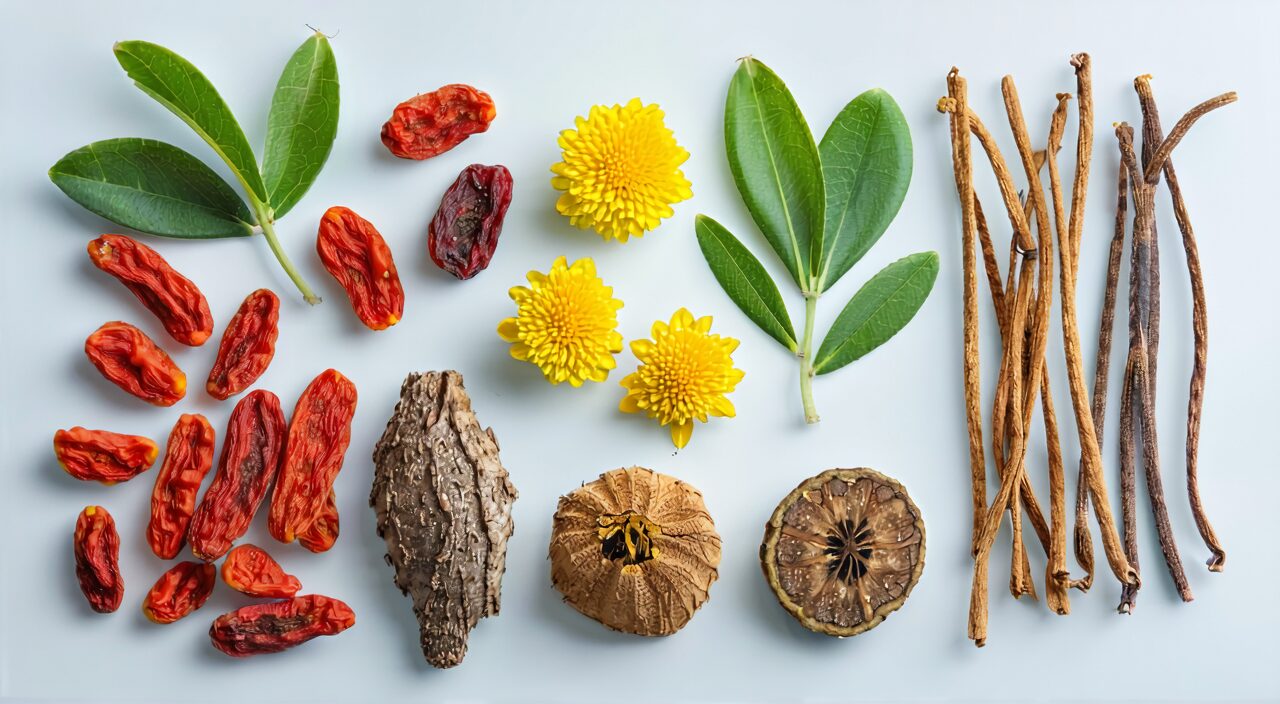
Qi Ju Di Huang Wan is not an entirely independent formula; it evolved from Liu Wei Di Huang Wan by adding two medicinal ingredients: Goji berry (Gou Qi Zi) and Chrysanthemum flower (Ju Hua). This modification shifts the focus of the formula to not only nourish kidney yin but also more specifically address the liver and the eyes.
Its basic composition and traditional formula meaning can be summarized as follows:
| Medicinal Ingredient | Traditional Action Direction Reference |
|---|---|
| Prepared Rehmannia (Shu Di Huang) | Nourishes yin, tonifies blood, enriches essence and replenishes marrow; often serves as the primary guiding direction in the formula |
| Cornus (Shan Zhu Yu) | Tonifies the liver and kidneys, astringes and consolidates |
| Chinese Yam (Shan Yao) | Supplements the spleen and stomach, tonifies the kidneys and astringes essence; addresses both spleen and kidneys |
| Tree Peony Bark (Mu Dan Pi) | Clears heat, cools blood, invigorates blood and resolves stasis; prevents stagnation during yin nourishment |
| Poria (Fu Ling) | Drains dampness, promotes urination, strengthens the spleen and calms the mind; prevents excessive supplementation from generating dampness |
| Alisma (Ze Xie) | Promotes urination, drains dampness and heat; restrains the potential cloying nature of prepared rehmannia |
| Goji Berry (Gou Qi Zi) | Nourishes and tonifies the liver and kidneys, enriches essence and improves vision; a commonly used medicinal for brightening the eyes |
| Chrysanthemum Flower (Ju Hua) | Disperses wind-heat, calms the liver and improves vision, clears the head and eyes |
From the perspective of traditional formula meaning, Liu Wei Di Huang Wan primarily nourishes kidney yin. Adding Goji berry and Chrysanthemum flower creates the classic structure of “nourishing the kidneys, nurturing the liver, and simultaneously clearing the head and eyes.” Goji berry focuses on enriching essence, while Chrysanthemum focuses on clearing, one tonifying and the other clearing, working together on eye discomfort caused by liver-kidney deficiency.
Therefore, Qi Ju Di Huang Wan is often categorized under the treatment principle of “enriching water to nourish wood,” especially associated with manifestations involving liver-kidney yin deficiency and deficient fire disturbing the eyes.
Who Might Qi Ju Di Huang Wan Be Suitable For

It must be emphasized that Chinese medicine values pattern differentiation; not everyone with eye discomfort can use the same formula. Qi Ju Di Huang Wan primarily corresponds to the pattern of “liver-kidney yin deficiency,” often accompanied by significant deficient-heat manifestations in the eyes or head.
Below are some directions traditionally considered potentially suitable for reference, but whether it is truly appropriate still requires assessment based on an individual’s overall condition.
Liver-Kidney Yin Deficiency Related Manifestations
- Eye dryness, easily fatigued vision, photophobia, blurred vision, or significantly decreased eyesight in dim light
- Frequently feeling dizzy, tinnitus with relatively fine sounds, tendency to worsen after exertion
- Soreness and weakness in the lower back and knees, with no obvious relief after activity and possibly feeling even more fatigued
- Accompanied by mild yin deficiency with internal heat signs such as memory decline, light sleep, vivid dreaming, and slightly warm sensations in the palms and soles
If a person’s discomfort pattern largely matches the combination above, and the overall tongue manifestation tends to be red with little or slightly yellow coating, a Chinese medicine practitioner might consider Qi Ju Di Huang Wan as a possible direction.
However, please be aware: these manifestations can also overlap with other health issues. For instance, simple visual fatigue may only require improved eye hygiene, while anemia or cervical spine problems can also cause dizziness and blurred vision, so self-prescription should not be applied arbitrarily.
Situations Requiring Special Caution or Where It Is Unsuitable
To avoid misuse, it is necessary to understand the scenarios where Qi Ju Di Huang Wan is less suitable. If the following conditions are present, it is usually not appropriate to use it on your own, or a professional assessment should be sought first.
When Pattern Does Not Match
- Spleen-stomach deficiency cold: Easily experiencing bloating, aversion to cold, loose stools, poor appetite, pale and puffy tongue with teeth marks. Qi Ju Di Huang Wan tends to be cloying and may worsen these discomforts.
- Internal exuberance of damp-heat or pronounced phlegm-dampness: Sensation of heavy body, bitter and sticky taste in the mouth, oily skin, yellow greasy tongue coating. In such cases, clearing damp-heat or transforming phlegm should be the main focus, and tonification is not advisable.
- Pure yang deficiency: Mainly manifesting as aversion to cold, cold limbs, pale complexion, and listlessness, without obvious yin deficiency signs. Using a yin-nourishing formula may not correspond to the pattern.
During Acute Discomfort Phase
- During acute external contractions such as externally-contracted fever, sore throat, or early-stage cough, tradition suggests suspending tonifying formulas to avoid “trapping pathogens inside.”
- If acute vomiting, diarrhea occurs in the digestive system, or a clear diagnosis of bacterial or viral infection is made, the acute issue should be addressed symptomatically first.
Special Physiological Stages
- Women during pregnancy, preparation for pregnancy, or breastfeeding should consult a qualified Chinese medicine practitioner or relevant physician before using any formula due to the special nature of their constitution and potential impact on the fetus or infant.
- Children, having delicate organs, respond differently to formulas with a cooling and nourishing nature compared to adults. Adult formulas should not be given to children casually.
If, while using any Chinese patent medicine or formula, new symptoms such as chest tightness, palpitations, persistent abdominal pain, obvious weight loss, sudden vision changes, nausea, or allergic reactions appear, discontinue use and seek medical attention promptly.
Differences Between Qi Ju Di Huang Wan and Similar Formulas
Many people confuse Liu Wei Di Huang Wan, Qi Ju Di Huang Wan, Zhi Bai Di Huang Wan, Ming Mu Di Huang Wan, and Mai Wei Di Huang Wan. They differ by only one or two medicinal ingredients, but their directions have already diverged. Understanding these differences helps clarify why they cannot be casually substituted.
| Formula Name | Core Modification | Traditional Direction Focus |
|---|---|---|
| Liu Wei Di Huang Wan | Prepared Rehmannia, Cornus, Chinese Yam, Tree Peony Bark, Poria, Alisma | Basis of nourishing kidney yin; leans towards lower back and knee soreness, dizziness and tinnitus due to kidney yin insufficiency |
| Qi Ju Di Huang Wan | Liu Wei plus Goji Berry, Chrysanthemum | While nourishing kidney yin, strengthens liver nourishment and eye brightening, clears the head and eyes; suitable for liver-kidney yin deficiency with prominent eye discomfort |
| Zhi Bai Di Huang Wan | Liu Wei plus Anemarrhena (Zhi Mu), Phellodendron (Huang Bai) | Enhances the effect of clearing deficient fire; suitable for yin deficiency with flourishing fire, tidal fever, night sweats, dry mouth and sore throat, leaning towards heat patterns |
| Ming Mu Di Huang Wan | Liu Wei plus Goji Berry, Chrysanthemum, Angelica, White Peony, Tribulus, Abalone Shell, etc. | Leans more towards nourishing yin and blood, calming the liver and brightening eyes; more complex formula, focusing on blood deficiency with liver hyperactivity eye disorders |
| Mai Wei Di Huang Wan | Liu Wei plus Ophiopogon (Mai Dong), Schisandra (Wu Wei Zi) | Leans towards nourishing kidneys and astringing lungs; suitable for dry cough, tidal fever, and night sweats caused by lung-kidney yin deficiency |
From this comparison, it can be seen that although they all carry the name “Di Huang Wan,” the different modifications target different organ patterns and symptom combinations.
- If a person’s discomfort mainly manifests as yin deficiency cough and hoarseness, the thinking behind Mai Wei Di Huang Wan may be closer.
- If yin deficiency combines with obvious fire hyperactivity, severe irritability and insomnia, Zhi Bai Di Huang Wan might be considered more often.
- The core characteristic of Qi Ju Di Huang Wan is “prominent eye symptoms.”
Understanding the Usage Approach from a Traditional Perspective

The rationale behind Qi Ju Di Huang Wan can be summarized as: on the fundamental basis of tonifying kidney yin, simultaneously taking care of the liver and the eyes.
Traditional theory holds that “the liver opens into the eyes” and “the liver and kidneys share the same source.” Sufficient kidney yin can nourish liver yin, and abundant liver blood can moisten and nourish the eyes. If one frequently stays up late, overuses the eyes, or has a constitution tending towards yin-blood deficiency over time, symptoms like eye dryness and dizziness may appear. Qi Ju Di Huang Wan is one of the tools designed to intervene starting from this pathological chain.
However, this approach is more suitable for chronic conditions without obvious organic lesions. If organic eye diseases such as glaucoma, cataracts, or macular degeneration are present, relying solely on such formulas is often insufficient, and evaluation by an ophthalmology specialist is necessary.
Furthermore, even if manifestations overlap with liver-kidney yin deficiency, other possible causes must be ruled out first, such as vision fluctuations caused by diabetes or Sjögren’s syndrome. These require clarification through modern medical examinations and cannot be self-judged based on symptoms alone.
Summary
Qi Ju Di Huang Wan is a classic formula that adds Goji berry and Chrysanthemum to Liu Wei Di Huang Wan. Traditionally, it is used for eye dryness, visual fatigue, dizziness, tinnitus, and lower back and knee soreness caused by liver-kidney yin deficiency. It can be seen as a representative formula of the “nourish kidney yin, nurture liver and brighten eyes” approach.
However, it is not a universal formula suitable for everyone. Individuals with spleen-stomach deficiency cold, pronounced damp-heat or phlegm-dampness, those in the acute phase of external contraction, and those in special physiological stages are usually not suitable for self-directed use. When comparing it with similar formulas such as Liu Wei Di Huang Wan, Zhi Bai Di Huang Wan, Ming Mu Di Huang Wan, or Mai Wei Di Huang Wan, the choice must be based on specific patterns and discomfort combinations, and casual substitution is not advisable.
Finally, it needs to be reminded that any formula or Chinese patent medicine should be used under the premise of pattern differentiation and treatment. If you are troubled by recurrent or persistent eye discomfort, dizziness or other issues, accompanied by significant anxiety, chest tightness, weight loss, or sudden vision changes, it is recommended to consult a doctor first for a more comprehensive evaluation. This article provides objective reference solely from the perspective of traditional Chinese medicine and cannot replace professional diagnosis or treatment advice.