
TCM Causes and Guidance for Receding Hairline

You look in the mirror and suddenly notice that the hair at both temple corners is becoming finer and softer, with the forehead hairline quietly receding, gradually forming a capital “M” — a concern faced by many men and some women.
Modern medicine often links this to androgenetic alopecia, while in traditional Chinese medicine observation, a receding hairline is not an isolated “scalp issue.” It is often seen as a reflection on the head of internal organ functions, qi and blood status, and internal factors such as phlegm dampness and fire heat. Clarifying these concepts may allow us to face this process more calmly and rationally, and find a daily care direction suited to our own body constitution.
Why Does a Receding Hairline Usually Start at the Forehead and Crown?
A classic saying in Chinese medicine theory is, “The hair is the surplus of blood,” meaning the luster or withering of hair is closely related to the nourishment by blood. Blood traveling upward to nourish the hair pores depends on the coordinated work of the liver, kidneys, and spleen. So why does a receding hairline tend to manifest first at the forehead and crown? Traditionally, there are some explanations based on meridian pathways.
Relationship Between the Forehead Region and the Yangming Meridian
The forehead hairline and both temple corners are associated in meridian theory mostly with the Foot-Yangming Stomach Meridian and Hand-Yangming Large Intestine Meridian. The Yangming meridians are rich in qi and blood. If diet is irregular, with excessive intake of greasy or sweet foods, or if the spleen-stomach transportation ability weakens, damp-heat can easily brew.
Damp-heat steaming upward along the meridians to the scalp may continuously “scorch” the hair pores on the forehead. The hair gradually becomes finer and softer, falls out easily, and the hairline slowly recedes. This is also why many people with excessive scalp oil and frontal hair loss also tend toward damp-heat signs such as facial oiliness, and a yellow greasy tongue coating.
Relationship Between the Crown and the Liver, Du Meridian
The crown region is often seen as closely related to the Liver meridian and Du Mai (Governing Vessel). The liver stores blood, the kidneys store essence, and essence and blood generate each other. If someone has long-term sleep deprivation, high stress, or emotional depression, liver blood and kidney yin are easily consumed in the background. When essence and blood are insufficient, they cannot ascend to nourish the crown, causing hair to lose nourishment and become sparse.
Thus, for some people, the receding hairline is not limited to the forehead but gradually expands to the crown, forming what is often called “O-type” hair loss or diffuse thinning. In TCM thinking, this pattern points more toward essence-blood depletion, liver-kidney insufficiency, and the like.
Several Common Body Constitution Patterns in Chinese Medicine
Although a receding hairline looks like the same scalp presentation, the underlying body constitution states can vary greatly from person to person. Without considering constitution, using the same method blindly to “grow hair” is like pouring the same fertilizer on plants with different needs — it is often hard to achieve the desired effect. Below are several patterns commonly linked to frontal hair loss and M-shaped hair loss, for informational direction only; specific assessment still requires combining one’s overall symptoms and professional judgment.
Liver-Kidney Yin Deficiency, Essence and Blood Insufficient
This pattern is commonly seen in people with prolonged mental tension, excessive mental exertion, frequent late nights, or those who already tend toward symptoms like lower back and knee soreness, dizziness, tinnitus, and dry eyes. Traditionally, it is believed that the liver stores blood and the kidneys store essence; essence and blood are the material foundation for hair growth. When liver-kidney yin is continuously depleted, and essence and blood cannot adequately nourish the head, the hair easily becomes dry, brittle, and inelastic. The hairline, especially at both temple corners, may gradually shift upward, while the crown may also become sparse.
People with this constitution type often also show signs of yin deficiency with internal heat, such as:
- Warm palms and soles, dry mouth and throat
- Waking easily at night, restlessness and irritability
- Red tongue with little coating, etc.
In terms of care direction, the focus is often on nourishing liver and kidney and replenishing essence and blood. For example, Liuwei Dihuang Wan (Six-Ingredient Rehmannia Pill) is a classic foundational formula targeting kidney yin deficiency; it can be a reference direction when there are related tendencies. If deficiency fire is more pronounced — for instance night sweats, dry and bitter mouth, red tongue with little coating — Zhibai Dihuang Wan, which adds Anemarrhena and Phellodendron to the Six-Ingredient base to also clear deficiency heat, may be more commonly referenced in such cases. Of course, these are just traditional application directions; whether and how to use them must be judged comprehensively based on one’s constitution, symptoms, and product instructions.
Damp-Heat Steaming Upward, Hair Pores Obstructed
Damp-heat steaming upward is also a very common type in temple hair loss and M-shaped hair loss. The typical characteristic is vigorous scalp sebum secretion — even soon after washing, the scalp quickly becomes oily and sticky, and the hair on the forehead and both sides easily becomes finer and softer. At the same time, it may be accompanied by:
- Itchy scalp, dandruff, even slight redness and small bumps
- Preference for greasy, sweet, spicy, and rich flavors
- Thick greasy or yellow greasy tongue coating, yellow urine, sticky difficult bowel movements, and a sensation of heavy body
Traditional Chinese medicine believes that fatty, greasy, and rich foods can promote dampness and generate heat. The water-damp that the spleen-stomach fails to transform accumulates into phlegm-turbidity; damp-heat steaming upward to the scalp is like covering the hair follicles with a layer of sticky “trash.” Over time, the hair pores cannot breathe or absorb nourishment normally, and the hair roots naturally become weaker and weaker.
In such cases, the care emphasis is usually on clearing heat, dispelling dampness, and unblocking the hair pores. Here, if one simply copies the liver-kidney nourishment approach, it may instead worsen the damp stagnation. Traditionally, directions like clearing heat, draining dampness, or strengthening the spleen to expel dampness are often referenced. For example, Shen Ling Bai Zhu San (Ginseng, Poria, Atractylodes Macrocephala Powder) was originally a formula for spleen deficiency with dampness and weakened transportation; in the process of eliminating dampness by strengthening the spleen and reducing scalp oiliness, it may be used in the adjustment of related constitutions. A reminder: damp-heat itself can be more heat-predominant or more damp-predominant, and may also be mixed with spleen deficiency in different degrees. Whether Shen Ling Bai Zhu San or similar is suitable must be analyzed comprehensively based on tongue appearance, pulse signs, bowel movements, and so on.
Blood Heat Generating Wind, Hair Losing Moistening
Another pattern is blood heat. Manifestations include an itchy scalp with a burning sensation, more pronounced scalp heat after emotional excitement or sun exposure, and possibly accompanied by irritability, easy anger, dry mouth, and dream-disturbed sleep. Chinese medicine has the saying “blood heat generating wind,” meaning blood heat stirred up can make hair fall beforehand, just as wind blows leaves off a tree. The hairline thus quietly retreats under this repeated “Wind.”
People of this type may also tend toward easy facial redness, acne, and dark yellow urine. Calming blood heat usually starts from cooling the blood, nourishing blood, and extinguishing wind. In terms of diet, one needs to avoid spicy, warm-stimulating foods, alcohol, and staying up late, since both alcohol and sleep deprivation can fan heat. In Chinese herbal medicine, there are often blood-cooling medicinals used in relevant directions, but specific combinations differ based on the severity of heat and whether stasis or dampness is also present.
Qi Stagnation, Blood Stasis, and the Role of Mental Stress
The role of mental stress in promoting a receding hairline is often understood in Chinese medicine within the framework of “liver qi depression” and “qi stagnation with blood stasis.” Being in a long-term state of high stress, anxiety, or melancholy, the liver’s function of coursing and discharging qi is easily obstructed. When qi dynamic is not smooth, blood circulation also becomes sluggish. The metabolism of the scalp depends on the smooth flow of qi and blood. Once local blood stasis occurs, nutrients cannot ascend, and shed hair has difficulty regenerating smoothly. The forehead region, due to meridian pathways, often becomes one of the positions sensitive to qi stagnation and blood stasis.
In adjusting this type, one cannot just focus on the scalp; regulating emotions and maintaining a regular daily rhythm holistically are even more needed. Appropriate exercise, keeping a consistent sleep rhythm, and reducing mental drain often have more long-term significance than merely topical products. Traditionally, there are also methods to soothe the liver, regulate qi, activate blood, and resolve stasis — for example, referencing Xiaoyao San type formulas under a physician’s guidance — but this requires strict pattern differentiation.
Key Care Points: The Direction Corresponding to Different Constitutions Cannot Be “One Size Fits All”
From the several patterns above, we can see that the causes of a receding hairline are very complex. Some people have a single constitution pattern, while others have several factors mixed — for example, having a base of liver-kidney yin deficiency, and on top of that, dietary indiscretion adding damp-heat; or long-term stress leading to qi stagnation and blood stasis, while also coexisting with yin deficiency fire and blood heat. This means that personalized adjustment is essential. The biggest taboo is to blindly chase after a trend just because you hear “a certain formula can grow hair.”
Identifying Your Constitution Is the First Step in Choosing a Direction
Different constitutional tendencies require completely different daily care focuses:
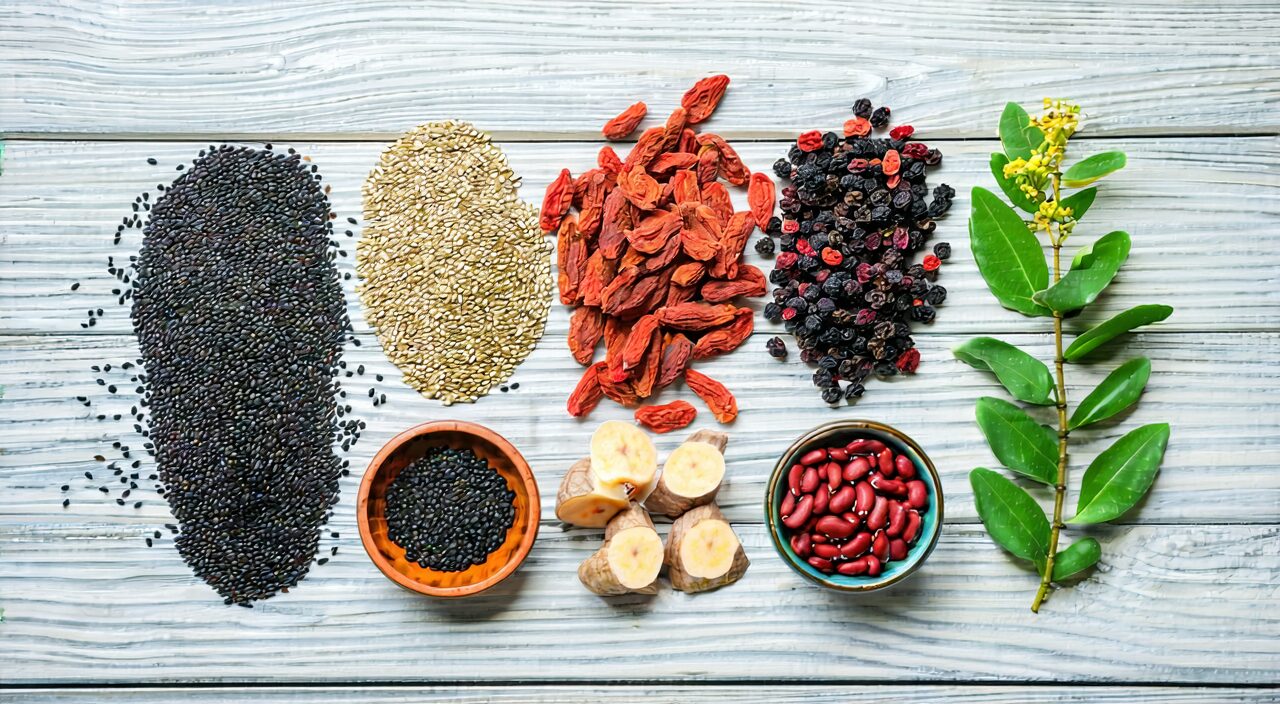
- If you tend toward lower back soreness, dry mouth, heat intolerance, warm palms and soles, easy to wake at night, and your receding hairline is accompanied by crown thinning, your daily care may lean more toward yin-nourishing and kidney-tonifying directions. In your diet, you can appropriately include black sesame, mulberry fruit, goji berries, Chinese yam, etc. At the same time, avoid late nights and overwork to protect liver-kidney yin.
- If your scalp is oily, hair strands clump together, tongue coating is thick and greasy, stools are unformed or stick to the toilet, and you have prominent temple and forehead hair loss, the care focus may not be to “supplement” but to give the body a “deep clean” — eliminating dampness, clearing heat, strengthening the spleen and promoting digestion. Diet should be light; eat more ingredients that help remove dampness, such as coix seed (Job’s tears), adzuki bean, winter melon, and hyacinth bean. Meanwhile, avoid fried, sugary, greasy foods, alcohol, and excessive dairy products.
- If you are accompanied by obvious restlessness, irascibility, and frequent scalp heat or itching, you may need to approach from the angle of cooling blood and extinguishing wind, while strictly limiting spicy and stimulating foods, and placing importance on emotional management.
It must be emphasized that Liuwei Dihuang Wan, Zhibai Dihuang Wan, Shen Ling Bai Zhu San and other patent Chinese medicines are only examples corresponding to different constitutional directions. Their traditional uses are different:
| Patent Medicine | Traditional Application Direction | Precautions |
|---|---|---|
| Liuwei Dihuang Wan | Often used for kidney yin deficiency leading to lower back and knee soreness, dizziness, tinnitus, etc. | Requires tongue and pulse assessment; not suitable for all hair loss types |
| Zhibai Dihuang Wan | While nourishing yin, it more strongly clears deficiency heat; suitable for yin deficiency fire exuberance with night sweats, dry mouth, etc. | Should not be used blindly if no deficiency heat is present |
| Shen Ling Bai Zhu San | Often used for spleen deficiency with heavy dampness and weak transportation, leading to indigestion, fatigue, loose stools, etc. | Requires careful assessment if damp-heat is severe or yin deficiency is obvious |
These formulas have been referenced in some traditional applications related to hair loss, but whether they are suitable for a specific individual must be judged comprehensively based on tongue signs, pulse signs, and systemic symptoms — one cannot decide based solely on the single sign of a “receding hairline.”
Holistic Regulation Is More Critical Than Localized Intervention
Beyond internal care directions, reasonable adjustment of lifestyle habits is often an easily overlooked foundation. Regular sleep and reducing late nights are vital for protecting liver-kidney yin and blood. Moderate eating and avoiding fatty, sweet, and rich foods can reduce the internal production of damp-heat from the source. Appropriate exercise and relieving emotions help the circulation of qi and blood, lowering the risk of qi stagnation and blood stasis. These seemingly ordinary habits may have a more fundamental significance in delaying hairline recession and maintaining a healthy scalp environment than any single intervention.
Summary
In traditional Chinese medicine, a receding hairline is not an isolated local issue. It is related to multiple internal factors such as the liver, kidneys, spleen, stomach, qi, blood, damp-heat, and emotions. Different hair loss patterns at the temple corners and crown may correspond to different constitutional leanings: liver-kidney yin deficiency easily affects both the crown and forehead, damp-heat steaming upward often manifests as an oily scalp with particularly evident changes on both sides of the forehead, and blood heat and stress can also contribute.
When facing this concern, it is more important to first understand your possible constitutional inclination rather than blindly following a single method or formula. Classic patent medicines like Liuwei Dihuang Wan, Zhibai Dihuang Wan, and Shen Ling Bai Zhu San each have their own range of applicability. Whether they match an individual’s condition still needs to be combined with specific symptoms and professional pattern differentiation. The various directions mentioned in this article are only a collation of traditional understanding, providing a reference for daily observation and self-awareness. If hair loss continues to worsen or is accompanied by other noticeable discomfort, it is recommended to consult a doctor or relevant professional promptly.