
Who Is Shen Ling Bai Zhu San Suitable For? Composition, Benefits and Contraindications

Many people experience heaviness in the body, poor appetite, chronic loose stools, mental fatigue and a thick, greasy tongue coating in daily life. From the perspective of traditional Chinese medicine, these manifestations are often associated with “spleen deficiency with dampness”.
Shen Ling Bai Zhu San is a long-standing formula for strengthening the spleen and draining dampness that is frequently mentioned. However, many people are unclear about which body types it suits, which people it does not suit, and how to differentiate it from similar formulas such Xiang Sha Liu Jun Zi Tang.
This article will explore its composition, traditional effects, suitable groups, contraindications and comparisons with similar formulas to help you develop a clearer understanding.
Core Approach of Shen Ling Bai Zhu San: Boosting Qi and Strengthening the Spleen, Draining Dampness and Stopping Diarrhea
Shen Ling Bai Zhu San originates from the Song Dynasty’s Tai Ping Hui Min He Ji Ju Fang and is one of the classic formulas for regulating spleen and stomach qi deficiency with internal stagnation of turbid dampness.
Traditional Chinese medicine holds that the spleen governs transformation and transportation, responsible for distributing the refined substances from food and drink throughout the body while also transforming and transporting water-dampness. If spleen qi is weak and its transforming and transporting ability is insufficient, not only do qi deficiency manifestations such as poor appetite, abdominal distension and fatigue appear, but water-dampness also easily accumulates within the body, forming signs of “dampness” such as loose stools, diarrhea, bodily heaviness and a white greasy tongue coating.
The main direction of this formula is to boost qi and strengthen the spleen while simultaneously draining dampness and stopping diarrhea. It is not merely about supplementing qi; rather, it supplements the spleen to assist transformation and transportation, and drains dampness to reduce the burden on the spleen and stomach, thus restoring the normal ascending and descending function of the middle burner.
Therefore, Shen Ling Bai Zhu San is often regarded as one of the representative formulas that “supplement without causing stagnation,” suitable for situations where spleen deficiency and dampness exuberance coexist.
Formula Composition and Combining Characteristics
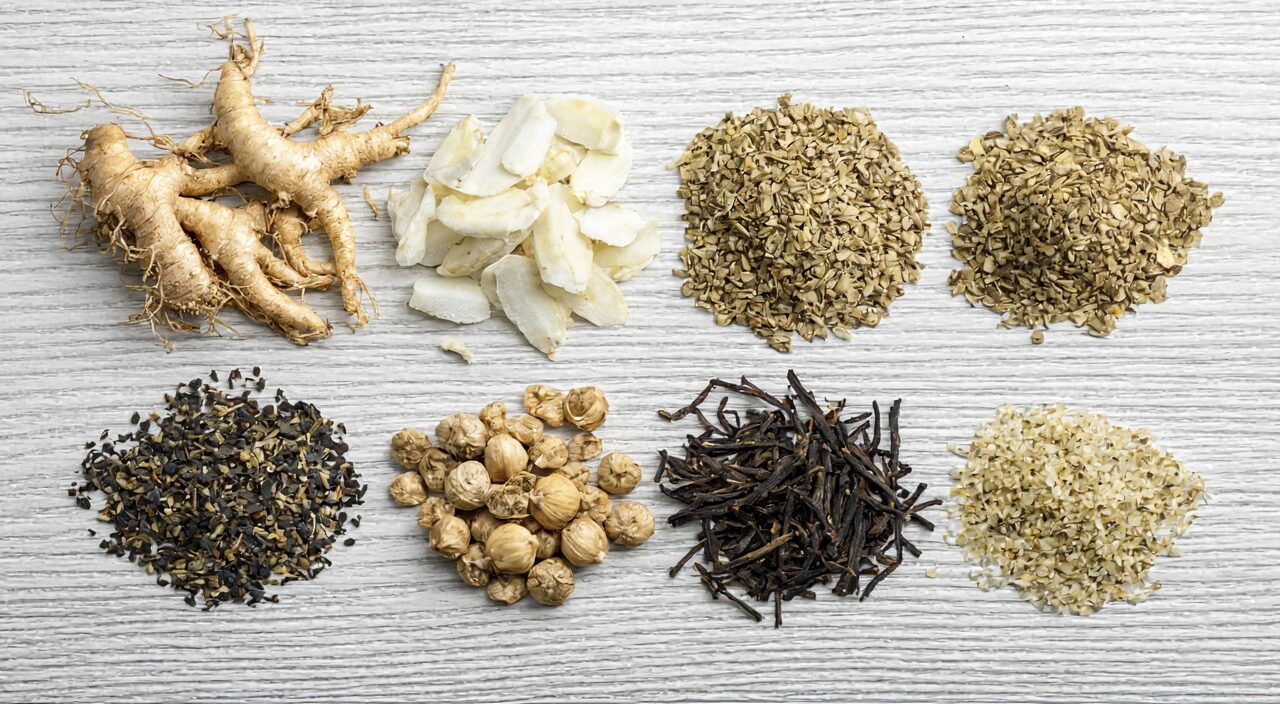
The combining concept of Shen Ling Bai Zhu San is meticulous, with the medicinals working synergistically to achieve the goals of boosting qi, strengthening the spleen, draining dampness and stopping diarrhea. Below are the commonly seen traditional ingredients and their brief actions:
| Medicinal | Traditional Action |
|---|---|
| Ren Shen (Ginseng) | Greatly supplements spleen and stomach qi, serves as the sovereign medicinal |
| Bai Zhu (White Atractylodes) | Strengthens the spleen and dries dampness, assists transformation and transportation |
| Fu Ling (Poria) | Strengthens the spleen and drains dampness, promotes urination without damaging the correct qi |
| Shan Yao (Chinese Yam) | Supplements the spleen and consolidates to bind, while also benefiting the lungs and kidneys |
| Lian Zi Rou (Lotus Seed) | Supplements the spleen and stops diarrhea, calms the heart and anchors the spirit |
| Bai Bian Dou (Hyacinth Bean) | Strengthens the spleen and transforms dampness, harmonizes the middle burner and relieves summerheat |
| Yi Yi Ren (Coix Seed) | Strengthens the spleen and drains dampness, relaxes sinew spasms |
| Sha Ren (Amomum Fruit) | Moves qi and harmonizes the stomach, transforms dampness and awakens the spleen, prevents supplementing from causing stagnation |
| Jie Geng (Platycodon Root) | Diffuses the lungs and benefits qi, carries medicinals upward to assist the spleen |
| Gan Cao (Licorice) | Supplements the spleen and harmonizes the middle burner, harmonizes all medicinals |
In the whole formula, Ren Shen, Bai Zhu and Fu Ling form the core combination, providing the foundational action of supplementing qi, strengthening the spleen and draining dampness.
Shan Yao and Lian Zi Rou not only assist in strengthening the spleen but also excel at stopping diarrhea; Bai Bian Dou and Yi Yi Ren enhance the force of transforming dampness; Sha Ren, with its aromatic nature, awakens the spleen and prevents excessive supplementation from stagnating the qi mechanism; Jie Geng embodies the concept of “consolidating earth to generate metal,” diffusing the lungs to assist the ascending of spleen qi; Gan Cao harmonizes all medicinals.
The whole formula supplements while maintaining free movement, simultaneously regulating the spleen and lungs, making it a relatively gentle supplementing and dampness-transforming formula.
Traditional Effects and Application Directions

In historical Chinese medical texts, Shen Ling Bai Zhu San is mainly used for various manifestations caused by spleen and stomach qi deficiency with accompanying dampness. Common directions include:
- Poor appetite and abdominal distension: epigastric and abdominal stuffiness and distension after eating, persistently poor appetite over a long period.
- Loose stools or chronic diarrhea: unformed stools, increased frequency, but often without pronounced urgency or burning sensation.
- Bodily heaviness and lack of strength: heavy limbs, low spirits, easy fatigue.
- Sallow complexion and soft, flaccid muscles: insufficient source of qi and blood production, muscles lacking nourishment.
- White greasy tongue coating and a weak, moderate pulse: pale, puffy tongue body with teeth marks, white and greasy coating.
Additionally, Shen Ling Bai Zhu San is often used for chronic cough and profuse thin phlegm caused by lung and spleen qi deficiency, due to its concept of “consolidating earth to generate metal”.
It should be noted that these application directions must be assessed based on the foundation of spleen deficiency with dampness. If the cough belongs to phlegm-heat or dryness, it is not suitable.
Who Is Shen Ling Bai Zhu San Suitable For
From the perspective of body constitution and symptomatic characteristics, Shen Ling Bai Zhu San may be more suitable as a reference direction for people with the following conditions, but it still needs to be assessed based on an individual’s overall situation:
- Relatively weak digestive function: frequent post-meal abdominal bloating, bloating worsens after consuming greasy or cold foods, small food intake.
- Chronically unformed stools: stools tend to be soft, loose, or thin, easily stick to the toilet bowl, but without evident anal burning or tenesmus.
- Bodily heaviness and tendency to puffiness: feeling of heaviness in the body, morning eyelid puffiness, slight ankle swelling in the afternoon.
- Mental fatigue and lack of strength: poor energy, feeling exhausted after slight activity, preference for reclining or leaning.
- Tongue presentation tending toward pale and puffy: the tongue color tends to be pale, the tongue body is enlarged, teeth marks on the edges, coating is white or white and greasy.
If a person has been in such a state for a long time, traditionally it may be considered from the perspective of spleen deficiency and dampness exuberance, and Shen Ling Bai Zhu San is one of the common regulating approaches.
However, whether it is truly applicable requires ruling out conditions such as damp-heat, food accumulation, and excess heat. It is not suitable to self-diagnose based on a single symptom alone.
Contraindications and Situations Where Use Is Inappropriate
Not all cases of indigestion and loose stools are suitable for using Shen Ling Bai Zhu San. The following situations are generally not recommended for self-use, or require extra caution:
- Damp-heat diarrhea: stools are sticky, foul-smelling, with anal burning and tenesmus, red tongue with yellow greasy coating. In such cases, clearing heat and dispelling dampness should be the priority; using qi-supplementing and astringent medicinals may instead worsen the discomfort.
- Excess heat pattern or obvious food accumulation: dry mouth, bad breath, abdominal distension that refuses pressure, dry or sour-smelling stools, thick yellow greasy tongue coating. Shen Ling Bai Zhu San tends to supplement and may trap pathogenic factors.
- Obvious constipation: Shen Ling Bai Zhu San has diarrhea-stopping and dampness-draining effects and is not suitable for people with excess-type or intestinal dryness constipation.
- Acute gastroenteritis or infectious diarrhea: when there is a sudden onset of abdominal pain, watery stool, fever, and marked nausea and vomiting, seeking professional medical attention should be the priority.
- Special populations: pregnant or breastfeeding women, children, and elderly or debilitated individuals need assessment under a professional’s guidance; self-diagnosis and self-use are not advised.
- Those with known allergies to medicinals in the formula: if there is a known allergy, contact should be avoided.
In summary, Shen Ling Bai Zhu San leans toward supplementation and is not suitable for the stage where “excess pathogenic factors are exuberant.” If you are uncertain about your body constitution, you should consult a Chinese medicine practitioner or a professional and make a comprehensive judgment based on product instructions and your actual situation.
Differences from Xiang Sha Liu Jun Zi Tang, Si Jun Zi Tang and Other Formulas
Among classic formulas for regulating the spleen and stomach, Shen Ling Bai Zhu San is often compared with Xiang Sha Liu Jun Zi Tang, Si Jun Zi Tang, Liu Jun Zi Tang, Ping Wei San and others. While all are related to the spleen and stomach, their focuses differ:
| Formula | Main Characteristics | Reference Application Direction |
|---|---|---|
| Si Jun Zi Tang | Basic qi-supplementing formula, gentle action | Spleen qi deficiency: shortness of breath, fatigue, poor appetite, loose stools, dampness signs are not obvious |
| Liu Jun Zi Tang | Additionally able to dry dampness and transform phlegm | Spleen qi deficiency with phlegm-dampness: cough with profuse sputum, nausea, chest stuffiness, thick white greasy coating |
| Xiang Sha Liu Jun Zi Tang | Enhanced action of moving qi, transforming dampness and relieving distension | Spleen and stomach qi deficiency, dampness obstructing and qi stagnation: epigastric and abdominal fullness and distension, belching, no desire to eat |
| Ping Wei San | Dries dampness and transports the spleen, moves qi and harmonizes the stomach | Dampness stagnating in the spleen and stomach: epigastric and abdominal distension and fullness, belching with putrid smell and sour regurgitation, heavy limbs, qi deficiency is not obvious |
| Shen Ling Bai Zhu San | Equal emphasis on boosting qi and strengthening the spleen, and draining dampness and stopping diarrhea, while also supplementing the lungs | Spleen deficiency with dampness, marked loose stools and diarrhea, physical deficiency with heavy dampness, pale greasy tongue |
Simply put, if dampness is relatively predominant and qi deficiency is not obvious, one may first consider Ping Wei San; if qi deficiency and phlegm-dampness coexist, Liu Jun Zi Tang can be understood; if accompanied by marked distension and belching, one may focus on Xiang Sha Liu Jun Zi Tang; if spleen deficiency with loose stools, bodily fatigue and a pale greasy tongue are the core, Shen Ling Bai Zhu San is a common reference direction.
Of course, specific choices cannot be separated from the four examinations and professional assessment. The above comparisons are only for knowledge organization and cannot replace pattern identification and treatment determination.
Summary
Shen Ling Bai Zhu San is a traditional formula with the core approach of boosting qi, strengthening the spleen, draining dampness and stopping diarrhea, primarily suitable for body constitutions with spleen deficiency and accompanying dampness.
Typical manifestations include poor appetite with abdominal distension, chronically unformed stools, bodily heaviness, mental fatigue and weakness, as well as a white greasy tongue coating. However, it is not suitable for those with internal damp-heat, excess heat, food accumulation or obvious constipation, and should not be used casually during acute stages of discomfort.
In comparisons with other spleen-strengthening formulas, the spleen-supplementing and diarrhea-stopping power of Shen Ling Bai Zhu San is relatively prominent, while its emphasis on moving qi and drying dampness differs from formulas such as Xiang Sha Liu Jun Zi Tang and Ping Wei San.
Every formula has its relatively suitable directions; whether it is suitable for an individual still requires comprehensive assessment based on specific body constitution, symptomatic presentations and professional advice.
This article is only for Chinese medicine popular science reference and cannot replace professional diagnosis or treatment plans.