
Who is Shi Quan Da Bu Tang Suitable For? Composition, Effects, and Contraindications

Many people hear the name “Shi Quan Da Bu Tang” (Ten Complete Great Tonifying Decoction) when they feel fatigued, pale, or sensitive to cold. But before determining if it’s suitable, it’s often more important to understand its specific composition, traditional action direction, and which situations may not be appropriate, rather than trying it directly. This article will approach from the perspective of traditional Chinese medicine (TCM) formula theory, organizing this information in a restrained manner to help readers establish a relatively clear understanding framework.
The Composition Logic of Shi Quan Da Bu Tang
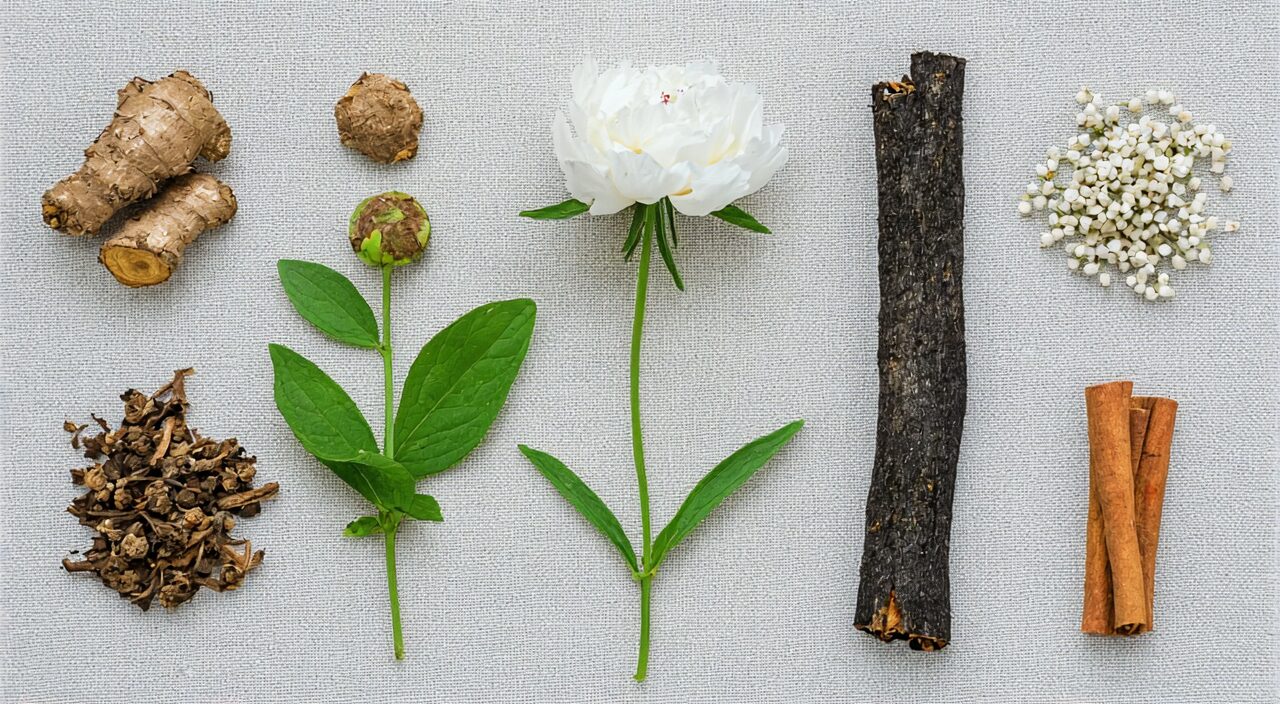
Shi Quan Da Bu Tang did not appear in isolation; it is derived from Bazhen Tang (Eight Treasure Decoction) with additional ingredients. Bazhen Tang itself is a combination of Si Jun Zi Tang (Four Gentlemen Decoction) and Si Wu Tang (Four Substances Decoction). Therefore, Shi Quan Da Bu Tang can be understood as building upon the dual supplementation of qi and blood, with further enhanced warming and nourishing strength.
Main Composition
| Herb Category | Herbs | Reference Role in the Formula |
|---|---|---|
| Qi-tonifying | Ren Shen (Ginseng), Bai Zhu (Atractylodes), Fu Ling (Poria), Zhi Gan Cao (Honey-fried Licorice) | Derived from the Si Jun Zi Tang approach, commonly used to supplement spleen and stomach qi |
| Blood-tonifying | Dang Gui (Angelica), Shu Di Huang (Prepared Rehmannia), Bai Shao (White Peony), Chuan Xiong (Sichuan Lovage) | Derived from the Si Wu Tang approach, commonly used to nourish and harmonize blood |
| Warm yang and tonify qi | Huang Qi (Astragalus) | Enhances the power of supplementing qi and securing the exterior |
| Warm and unblock yang qi | Rou Gui (Cinnamon Bark) | Adds warming and unblocking action to the supplementation, tending to improve deficiency-cold tendencies |
From its composition, it can be seen that Shi Quan Da Bu Tang is not simply about supplementing qi and blood. The addition of Rou Gui steers the entire formula more toward warming supplementation. Traditionally, it is often classified under “warming and supplementing qi and blood” formulas, used for certain presentations where qi and blood are insufficient and there is a tendency toward deficiency-cold.
Understanding the Traditional Effect Directions
In TCM theory, qi and blood are vital material foundations that sustain normal human functions. Insufficient qi easily leads to fatigue, shortness of breath, spontaneous sweating, etc.; insufficient blood easily affects complexion, spirit, and nourishing functions. When dual deficiency of qi and blood persists for a long time and signs of insufficient yang qi further appear, using Bazhen Tang alone may feel that the warming power is inadequate. At this point, Shi Quan Da Bu Tang becomes an option worth understanding.
Traditionally, this formula may be considered for the following directions:
- During prolonged illness or recovery, when overall function is low, presenting with both shortness of breath and reluctance to speak, fatigue, as well as aversion to cold and cold extremities.
- For some women after menstruation or postpartum, when obvious signs of dual qi-blood depletion accompanied by cold manifestations appear, but this requires strict assessment based on the constitution at that time.
- For elderly individuals or those with a chronically weak constitution, who fear cold and feel low in spirit during autumn and winter, without obvious heat signs or dampness stagnation.
It should be noted that these application directions are all premised on a deficiency-cold constitution. Without this constitutional premise, blind tonification may instead bring discomfort.
Who is Shi Quan Da Bu Tang Suitable For

The reason “who is it suitable for” is repeatedly emphasized is because tonifying formulas are not about the more tonification the better. From the perspective of traditional pattern differentiation, the following presentations may be seen as signals worth further investigation, but they absolutely cannot serve as a basis for self-diagnosis:
- Prolonged deficiency fatigue: Not short-term tiredness, but rather a long-lasting whole-body weakness that is hard to relieve even with rest.
- Pale or sallow complexion: Lacking healthy color, accompanied by pale lips and nails.
- Aversion to cold and fear of coldness: Especially cold hands and feet, preferring warmth and disliking cold.
- Shortness of breath and palpitations: Feeling breathless even with slight activity, or occasional heart flutters.
- Recovery-period weakness: Such as after a major illness or surgery, with overall low status, poor appetite, decreased body temperature regulation, and no signs of fever or infection.
- Spontaneous sweating and susceptibility to illness: Sweating easily without activity, and commonly liable to catch colds.
If these presentations exist simultaneously, and the tongue body tends to be pale with no yellow, thick, or greasy coating, traditionally Shi Quan Da Bu Tang might be considered as a thinking direction. However, this requires comprehensive assessment and a judgment made by a TCM professional; one should not self-identify based on isolated presentations alone.
Differences Between Shi Quan Da Bu Tang and Bazhen Tang
This is a question many readers care about. The key difference lies in the addition of Rou Gui and Huang Qi.
- Bazhen Tang: Composed of Si Jun Zi plus Si Wu, it evenly supplements qi and blood, with no prominent warming nature. It is more suitable for stages of dual qi-blood deficiency where cold or heat tendencies are not obvious.
- Shi Quan Da Bu Tang: Based on Bazhen Tang, it emphasizes Huang Qi and adds Rou Gui, clearly shifting toward warming supplementation. For conditions not only involving qi and blood deficiency but also deficiency-cold presentations such as aversion to cold, cold extremities, and mental fatigue, it may attract more attention.
Simply put, Bazhen Tang leans toward a basic direction of supplementing qi and blood, while Shi Quan Da Bu Tang is more like an enhanced version that incorporates warming and unblocking actions onto that foundation. If the constitution can receive tonification and indeed has deficiency-cold tendencies, Shi Quan Da Bu Tang may become a consideration; if there is deficiency without cold, or even with slight deficiency-heat, then Bazhen Tang might be more worth further understanding.
Differences from Bu Zhong Yi Qi Tang, Si Wu Tang, and Jin Gui Shen Qi Wan
Though the names of these formulas seem related, their traditional usage directions are clearly different and should not be conflated:
- Bu Zhong Yi Qi Tang: Focuses on supplementing the middle qi and lifting the clear yang. It is often used for fatigue, rectal prolapse, or tendency toward stomach prolapse caused by qi deficiency and sinking. Its blood-nourishing power is weak, and its warming yang power is limited.
- Si Wu Tang: Specializes in nourishing and regulating blood. It is the foundation of many menstrual-regulating formulas, with very weak qi-tonifying power. When there is pure blood deficiency without obvious qi deficiency and yang deficiency, the direction of Si Wu Tang is more focused.
- Jin Gui Shen Qi Wan: Warms and supplements kidney yang. Its core difference from Shi Quan Da Bu Tang is that it targets kidney yang, primarily treating signs of kidney yang deficiency such as soreness and weakness of the lower back and knees, difficult urination, or frequent nighttime urination. Supplementing qi and blood is not its main task.
Therefore, these formulas cannot be casually substituted for one another. Which direction is more suitable needs to be comprehensively evaluated based on the relative emphasis of qi, blood, yin, and yang deficiencies as well as specific presentations. It is recommended to make a choice under professional guidance.
Which Situations May Not Be Suitable
The foremost prerequisite for tonifying formulas is “having deficiency that can accept tonification.” The following types of situations usually require great caution or direct avoidance of self-use:
- Yin deficiency with fire effulgence tendency: Heat in the palms and soles, dry mouth and throat, night sweats, red tongue with little coating, etc. If warming tonics are used in such constitutions, discomfort such as dry mouth, mouth sores, and irritability may easily occur.
- Damp-heat or phlegm-damp excess conditions: Heaviness in the body, thick and greasy tongue coating, sticky stools, poor appetite accompanied by bloating sensation. Tonification at this time may worsen stagnation.
- During external contraction: Such as colds, fevers, cough, sore throat, etc. At these times, external problems should be addressed first; it is not advisable to tonify rashly.
- Special physiological stages: Pregnancy and lactation must be judged under the careful guidance of professionals; one must not self-select based solely on general informational content.
- Severe chronic diseases or unexplained symptoms: When experiencing chest tightness or pain, severe palpitations, persistent abdominal pain, black stools, unintended weight loss, etc., one must prioritize seeking medical examination to identify the cause, rather than considering self-tonification.
If it is difficult to judge which category one falls into, or if symptoms are complex and recurrent over the long term, one should first consult a TCM practitioner or physician, rather than self-matching based solely on written descriptions.
Summary
Shi Quan Da Bu Tang is one of the representative formulas for warming and supplementing qi and blood in the tradition. It highlights warming yang on the foundation of Bazhen Tang, and may be more suitable for people with dual deficiency of qi and blood accompanied by obvious deficiency-cold tendencies. Its composition determines that it is not suitable for everyone; particularly, yin deficiency, damp-heat, and external contraction states are usually inappropriate.
Compared with formulas like Bazhen Tang, Bu Zhong Yi Qi Tang, Si Wu Tang, and Jin Gui Shen Qi Wan, their respective focuses differ in qi, blood, yin, and yang. Understanding these differences helps in selecting a direction more suitable for one’s own situation under professional guidance.
No tonifying formula should be viewed as a daily health supplement. Whether it is suitable to use, and how to use it, must be based on individual constitution, current symptoms, and TCM pattern differentiation, with opinions given by qualified professionals. This article serves only as a compilation of traditional knowledge and cannot replace diagnosis or treatment advice.