
Who Is Suo Quan Wan Suitable For? Composition, Effects and Contraindications Explained

Many adults and elderly individuals face a difficult-to-discuss concern: frequent urges to urinate during the day, needing to get up multiple times at night, or even leaking urine when coughing or exerting slight effort. When these symptoms appear together with cold intolerance, soreness and weakness in the lower back and knees, and low energy, traditional Chinese medicine often interprets them through the lens of “kidney qi insecurity” and “deficiency cold in the lower origin.” Suo Quan Wan is one of the representative formulas frequently mentioned in this line of thinking.
This article will objectively explain the composition of Suo Quan Wan, its therapeutic direction, the types of people it may be suitable for, situations requiring caution, and how it differs from formulas such as Jin Gui Shen Qi Wan, You Gui Wan, Bi Xie Fen Qing Yin, and Wu Ling San. This aims to help overseas Chinese readers develop a clearer understanding.
How Traditional Chinese Medicine Understands the Therapeutic Direction of Suo Quan Wan
In traditional understanding, Suo Quan Wan primarily centers on the principle of “warming the kidneys, dispelling cold, reducing urination, and stopping leakage.” The “kidney” here does not equate to the modern medical kidney but rather represents a broader concept encompassing the regulation of water metabolism, storage, and containment. When the body is considered to have insufficient kidney qi and deficiency cold in the lower origin, the bladder’s qi transformation and restraining ability weaken, potentially leading to frequent urination, increased nocturia, or even enuresis.
From the perspective of formula theory, this prescription is generally not aimed at acute urinary irritation, nor does it focus on clearing damp-heat. Instead, it emphasizes warming, tonifying, and astringing, providing a treatment approach for bladder dysfunction caused by cold deficiency. Therefore, Suo Quan Wan is more suited to gradual, steady improvement rather than rapid relief of acute conditions.
Composition Characteristics and the Targeted Role of Each Herb
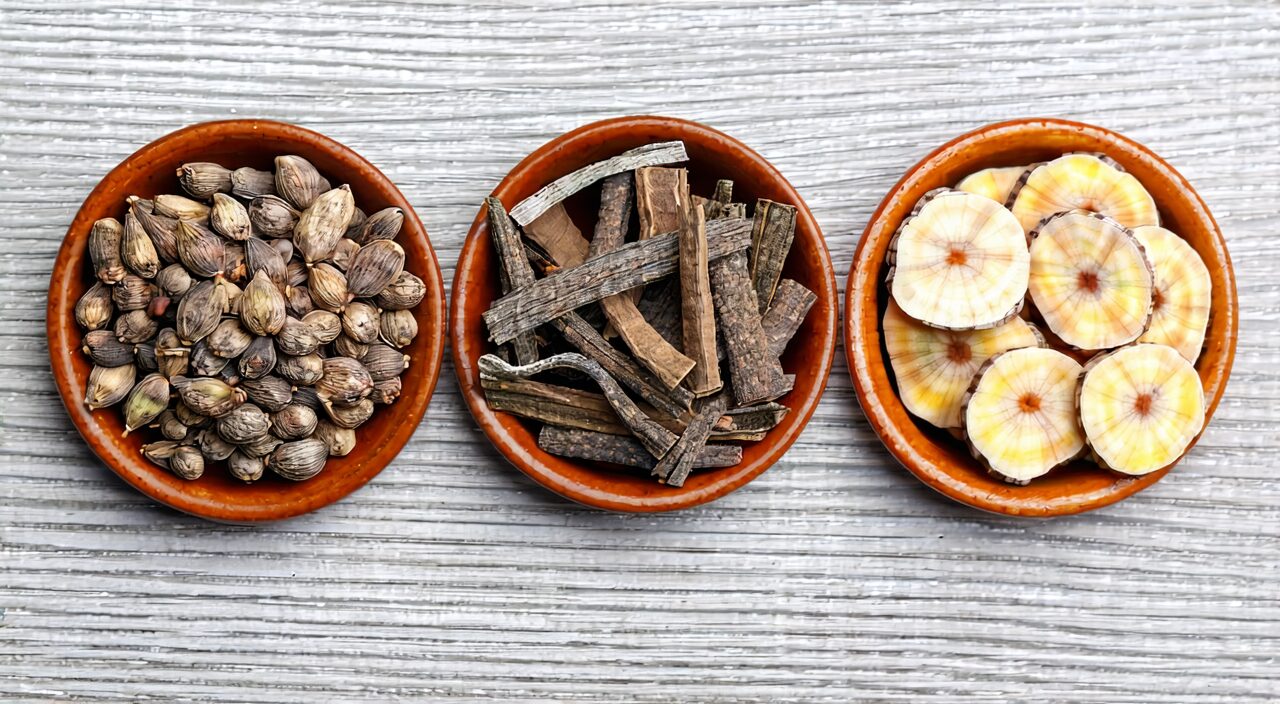
The composition of Suo Quan Wan is relatively simple, typically containing three herbs, each with its own emphasis that together warm the kidneys and reduce urination.
| Herb | Traditional Function Focus |
|---|---|
| Yi Zhi Ren (Alpinia oxyphylla) | Warms the spleen and kidneys, stabilizes essence and reduces urination; commonly used for frequent urination and enuresis due to deficiency cold in the lower origin |
| Wu Yao (Lindera aggregata) | Promotes qi circulation, disperses cold, warms the kidneys and reduces urination; helps strengthen bladder qi transformation and restraint |
| Shan Yao (Chinese yam) | Tonifies the spleen and stabilizes the kidneys, boosts qi and nourishes yin; plays a role in supporting both the spleen and kidneys in the formula |
The combination of these three herbs has traditionally been used to address states where “kidney cold” prevents proper containment. The formula does not heavily rely on strongly warming and tonifying herbs; it leans more toward gentle support and astringency. Therefore, it is not suitable for all types of frequent urination.
What Symptoms May Be More Suitable for Suo Quan Wan
Based on traditional usage directions, Suo Quan Wan is often considered for people with the following characteristics. However, it is important to note that suitability must be determined based on an individual’s constitution, symptoms, and professional assessment.
Primarily Characterized by Kidney Qi Insecurity with a Cold Tendency
- Increased frequency of urination during the day; volume is not large but the urge to urinate persists
- Significantly increased nighttime urination that disrupts sleep
- Urine is relatively clear and copious, without obvious burning sensation or turbidity
- General tendency to feel cold, cold hands and feet, frequent soreness and weakness in the lower back and knees
- Easily fatigued, slow recovery of energy, pale or dull complexion
- Small amounts of urine leakage may occur when coughing, sneezing, or jumping
If the above manifestations are present simultaneously and the constitution leans toward “cold” and “deficiency,” this is traditionally more likely to be a consideration for Suo Quan Wan. However, for simple age-related physiological changes or postpartum decline in pelvic floor muscle function, a more comprehensive evaluation is needed; one cannot simply rely on a single formula.
Situations Requiring Caution or Where It May Not Be Suitable
Not all cases of frequent urination and increased nocturia are suitable for Suo Quan Wan. The following types of situations are traditionally advised to be avoided, or professional advice should be sought before considering its use.
Urinary Abnormalities of the Damp-Heat Descending Type
If frequent urination is accompanied by dark yellow urine, urgency, urethral burning, painful urination, or a subjective feeling of distension and pain in the lower abdomen, this traditionally falls under “damp-heat pouring downward” or heat in the bladder. This direction is opposite to Suo Quan Wan’s warming and astringent approach. Using a kidney-warming, urine-reducing formula in such cases may trap damp-heat internally and aggravate discomfort. Such situations are commonly seen in acute urinary tract infections or acute exacerbations of some chronic prostate issues.
Accompanied by Fever, Thirst with a Desire for Cold Drinks, and Other Heat Signs
When the body shows clear signs of heat, such as fever, thirst with a desire to drink cold water, irritability, a red tongue with a yellow coating, and an overall yang-heat state, the warming nature of Suo Quan Wan may not be appropriate.
Diabetes or Urinary Tract Diseases Not Yet Clearly Assessed
Increased urination in diabetic patients is often directly related to blood sugar control; its mechanism is different from the “kidney cold insecurity” that Suo Quan Wan addresses. Using it without identifying the cause may delay blood sugar management. Similarly, urinary tract structural abnormalities, difficulty urinating due to prostatic hyperplasia, or urinary retention must first be evaluated by a professional; astringent formulas are not suitable for direct use in such cases.
Special Populations such as Pregnant Women and Children
Pregnant women and children have unique constitutions. Even commonly used traditional formulas require evaluation under strict guidance and should not be used based on general adult experience without professional advice.
Furthermore, any long-standing, recurrent problem with frequent urination or urinary incontinence, especially when accompanied by significant weight loss, abdominal pain, blood in the urine, difficulty urinating, or persistent pain in the lumbosacral region, should prioritize medical examination to rule out organic diseases.
Comparison with Similar Formulas
When learning about Suo Quan Wan, many people also come across Jin Gui Shen Qi Wan, You Gui Wan, Bi Xie Fen Qing Yin, and Wu Ling San. These formulas do have significant differences in their traditional applications. The following distinguishes them by core direction for reference only; specific choice must be based on individual circumstances.
Suo Quan Wan vs. Jin Gui Shen Qi Wan
Jin Gui Shen Qi Wan leans more toward warming and tonifying kidney yang, transforming qi, and promoting urination. It is often used for cold pain in the lower back and knees, difficult urination or edema, and systemic symptoms like aversion to cold and cold limbs caused by insufficient kidney yang. It combines water-promoting and tonifying actions rather than specifically astringing and securing. Suo Quan Wan focuses on astringing and reducing urination, targeting frequent urination and enuresis due to “a gate that cannot close.” Its tonifying scope is relatively smaller. Simply put, the former leans toward “tonifying yang and promoting urination,” while the latter leans toward “warming the kidneys and reducing urination.” In some cases where kidney yang deficiency is combined with frequent urination, although their directions may overlap, the primary and secondary focus are different.
Suo Quan Wan vs. You Gui Wan
You Gui Wan is a more typical formula for warming and tonifying kidney yang and replenishing essence and marrow. It is often used when kidney yang deficiency is relatively severe, accompanied by marked aversion to cold, cold pain in the lower back and knees, mental fatigue, and even diminished reproductive function. Although Suo Quan Wan also involves kidney yang, its herbal application is lighter, with the emphasis on reducing urination and astringing; it does not specialize in heavily tonifying kidney essence. If systemic deficiency cold and insufficiency of essence and marrow are dominant, a formula like You Gui Wan is traditionally considered first. If the degree of deficiency cold is not severe, but frequent urination and enuresis are the core issues, Suo Quan Wan may receive more attention.
Suo Quan Wan vs. Bi Xie Fen Qing Yin
Bi Xie Fen Qing Yin is traditionally used for strangury with turbid urine, white turbidity, and frequent urination with turbid discharge caused by deficiency cold in the lower jiao with internal retention of damp turbidity. It can both warm kidney yang and separate the clear from the turbid, addressing situations where cold and dampness intermingle and clear/turbid are not separated. Suo Quan Wan targets excessive urination that is clear and copious, generally not involving unresolved damp turbidity. If the urine is turbid or has white sediment, the traditional approach may lean more toward the direction of Bi Xie Fen Qing Yin. Although both can be used for “cold” conditions, one involves damp turbidity, while the other is a more pure weakness in restraint.
Suo Quan Wan vs. Wu Ling San
Wu Ling San’s core actions are promoting urination, percolating dampness, warming yang and transforming qi. It is often used when bladder qi transformation is impaired, leading to difficult urination, edema, thirst but vomiting upon drinking water, and other signs of internal water-dampness retention. It mainly helps expel abnormally retained fluids rather than astringe. Suo Quan Wan aims to “secure and hold” rather than “promote and drain.” Therefore, if there is difficulty urinating, scanty urine, or edema, the direction of Wu Ling San is more often considered; if urination is excessive and restraint is weak, then one might look toward Suo Quan Wan. The two directions are almost opposite and should not be confused.
For easy reference, the core differences between these formulas are summarized below:
| Formula | Core Direction | Key Reference Symptoms |
|---|---|---|
| Suo Quan Wan | Warms kidneys, reduces urination, astringes | Deficiency cold frequent urination, enuresis, clear and copious urine |
| Jin Gui Shen Qi Wan | Warms and tonifies kidney yang, transforms qi and promotes urination | Cold pain in lower back and knees, difficult urination or edema |
| You Gui Wan | Warms and tonifies kidney yang, replenishes essence and marrow | Pronounced systemic deficiency cold, insufficiency of essence and marrow |
| Bi Xie Fen Qing Yin | Warms kidneys, resolves dampness, separates clear from turbid | Turbid urine, white turbidity, or strangury with turbid urine |
| Wu Ling San | Promotes urination, percolates dampness, warms yang and transforms qi | Difficult urination, edema, thirst without desire to drink |
Some Points to Note from a Traditional Perspective During Use
In traditional application, Suo Quan Wan often adheres to the principle of “stopping once the condition improves,” meaning that once symptoms improve, it should not be taken blindly over the long term to avoid excessive astringency that may affect qi dynamics.
In addition, adjustments in daily life, such as avoiding cold exposure, reducing nighttime fluid intake, and engaging in appropriate pelvic floor muscle training, may also actively help improve symptoms. However, these are general health suggestions and cannot replace professional guidance.
It must be emphasized again that before using any Chinese herbal formula, it is advisable to combine product instructions, personal constitution, and a comprehensive evaluation by a professional. Especially for overseas users, due to differences in constitution, lifestyle habits, and the medical support available, it is even more important to carefully compare it to one’s own situation and not directly copy the experiences of others.
Summary
As a classic traditional formula for warming the kidneys, dispelling cold, astringing, and reducing urination, Suo Quan Wan is often used in Chinese medicine for frequent urination, increased nocturia, and enuresis caused by kidney qi insecurity and deficiency cold in the lower origin. Its composition is simple, mainly consisting of three herbs—Yi Zhi Ren (Alpinia oxyphylla), Wu Yao (Lindera aggregata), and Shan Yao (Chinese yam)—centered around warming and astringency.
However, there are many causes of frequent urination and enuresis, and not all situations are suitable for this formula. Damp-heat pouring downward, heat in the bladder, uncontrolled diabetes, and structural urinary tract abnormalities are generally outside the typical scope of Suo Quan Wan’s application and require thorough evaluation before use. At the same time, although formulas such as Jin Gui Shen Qi Wan, You Gui Wan, Bi Xie Fen Qing Yin, and Wu Ling San may have overlapping symptoms in some cases, their core directions differ significantly, and they cannot be casually interchanged.
This article is for informational reference only and cannot substitute professional diagnosis or treatment advice. If related symptoms persist or worsen, it is recommended to consult a qualified healthcare professional for targeted assessment and guidance.