
Xiao Jian Zhong Tang: Who Is It For? Composition, Benefits, and Contraindications

When many people experience dull, intermittent abdominal pain that feels better with warmth and pressure, easy fatigue, and cold hands and feet, they think of the traditional formula “Xiao Jian Zhong Tang.” It originates from the Treatise on Cold Damage (Shang Han Lun) and in Chinese medicine is often used from the perspective of warming the middle, tonifying deficiency, and relieving spasmodic pain for certain cold-deficiency abdominal discomforts.
So, exactly which herbs make up Xiao Jian Zhong Tang? What types of presentations is it more suitable for? What are the contraindications for its use? How does it differ from Fu Zi Li Zhong Wan, Huang Qi Jian Zhong Tang, and others? This article will sort through these questions based on traditional understanding, helping overseas Chinese readers gain a more rational understanding of this classic formula.
Traditional Positioning of Xiao Jian Zhong Tang: Warming the Middle, Tonifying Deficiency, and Relieving Spasmodic Pain
Traditional Chinese medicine holds that the spleen and stomach are located in the middle burner and govern transportation and transformation. When the spleen and stomach are weak, middle burner yang qi is insufficient, or there is disharmony between the nutritive and defensive qi, manifestations such as spasmodic abdominal pain, a preference for warmth and pressure, reduced appetite, fatigue, and palpitations may occur.
Xiao Jian Zhong Tang is precisely designed around the concept of “fortifying the middle” — that is, restoring spleen and stomach function by warming and nourishing the middle burner and harmonizing qi and blood.
Unlike approaches that focus on dispersing cold or supplementing and moving qi, Xiao Jian Zhong Tang’s distinctive characteristic is “relieving spasm and pain.” The maltose and peony in the formula are believed to relieve cramping abdominal pain through sweet and relaxing properties, while cinnamon twig and fresh ginger work together to warm and unblock yang qi. Therefore, it is traditionally used for patterns described as “deficiency-taxation with internal urgency” and “abdominal pain.”
Brief Analysis of Xiao Jian Zhong Tang’s Composition
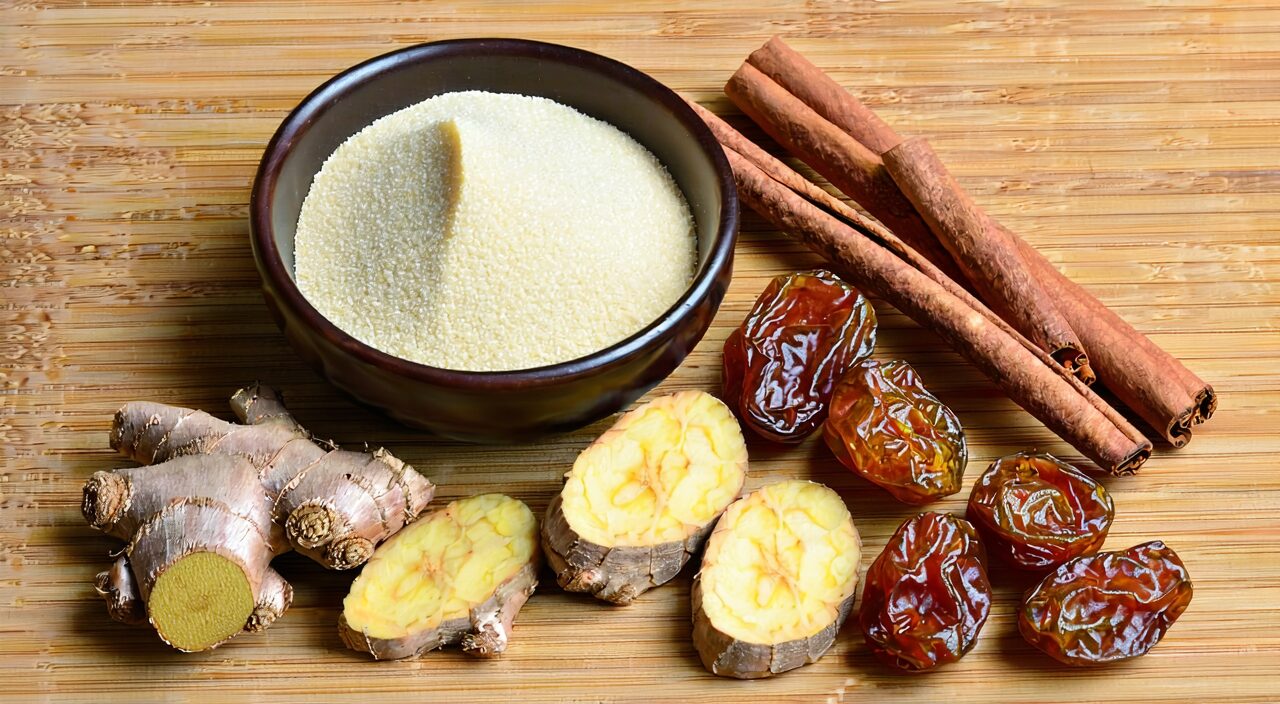
To better understand its rationale, let’s first look at the original composition (the following are traditional common dosages; practical application varies from person to person):
| Herb | Traditional Reference Dosage | Main Role in the Formula |
|---|---|---|
| Maltose (Yi Tang) | 30 g | Sweet-warm to tonify the middle and relieve spasm and pain; considered the sovereign herb |
| Cinnamon twig (Gui Zhi) | 9 g | Warms and unblocks yang qi, complements maltose |
| Chinese peony (Shao Yao) | 18 g | Nourishes blood and harmonizes the nutritive qi, good at relieving cramping abdominal pain |
| Fresh ginger (Sheng Jiang) | 9 g | Warms the middle and disperses cold, assists spleen yang |
| Jujube (Da Zao) | 6 pieces | Supplements the spleen and stomach, benefits qi and blood |
| Honey-fried licorice root (Zhi Gan Cao) | 6 g | Tonifies the middle and boosts qi, harmonizes the actions of other herbs |
From this brief analysis, it can be seen that Xiao Jian Zhong Tang is essentially a modification of Gui Zhi Tang (Cinnamon Twig Decoction), in which the peony dosage is doubled and maltose is added, thereby shifting the original function of harmonizing the nutritive and defensive qi toward an internal direction of warming the middle, tonifying deficiency, and relieving spasm and pain. This also explains its connection to and difference from Gui Zhi Tang.
Populations That Xiao Jian Zhong Tang May Be More Suitable For

In Chinese medicine pattern differentiation, Xiao Jian Zhong Tang generally corresponds to abdominal urgency pain caused by spleen-stomach deficiency-cold, qi and blood insufficiency, or middle burner weakness. If the following combination of manifestations appears, it is traditionally considered as a potential direction for exploration:
- Dull, intermittent pain in the stomach and abdomen that comes and goes, feels better with warmth and pressure, and is relieved by massage or heat application.
- Poor appetite, eating only small amounts, feeling bloated after eating, but without obvious heartburn or acid reflux.
- Easily fatigued, with a pale or sallow complexion, and speaking with a weak voice.
- Often cold hands and feet, possibly accompanied by mild palpitations and vexation.
- Pale tongue with a thin white coating; pulse is thready, moderate, or weak.
People with such presentations are often categorized in traditional pattern identification as having deficiency-cold or insufficient qi and blood type abdominal pain, and Xiao Jian Zhong Tang’s approach of warming the middle to tonify deficiency and relieving spasm and pain may be quite fitting. However, everyone’s constitution differs, and whether it is suitable still requires evaluation based on specific circumstances; one should not simply apply it on one’s own.
Common Contraindications and Unsuitable Populations for Xiao Jian Zhong Tang
Although Xiao Jian Zhong Tang is frequently used for deficiency-cold abdominal pain, not all abdominal discomfort can be treated with it. The following situations are usually regarded as unsuitable or requiring caution:
- Stomach heat or internal exuberant damp-heat: symptoms include dry mouth, bad breath, burning sensation in the stomach, constipation, red tongue with yellow greasy coating. Using warming and tonifying formulas may instead aggravate the heat.
- Excessive-type abdominal pain: such as severe distension and pain caused by food stagnation that refuses pressure, or stabbing pain due to qi stagnation and blood stasis; sweet and relaxing tonics are inappropriate.
- Acute severe abdominal pain: acute abdomen (such as appendicitis, pancreatitis, intestinal obstruction, etc.) demands immediate medical care; do not attempt to self-treat.
- Special populations: pregnant women, infants, nursing mothers, and those with chronic diseases on long-term medication should not use it without professional evaluation.
- During external contraction with fever: when exterior pathogens have not been resolved, releasing the exterior takes priority; tonification should not be applied too early.
Additionally, the maltose in the formula is high in sugar, so those with poor blood sugar control need to pay special attention. In summary, Xiao Jian Zhong Tang leans toward tonification, and cases with obvious excess pathogens or heat signs should generally be avoided.
Differences Between Xiao Jian Zhong Tang and Similar Formulas
Xiao Jian Zhong Tang vs. Fu Zi Li Zhong Wan
- Both are commonly used for middle burner deficiency-cold.
- Fu Zi Li Zhong Wan (Aconite Center-Regulating Pill) combines prepared aconite, dried ginger, etc., and has a stronger effect in warming yang and dispelling cold. It is more often used for more prominent spleen-kidney yang deficiency, such as cold abdominal pain, watery diarrhea, and obviously cold extremities.
- Xiao Jian Zhong Tang mainly uses maltose and peony, emphasizing relieving spasm and pain and tonifying deficiency. Cold signs are relatively milder, and the pain often has a “cramping” character.
Xiao Jian Zhong Tang vs. Gui Zhi Tang
- Gui Zhi Tang mainly addresses external contraction with exterior deficiency pattern, functioning to release the muscle layer, resolve the exterior, and harmonize the nutritive and defensive qi. Its symptoms are mainly aversion to wind, fever, sweating, and a floating, moderate pulse.
- Although Xiao Jian Zhong Tang was developed from Gui Zhi Tang, its action has turned inward, making it suitable for deficiency-cold abdominal pain without obvious exterior signs.
Xiao Jian Zhong Tang vs. Huang Qi Jian Zhong Tang
- Huang Qi Jian Zhong Tang is Xiao Jian Zhong Tang plus astragalus, enhancing the power to tonify qi and secure the exterior on top of warming the middle and tonifying deficiency.
- It is commonly used for individuals with more pronounced deficiency-taxation with internal urgency, spontaneous sweating, night sweats, shortness of breath, and fatigue.
- If qi deficiency is not prominent, plain Xiao Jian Zhong Tang may be more appropriate.
Xiao Jian Zhong Tang vs. Xiang Sha Liu Jun Zi Tang
- Xiang Sha Liu Jun Zi Tang (Six Gentlemen Decoction with Aucklandia and Amomum) focuses on fortifying the spleen, harmonizing the stomach, and rectifying qi. It targets spleen deficiency and qi stagnation leading to epigastric distension and fullness, belching, poor appetite, and loose stools, without obvious cold pain or cramping.
- If abdominal discomfort is mainly distension, feeling of moving gas, and there is no distinct deficiency-cold cramping pain, Xiang Sha Liu Jun Zi Tang is a more suitable direction for reference.
The above comparisons are only a popular science guide based on traditional pattern differentiation. The selection of different formulas requires careful identification of specific symptoms, tongue, and pulse; one cannot simply decide based on a few isolated signs.
Summary
Xiao Jian Zhong Tang is a classic formula designed around the concept of “warming the middle, tonifying deficiency, and relieving spasm and pain.” It is traditionally used for dull abdominal pain with a preference for warmth and pressure, fatigue, and poor appetite arising from middle burner deficiency-cold and insufficient qi and blood. Its core composition includes maltose, peony, cinnamon twig, and other herbs, redirecting Gui Zhi Tang’s harmonization of nutritive and defensive qi toward treating internal deficiency-cold.
Every formula has its suitable and unsuitable scope. Xiao Jian Zhong Tang should be avoided or used with extreme caution in cases of stomach heat, damp-heat, excessive-type abdominal pain, acute severe pain, as well as in pregnant women and other special populations. The distinctions from Fu Zi Li Zhong Wan, Huang Qi Jian Zhong Tang, Xiang Sha Liu Jun Zi Tang, and others should also be based on analyzing the specific symptom pattern. This article is provided for informational purposes only and cannot substitute professional diagnosis or treatment advice. When considering its use, always take your individual constitution and actual situation into account and seek guidance from a licensed Chinese medicine practitioner.