
Who Is Yin Qiao San Suitable For? Composition, Effects, and Contraindications

Many people turn to traditional formulas when they experience throat discomfort, fever, thirst, and other symptoms, and Yin Qiao San is one that often comes up. It originates from the Qing Dynasty text Wen Bing Tiao Bian (Systematized Identification of Warm Diseases) and is regarded in Chinese medicine as a representative pungent-cool exterior-releasing formula. However, the specific situations it suits and who needs to be particularly cautious are often overlooked. This article provides a comprehensive overview of its composition, traditional understanding, suitable populations, contraindications, and differences from several similar formulas.
What Is Yin Qiao San For? Its Role in Traditional Understanding

In Chinese herbal formula classification, Yin Qiao San is typically categorized as a pungent-cool exterior-releasing formula. It addresses “wind-heat external invasion,” traditionally referred to as the “early stage of warm disease.” Unlike formulas that target wind-cold, Yin Qiao San does not focus on inducing sweating to disperse cold. Instead, it uses pungent-cool outthrusting, heat-clearing, and toxin-resolving actions to alleviate discomfort caused by external invasion.
Traditionally, when wind-heat pathogens invade through the mouth, nose, or skin and affect the lung-wei (defensive) function, a person is prone to fever, slight aversion to wind, a red, swollen, and painful throat, thirst, and cough. Yin Qiao San is designed to simultaneously disperse wind-heat and clear heat-toxins, both providing an exit for the pathogen and clearing existing “heat.”
Overall, Yin Qiao San is not a formula that “treats all colds.” In traditional usage, it has a relatively clear direction of application—the early stage of wind-heat external invasion marked primarily by fever, throat discomfort, and thirst.
Composition of Yin Qiao San and the Role of Each Ingredient
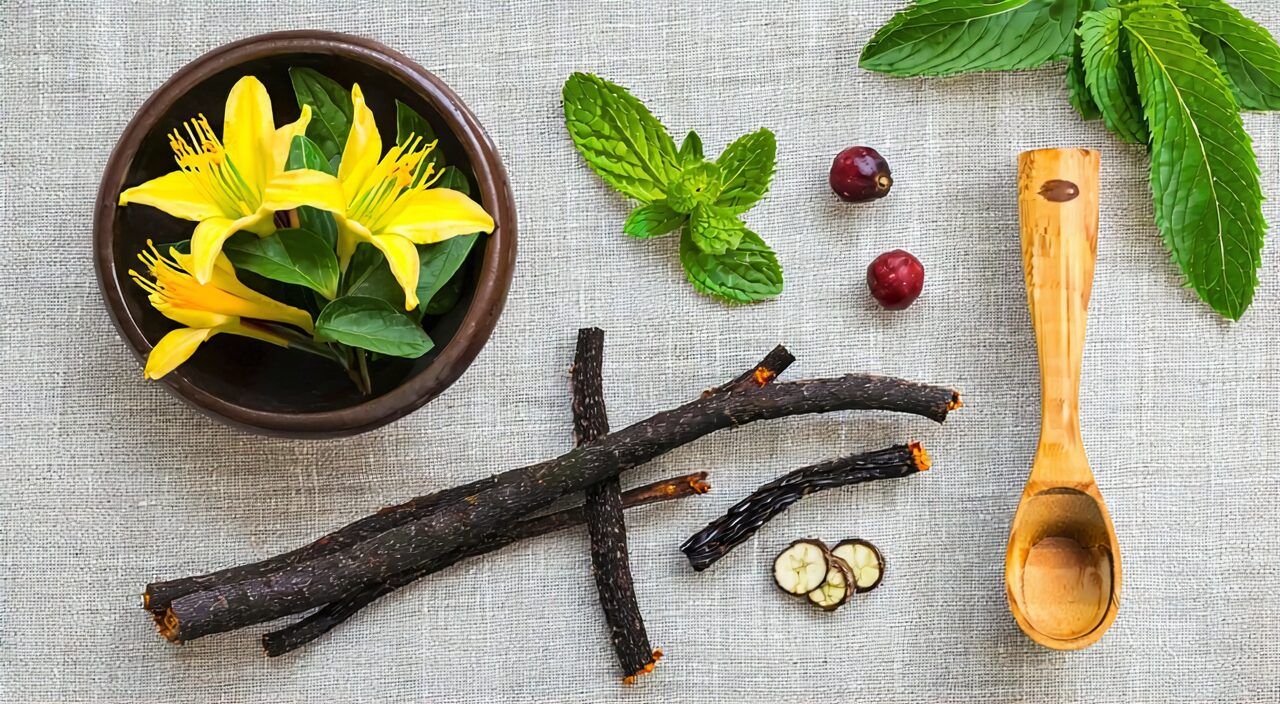
Yin Qiao San is composed of multiple herbs working together. The classic ingredients include Jin Yin Hua (Lonicera flower), Lian Qiao (Forsythia fruit), Jie Geng (Platycodon root), Bo He (Mint), Dan Zhu Ye (Lophatherum leaf), Jing Jie (Schizonepeta), Dan Dou Chi (Prepared soybean), Niu Bang Zi (Arctium fruit), and Gan Cao (Licorice). To better understand the general role of each herb in the formula, they can be organized according to traditional understanding as follows:
| Herb | Common Traditional Understanding |
|---|---|
| Jin Yin Hua (Lonicera flower) | Clears heat, resolves toxin, disperses wind-heat |
| Lian Qiao (Forsythia fruit) | Clears heat, resolves toxin, reduces swelling and dissipates nodules |
| Bo He (Mint) | Disperses wind-heat, clears the head and eyes, benefits the throat |
| Jing Jie (Schizonepeta) | Releases the exterior and disperses wind, vents pathogens outward |
| Dan Dou Chi (Prepared soybean) | Releases the exterior, relieves restlessness, diffuses constrained heat |
| Niu Bang Zi (Arctium fruit) | Disperses wind-heat, ventilates the lungs and benefits the throat, resolves toxin and promotes eruption |
| Jie Geng (Platycodon root) | Ventilates the lungs and expels phlegm, benefits the throat and expels pus |
| Dan Zhu Ye (Lophatherum leaf) | Clears the heart and promotes urination, guides heat downward |
| Gan Cao (Licorice) | Harmonizes all herbs, also moistens the lungs and stops cough |
In the formula, Jin Yin Hua and Lian Qiao serve as the core, emphasizing heat-clearing and toxin-resolving actions. Bo He, Jing Jie, and Dan Dou Chi assist with pungent dispersal and venting pathogens, allowing wind-heat to resolve from the surface. Niu Bang Zi and Jie Geng tend to ventilate the lungs and benefit the throat, relieving throat and respiratory discomfort. Dan Zhu Ye clears and promotes urination to conduct heat out through the urine. Gan Cao protects the center and harmonizes all herbs, making the entire formula more coordinated.
From its composition, it can be seen that although Yin Qiao San is named with “San” (powder/dispersing), it is not a pungent-warm, strongly diaphoretic formula. Instead, it is primarily pungent-cool, combined with multiple strategies such as clearing heat, benefiting the throat, and ventilating the lungs.
Who Might Yin Qiao San Be Suitable For? Common Reference Presentations

In traditional Chinese medicine, Yin Qiao San is commonly used in the early stage of wind-heat external invasion. Viewed from a symptomatic perspective, the following presentations may align relatively well with the traditional usage direction of Yin Qiao San:
- Fairly pronounced fever with elevated body temperature, while the degree of aversion to cold is relatively mild, or only a slight aversion to wind.
- Dryness, pain, or redness and swelling in the throat, with increased discomfort when swallowing.
- Thirst, with a desire to drink water.
- Headache, sometimes accompanied by slight head distension or a sensation of heat in the face.
- Cough with yellowish or relatively sticky phlegm, or a dry cough with little phlegm.
- The tip and edges of the tongue are relatively red, with a thin white or thin yellow tongue coating, and the pulse is floating and rapid.
It must be emphasized that the above are only common reference directions from traditional experience and are not fixed criteria. Whether Yin Qiao San is truly suitable requires comprehensive consideration of specific body constitution, the overall state at the time, and professional judgment. Some people may present only two or three of these signs, but if the overall picture matches wind-heat characteristics, they may still be considered in traditional practice.
It is particularly important to note that fever does not automatically mean Yin Qiao San is suitable. In cases of wind-cold external invasion with high fever, severe aversion to cold, absence of sweating, and clear nasal discharge, or when there is pronounced internal dampness with a thick, greasy tongue coating, directly using Yin Qiao San may not address the pattern correctly.
Who Should Not Take It? Contraindications and Precautions for Yin Qiao San
Based on the nature of the formula and traditional experience, the following groups need to be particularly cautious with Yin Qiao San and should ideally avoid self-selecting it:
- Those with pronounced wind-cold external invasion presentations: Prominent aversion to cold, absence of sweating, clear runny nose, thin white phlegm, absence of thirst, etc., belong to wind-cold characteristics. Yin Qiao San’s pungent-cool and heat-clearing direction may easily aggravate cold signs.
- Spleen-stomach deficient cold constitution: People who easily feel cold in the abdomen, fear consuming cold or raw foods, tend toward loose stools, and experience epigastric discomfort may find the multiple cold and cool herbs in the formula burdensome to the spleen and stomach.
- Those with pronounced qi deficiency or yang deficiency: Individuals prone to recurrent colds, shortness of breath, fatigue, cold hands and feet, and a pale complexion. The outthrusting and dispersing direction of Yin Qiao San may further consume qi, requiring more complex formula adjustments.
- Special populations: Pregnant women, breastfeeding women, children, the elderly, or those with chronic illnesses. Even if they need to explore this direction, it must rely on professional assessment and cannot be applied by oneself.
- Those whose condition has progressed deeper or developed complications: If fever persists without resolution, cough is severe, breathing is rapid, there is chest oppression or pain, or it is accompanied by severe vomiting, abdominal pain, or listlessness, this has already exceeded the scope of early-stage wind-heat external invasion and requires timely medical attention rather than experimenting with a single traditional formula.
Additionally, in traditional usage it is generally emphasized to “stop the formula once the disease is addressed,” meaning that after symptoms ease, it should not be used long-term to avoid excessive dispersion or damage to the center from cold and cool properties. Any practice of prolonged self-administration does not align with the principle of cautious herbal use in Chinese medicine.
Differences Between Yin Qiao San and Formulas Like Sang Ju Yin and Xiao Chai Hu Tang
When wind-heat external invasion is mentioned, Yin Qiao San is often compared with Sang Ju Yin (Mulberry Leaf and Chrysanthemum Beverage), and sometimes also compared with Xiao Chai Hu Tang (Minor Bupleurum Decoction), Gui Zhi Tang (Cinnamon Twig Decoction), and even Huang Lian Jie Du Tang (Coptis Toxin-Resolving Decoction). Clarifying the differences between them helps avoid directional misuse.
Yin Qiao San vs. Sang Ju Yin
Sang Ju Yin also originates from Wen Bing Tiao Bian and is a pungent-cool exterior-releasing formula, but its emphasis differs.
| Comparison Item | Yin Qiao San | Sang Ju Yin |
|---|---|---|
| Primary emphasis | Clearing heat, resolving toxin, benefiting the throat | Ventilating the lungs and stopping cough |
| Common applicable presentations | Fever and pronounced throat swelling and pain | Cough is prominent; fever and throat redness/swelling are milder |
| Core reference herbs | Jin Yin Hua, Lian Qiao | Sang Ye (Mulberry leaf), Ju Hua (Chrysanthemum) |
Yin Qiao San vs. Xiao Chai Hu Tang
Xiao Chai Hu Tang is a representative formula for harmonizing the Shao Yang, traditionally used for “alternating chills and fever, fullness and discomfort in the chest and hypochondrium” and other half-exterior half-interior patterns.
| Comparison Item | Yin Qiao San | Xiao Chai Hu Tang |
|---|---|---|
| Level of action | Tends toward the early stage of wind-heat in the exterior | Suitable for alternating chills and fever where pathogens are not purely in the exterior |
| Scope of attention | Mainly wind-heat external invasion | Involves external invasion as well as spleen-stomach and liver-gallbladder qi dynamic disharmony |
| Common reference presentations | Fever, sore throat, thirst | Bitter taste in mouth, dry throat, silent desire not to eat, chest and hypochondriac fullness and discomfort |
Yin Qiao San vs. Gui Zhi Tang
Gui Zhi Tang is a classic pungent-warm exterior-releasing formula applicable to “Tai Yang wind strike” pattern, with its core action in harmonizing the ying (nutritive) and wei (defensive). Its herbal nature tends to be warm.
| Comparison Item | Yin Qiao San | Gui Zhi Tang |
|---|---|---|
| Formula nature | Pungent-cool, clearing heat | Pungent-warm, releasing the exterior and harmonizing ying and wei |
| Typical reference presentations | Fever, sore throat, thirst, red tongue tip | Fever, aversion to wind, sweating, floating and slow pulse |
| Directional difference | Outthrusts and disperses wind-heat | Warm in nature, not suitable for those with pronounced heat signs |
These two are opposite in temperature—one cool, one warm. If Yin Qiao San were used for the exterior deficiency, sweating, and pronounced aversion to wind without heat signs that Gui Zhi Tang addresses, it might instead damage yang qi. Therefore, distinguishing cold from heat is key to differentiating these two formulas.
Yin Qiao San vs. Huang Lian Jie Du Tang
Huang Lian Jie Du Tang is a formula that purely clears internal heat, mainly targeting exuberant fire toxin in the triple burner, such as high fever, irritability, dry mouth and throat, and even loss of consciousness, vomiting of blood, or skin macules.
| Comparison Item | Yin Qiao San | Huang Lian Jie Du Tang |
|---|---|---|
| Main direction | Pungent-cool outthrust from the exterior, clearing heat and resolving toxin | Purely clears internal heat, bitter-cold direct reduction |
| Exterior-releasing action | Retains pungent dispersing and pathogen-venting action | Has no exterior-releasing action; not suitable for exterior patterns of external invasion |
| Applicable stage | Early-stage wind-heat external invasion where exterior pattern remains | Possible stage of blazing internal heat without exterior pathogen |
It is important to note that Huang Lian Jie Du Tang is extremely bitter and cold in nature. It can only be considered when there is definite blazing internal heat without exterior pathogen; self-administration carries even higher risks.
Summary
Yin Qiao San is a commonly used pungent-cool exterior-releasing formula in traditional Chinese medicine. It is often taken as a reference direction when wind-heat external invasion is in its early stage, with presentations such as fever, sore throat, thirst, and cough with heat signs. It alleviates discomfort by dispersing wind-heat and clearing heat-toxins, but this absolutely does not mean it can be used for all cold-like conditions.
If cold signs are prominent, there is spleen-stomach deficient cold, or the constitution is relatively weak, Yin Qiao San may not be suitable. Differences from formulas such as Sang Ju Yin, Xiao Chai Hu Tang, and Gui Zhi Tang also need to be assessed based on specific presentations, and simple substitution is inadvisable. Regardless of the formula, it is recommended to consider individual constitution, symptom characteristics, and professional opinions comprehensively. Self-administration over a long period or at will is not appropriate. This article serves only as a popular science overview of traditional formula knowledge and cannot replace professional diagnosis or treatment advice.