
Liver Qi Stagnation Type Obesity: Weight Gain Caused by Stress and Poor Mood

Have you noticed that during periods of continuous overtime, when you’re holding back anger, or feeling emotionally low, weight tends to creep up especially easily? Many people simply dismiss this as “overwork fat” or “stress weight,” thinking it’s just about eating more and moving less. But from another often overlooked perspective, a persistent state of emotional tension itself can become a recurring factor on the weight management journey. Traditional Chinese medicine often interprets this kind of problem through the lens of “liver qi stagnation.”
Another link between stress and body weight: qi flow is “blocked”

In the TCM framework, the liver is responsible for free flow and maintaining the smooth movement of qi throughout the body. Emotional fluctuations, especially feelings like repression, anxiety, anger, and depression, most easily disturb the liver’s normal dispersing function. When liver qi fails to flow freely, “qi stagnation” occurs—roughly understood as an internal “traffic jam.”
Why does qi stagnation make people prone to weight gain?
Qi is the driving force that propels body fluids and blood. Once qi flow is blocked, the efficiency of water metabolism and nutrient distribution decreases, making it easy for pathological products like phlegm-dampness and stasis to accumulate. At the same time, qi stagnation itself can affect the spleen and stomach’s transportation and transformation ability, meaning that what you eat cannot be properly transformed into qi and blood, but instead turns into excess fat stored in the body.
More importantly, many people unconsciously soothe their emotions through eating when they feel stressed or anxious—this is known as emotional eating. In a state of constrained liver qi, the body often leans toward heavy-flavored, high-sugar, and high-fat foods for momentary relief, and this cycle further increases the body’s metabolic burden. Therefore, liver qi stagnation obesity is not simply a matter of intake versus expenditure; it is a result of the interaction between emotions and physiology.
What manifestations might suggest liver stagnation type obesity?
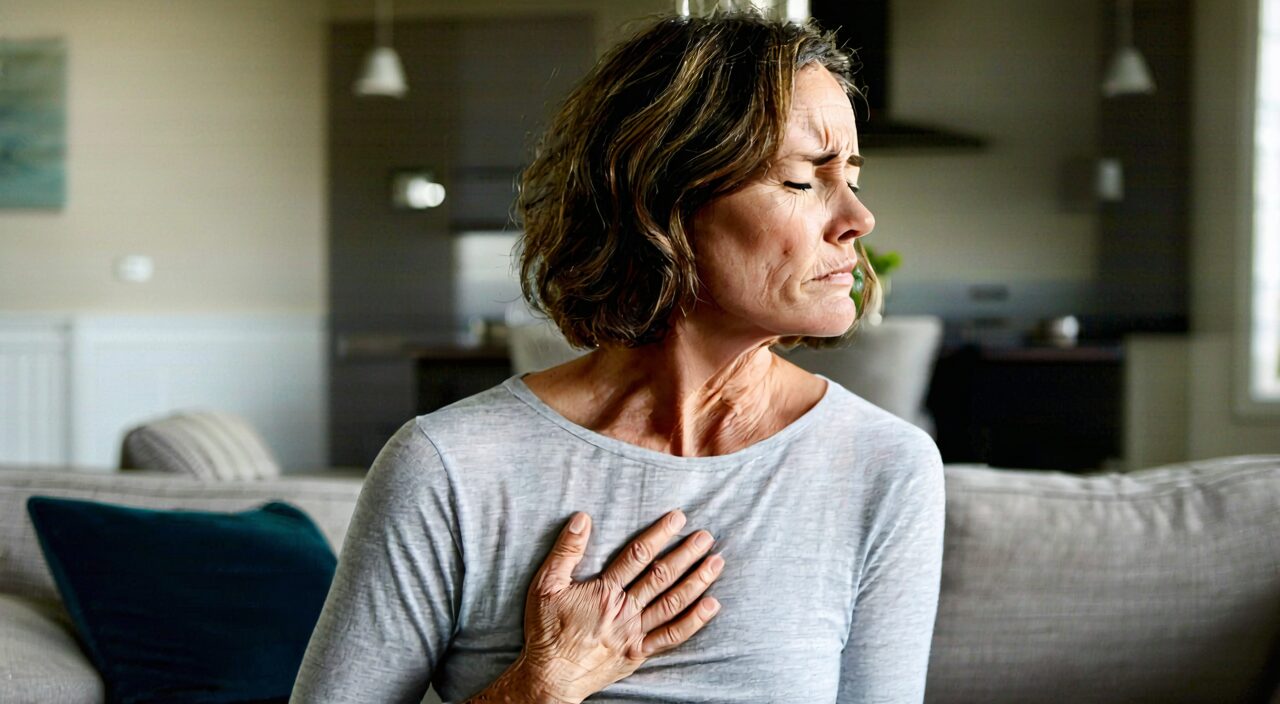
Weight gain is only one aspect. If observed carefully, this body type often comes with a series of physical sensations related to impaired qi flow, which can serve as references for understanding your own state.
Fullness or migratory pain in the chest, hypochondrium, breasts, and lower abdomen
Many people feel a distending pressure around both sides of the chest and near the ribs, as if qi were stuck there. Sometimes there is even a wandering pain sensation. Women often experience breast tenderness before menstruation, which is also closely related to constrained liver qi.
Frequent belching, sighing, or a sensation of a foreign body in the throat
You may find yourself sighing involuntarily, or constantly feel as if something is lodged in the throat—unable to cough it out or swallow it down. In TCM, this is called “plum-pit qi,” another classical sign of qi stagnation. Frequent belching and hiccupping indicate that qi is rebelling upward instead of descending smoothly.
Noticeable mood swings
Easy irritability, quick temper, or low mood and silent brooding. These emotional changes often form a mutually reinforcing cycle with body weight fluctuations: bad mood triggers eating or metabolic changes, weight gain adds to psychological burden, and further deepens the qi stagnation.
Decreased sleep quality
Tossing and turning in bed with a stream of thoughts, difficulty falling asleep, or excessive dreaming. When liver stagnation transforms into fire, it may be accompanied by restlessness and early waking. Insufficient sleep further affects endocrine function and appetite, making weight management even harder.
Irregular menstruation
For women, liver qi stagnation often presents as irregular menstrual cycles, aggravated premenstrual breast tenderness, impeded menstrual flow, and blood clots. This also explains why many people experience water retention and temporary weight gain before their period, with heightened emotional and physical tension.
If several of these signs match your current condition and weight changes have persisted for some time, then adjusting your lifestyle from the direction of soothing the liver and regulating qi may be a worthwhile entry point to explore.
Start with “soothing the liver”: don’t treat weight loss as the only goal
It needs to be clear that for liver qi stagnation type weight management, the primary task is not to stare at the number on the scale, but to help the body restore smooth qi flow, allowing emotions and metabolism to gradually return to a relatively stable state. This process may not bring instant results, but it is more aligned with the body’s true needs.
Emotional regulation is the foundation
Since emotional issues play a significant role, consciously loosening those stuck emotions becomes crucial. You don’t need to “fully let go” or “completely relax” right away. Even setting aside ten minutes a day to quietly listen to soothing music, or talking to someone you trust about inner frustrations, can help unblock qi flow. Traditional guiding exercises like Baduanjin and Taijiquan, which emphasize coordination of movement and breath, are particularly helpful for relieving nervous tension and smoothing qi flow. If you are in a state of marked anxiety or depression for a long time, or feel that emotions have seriously affected your daily life, please seek help from a psychologist or mental health professional. This is not a sign of weakness, but of taking responsibility for yourself.
Exercise should be stretching, not forcing
People with liver qi stagnation are suited to aerobic exercises that stretch the body and produce a light sweat, such as brisk walking, jogging, yoga, or Pilates. The volume of exercise should not be too high, and you must not exercise with the compulsive mindset of “I must burn X calories,” as that may actually increase stress. Choose activities that bring you joy; even a daily evening walk, observing the plants and trees around you, can help soothe the liver.
Diet that cares for both the liver and spleen
For regulation, you can choose foods that help move qi, relieve depression, and strengthen the spleen, such as:
- Jasmine or rose flower infused in water
- Moderate amounts of ingredients that promote qi flow, like white radish, celery, citrus fruits, and finger citron
At the same time, avoid overly greasy, sweet, and cold foods to reduce the burden on the spleen and stomach. In traditional dietary therapy, cooking porridge with a small amount of aged tangerine peel or finger citron is both gentle and assists in regulating qi, and can be considered as a home care option.
Xiaoyao Wan and Jiawei Xiaoyao Wan: A reference direction from classical formulas
Among classical formulas for soothing the liver and regulating qi, Xiaoyao Wan and Jiawei Xiaoyao Wan are two frequently mentioned. They are both derived from the traditional “Xiaoyao Powder” approach, primarily aimed at harmonizing the liver and spleen and resolving stagnation. However, this does not mean they are weight loss products, nor are they suitable for everyone to choose on their own.
Xiaoyao Wan is commonly used for liver qi stagnation with blood deficiency and spleen weakness, manifesting as chest and hypochondrium distension, dizziness, decreased appetite, and irregular menstruation. Jiawei Xiaoyao Wan, on the other hand, adds heat-clearing herbs on top of Xiaoyao Wan’s foundation, and may be another reference direction for those with prolonged liver stagnation showing some heat signs (such as more pronounced restlessness, dry mouth, and red tongue).
It should be noted that these types of patent Chinese medicines are not used for direct weight control, but rather as part of the regulation approach from the perspective of adjusting liver-spleen function and overall body condition, under professional pattern differentiation. Whether it is suitable, which one to choose, and how long to take it should all be judged based on product instructions, individual circumstances, and ideally after consulting a qualified professional. Especially for pregnant or breastfeeding women, or those with other underlying conditions, never take them without guidance.
Breaking the “stress – eating – weight gain – anxiety” cycle

The difficulty of liver qi stagnation obesity lies in the fact that it often falls into a closed loop:
- Stress brings qi stagnation and emotional eating
- Weight gain triggers new body image anxiety
- Anxiety further worsens qi stagnation
To break out of this cycle, it requires patient effort at multiple points simultaneously.
You can try to establish a simple habit of recording: not obsessively counting calories, but noting your emotional state, urges to eat, and physical sensations in the moment. After persisting for one or two weeks, many people discover in what situations they are most likely to lose control—perhaps at the afternoon stress peak around 3 p.m., or late at night when feeling lonely. With this awareness, you can prepare alternative strategies in advance, such as not heading to the fridge when stressed, but taking a ten-minute brisk walk downstairs, or doing a few stretching movements, giving your emotions a buffer outlet.
Summary
Liver qi stagnation obesity reminds us that weight management is never simply a matter of calorie arithmetic; the interaction between emotions and the body is often more subtle. When you sense that high stress and poor mood are quietly altering your body shape, paying attention to the smooth flow of liver qi may have more long-term significance than mere dieting or excessive exercise.
In daily life, emotional release, stretching exercise, and dietary adjustments can help soothe the liver and regulate qi. Classical formulas such as Xiaoyao Wan and Jiawei Xiaoyao Wan are mentioned only as further directions to understand, and must be viewed prudently in combination with personal circumstances under professional guidance. If weight issues are accompanied by severe chest or hypochondrium pain, persistent palpitations, abnormal breathing, or significant emotional disturbances, it is recommended to consult a doctor promptly for systematic evaluation to avoid delay.