
Middle-Age Spread and Expanding Waistline? TCM Explains Age-Related Metabolic Changes

Have you also felt this way? Back in your youth, you could eat almost anything without gaining much weight; but after forty, even with no big changes in your diet, your belly seems to expand layer by layer. Your waistband feels increasingly tight, your weight climbs year after year, and your overall appearance becomes noticeably “fuller.”
This phenomenon is very common among middle-aged people and is often jokingly referred to as “middle-age spread.” A clearly thickening waistline and increased visceral fat are not just changes in appearance; they are often accompanied by decreased energy, easy fatigue, and post-meal drowsiness.
Many people attribute this to “slowing metabolism” and try dieting or increasing exercise, only to find that the results are less than satisfactory, or they even feel more tired. From a Chinese medicine perspective, middle-age weight gain is not merely a matter of calorie balance; it is closely related to natural changes in the body’s internal functions. Understanding these changes can help us view the body’s stage-of-life transitions more calmly and find relatively gentle approaches to regulation.
Why Middle-Age Weight Gain Is Common — A Chinese Medicine Perspective

Chinese medicine does not view weight gain in isolation; rather, it considers it within the larger context of the body’s overall functions. Traditional Chinese medicine holds that, in middle age, especially after forty, certain natural physiological transitions occur, and those most closely related to body weight can be summarized in three aspects: gradual decline of kidney qi, insufficient spleen yang, and the internal generation of phlegm-dampness.
Gradual Decline of Kidney Qi — The Natural Weakening of the Body’s Vital Force
The Yellow Emperor’s Inner Classic (Huangdi Neijing) records: “For women… at five times seven, the yangming meridian declines, the face begins to wither, and the hair starts to fall; for men… at five times eight, kidney qi declines, the hair falls and the teeth wither.” This shows that ancient people had already observed that as one ages, the body’s “kidney qi” gradually diminishes. The term “kidney” here is not entirely equivalent to the kidney in modern medicine; it refers more to a vital primordial force related to growth, development, reproduction, and overall energy metabolism.
When kidney qi is abundant, the body’s qi transformation function is vigorous, fluid metabolism is smooth, and fat does not easily accumulate abnormally. As kidney qi declines, the body’s warming and propelling capacity weakens, the metabolic fire is no longer as strong as in youth, and it becomes easy for water-dampness to stagnate and for fat utilization to decrease. Some people may experience soreness and weakness of the lower back and knees, aversion to cold, and increased nighttime urination—these may be related to insufficient kidney yang and are often accompanied by gradual weight gain and a soft, flabby abdomen.
Insufficient Spleen Yang — The Natural Decline of Transformation and Transportation
In Chinese medicine, the spleen and stomach are called the “root of postnatal life,” responsible for transforming food into essential nutrients and transporting them throughout the body. The spleen’s functions of transformation and transportation depend on the warmth and propulsion of “spleen yang.” After middle age, as the overall yang qi weakens, spleen yang also tends to become insufficient. Moreover, prolonged sitting, irregular eating habits, or excessive consumption of raw, cold, and greasy foods can further impair the spleen’s transforming ability.
When the spleen’s transformation capacity declines, food and fluids cannot be fully converted into usable energy and instead tend to become “phlegm-dampness” retained in the body. Common characteristics of such individuals include:
- Overweight but with soft, untoned muscles
- Prone to puffiness, especially heavy legs in the afternoon
- Sticky, unformed stools
The waist and abdomen, as important areas traversed by the spleen meridian, are often the first to reflect this impairment of transformation and transportation, leading to a gradually expanding waistline.
Internal Phlegm-Dampness — Accumulation of Metabolic Waste
“Phlegm-dampness” is a product in Chinese medicine pathology. It can refer to visible phlegm, but more often it denotes invisible phlegm, a pathological state that is sticky, heavy, and turbid. When kidney qi transformation is insufficient and spleen transportation is weakened, water-dampness cannot be metabolized properly and gradually congeals into phlegm-dampness. Once formed, phlegm-dampness further obstructs the circulation of qi and blood, slowing metabolism even more and trapping the body in a cycle of “damp-type obesity.”
Phlegm-dampness type middle-age weight gain often presents with:
- Large, soft, flabby abdomen
- Body feels heavy and sluggish
- Thick, greasy tongue coating
- Persistent sensation of phlegm in the throat
This type of constitutional change is usually gradual, but once established, it is difficult to improve through simple dieting, because the core issue is not excessive intake but rather blockages in metabolism and transportation.
The Interplay Between Lifestyle and Midlife Weight Changes
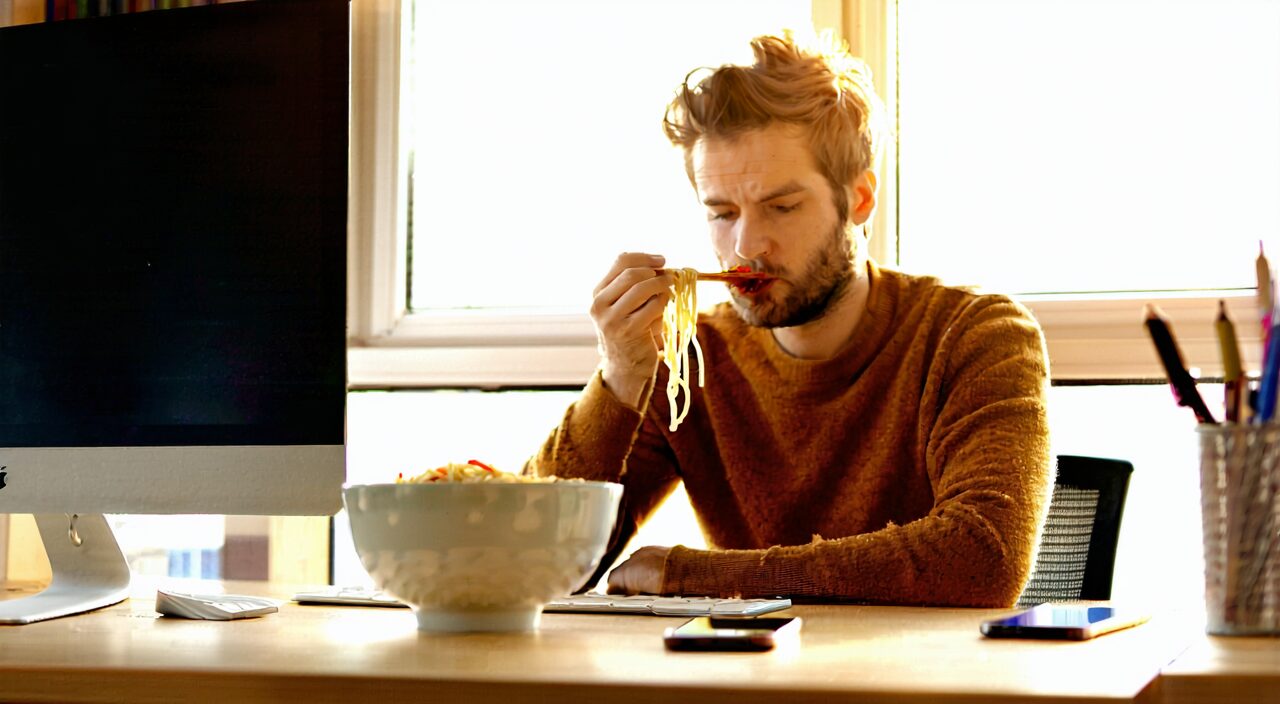
Although Chinese medicine emphasizes the natural decline of internal organ functions, this does not mean that lifestyle is unimportant. On the contrary, certain lifestyle habits in midlife often superimpose on constitutional changes, making waistline expansion more pronounced.
Prolonged Sitting, Lack of Movement, and Suppressed Yang Qi
Prolonged sitting is the norm in modern work. Movement generates yang, while prolonged sitting causes qi stagnation. Chinese medicine says “prolonged sitting injures the flesh,” and the flesh here is closely related to the spleen’s transportation function. A long-term lack of physical activity fails to stimulate the spleen, and the body’s yang qi is easily suppressed, making it more likely for phlegm-dampness to accumulate in the abdomen and buttocks.
Subtle Shifts in Dietary Patterns
Many middle-aged people still maintain the eating habits of their younger years or even consume more calories due to increased social engagements. However, the body’s digestive ability is no longer what it used to be, and excess energy along with greasy, sweet, and rich foods that are hard to transform places a heavier burden on the spleen, leading to dampness and turbidity.
The Influence of Sleep and Emotions
Midlife often brings more family and work pressures. Excessive thinking injures the spleen, and emotional distress causes qi stagnation, which also affects fluid metabolism. Chronic sleep deprivation or poor sleep quality can disrupt the body’s rhythms, cause yin-yang imbalance, and further impair metabolism.
Overall, middle-age weight gain is a result of multiple intertwined factors: the body’s foundational kidney qi and spleen yang are naturally weakening, while lifestyle habits have not been adjusted in time. Internal and external factors combine, and the waistline quietly expands.
Gentle Approaches Through Regulating Spleen, Kidney, and Phlegm-Dampness
After recognizing the natural patterns of midlife weight changes, we can attempt to offer some support to the body by regulating the spleen and kidney and reducing phlegm-dampness. This process should not aim for rapid weight loss but should follow the body’s rhythms and gradually improve the internal environment.
Gently Nourish the Spleen and Stomach’s Transformation Functions
If you frequently experience abdominal bloating, post-meal drowsiness, and unformed stools, traditional Chinese medicine may consider the approach of strengthening the spleen and resolving dampness. Some classical herbal formulas and patent Chinese medicines are often used for this direction of regulation.
- Xiangsha Liujun Wan (Six Gentlemen Pill with Aucklandia and Amomum): Traditionally used for spleen and stomach qi deficiency with dampness obstructing and qi stagnating. It may be a reference for states of poor appetite, epigastric and abdominal distension, loose stools, and puffiness type of overweight.
- Jianpi Wan (Spleen-Strengthening Pill): More focused on strengthening the spleen and harmonizing the stomach, commonly used for abdominal fullness and difficulty losing weight caused by spleen-stomach weakness with food stagnation.
However, whether these are suitable must be determined based on specific tongue coating, pulse patterns, and overall symptoms. Not all abdominal obesity fits the same approach.
Reference Choices for Addressing Phlegm-Dampness
If you feel noticeably heavy in body, have a thick greasy tongue coating, and a frequent sensation of phlegm in the throat, traditional Chinese medicine may approach it from drying dampness and resolving phlegm. Er Chen Wan (Two-Cured Pill) is a classic phlegm-resolving formula, traditionally used for bodily heaviness, cough with profuse phlegm, and gastric fullness caused by phlegm-dampness stagnation. For phlegm-dampness type midlife obesity, it is sometimes used as an auxiliary regulatory direction.
But these formulas need to be used cautiously, as “phlegm” can be differentiated into cold and heat, and body constitutions vary. It is best to consider their use after fully understanding your constitution and the product’s instructions, combined with professional advice.
A Comprehensive Assessment Is Necessary
Because individual constitutions vary greatly—some may have prominent cold-dampness, others may have damp-heat, and still others may have a combination of qi deficiency and blood stasis—the above-mentioned patent Chinese medicines, although common traditional choices for relevant regulatory directions, are each applicable to different pattern types and should not be mixed or used for self-medicated long-term use indiscriminately.
| Patent Chinese Medicine | Traditional Direction of Application | Possible Reference Indications |
|---|---|---|
| Xiangsha Liujun Wan | Spleen-stomach qi deficiency, damp obstruction and qi stagnation | Poor appetite, epigastric and abdominal distension, loose stools, puffiness-type overweight |
| Jianpi Wan | Strengthen spleen, harmonize stomach, digest food and relieve stagnation | Spleen-stomach weakness, food stagnation, abdominal fullness, difficulty losing weight |
| Er Chen Wan | Dry dampness and resolve phlegm | Phlegm-dampness stagnation, body heaviness, thick greasy tongue coating, profuse phlegm, gastric distension |
The above is only a brief outline of traditional application directions. For specific selection, it is recommended to combine the product instructions, your current physical condition, and the advice of an experienced Chinese medicine practitioner to comprehensively judge suitability and method of use.
Daily Self-Observation and Professional Help When Necessary

Although midlife weight gain is common, it cannot be generalized. An increase in weight and waist circumference could simply be a decline in metabolism, or it could be a manifestation of certain health issues. The following situations should not be treated as ordinary “middle-age spread” and warrant timely consultation with a doctor for a systematic check-up:
- Rapid weight gain and abdominal enlargement over a short period
- Accompanied by marked fatigue, menstrual irregularities, purple skin striae, or a dark, lusterless complexion
- Accompanied by palpitations, chest tightness, difficulty breathing, etc.
For those with long-term weight struggles, repeated fluctuations that affect mood and daily life, or even significant anxiety and depressive tendencies, it is advisable to seek professional medical help rather than relying solely on a single regulatory method.
Summary
Middle-age weight gain is a shared experience many people encounter as years go by. The increasing waistline often reflects deep-seated changes in kidney qi and spleen yang, as well as the accumulation of phlegm-dampness resulting from these changes. Understanding these shifts from a Chinese medicine perspective is not meant to create anxiety, but to help us more clearly recognize the body’s natural rhythms, reducing unnecessary self-blame and blind weight loss attempts.
In terms of gentle regulation, paying attention to the spleen and stomach’s transformation function and the state of phlegm-dampness may help improve the body’s metabolic environment. Traditional formulas like Xiangsha Liujun Wan, Er Chen Wan, and Jianpi Wan, though often referenced for these directions, must be carefully chosen based on individual constitution and symptom differences, and combined with professional judgment.
Most importantly, accepting the way our bodies look at different stages of life with equanimity, while maintaining moderate exercise, a balanced diet, and a relaxed mind, is the long-term way to live well with midlife. If weight changes cause significant discomfort or health concerns, be sure to consult a doctor or qualified professional first for targeted guidance and help.